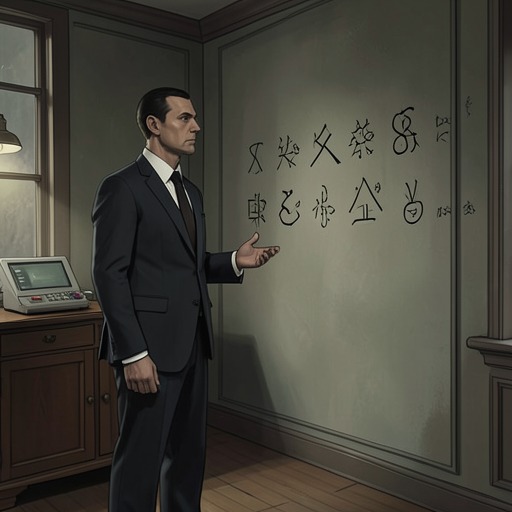
Han Fastolfe
The Caves of SteelHan Fastolfe is the Spacer scientist in charge of Spacetown’s side of the investigation into Dr. Sarton’s murder, and a key interlocutor for Elijah Baley. He receives Baley across the boundary between the City and Spacetown, explains the medical and social rules that govern their contact, and disputes Baley’s reasoning about R. Daneel Olivaw. Fastolfe’s role joins practical cooperation to a larger disagreement: he seeks a quiet resolution to the murder while defending Spacer practices and policies that Baley sees as threatening Earth’s people.
Identity and Introduction
Fastolfe first appears as a Spacer waiting at the approach to Spacetown, dressed in Earth-style clothes but distinguished, in Baley’s perception, by his composed bearing and unmistakably Spacer appearance. He greets Baley after R. Daneel steps forward to welcome him, then accompanies him inside one of the domes. The contrast between familiar clothing and a presence Baley reads as foreign establishes the uneasy proximity between City and Spacer worlds before Fastolfe has explained their differences.
Fastolfe is not merely a host. He identifies himself as the person directing the investigation at the Spacetown end, with Commissioner Julius Enderby responsible at the City end. He offers to help Baley and says that Spacetown wants a quiet solution and to prevent further incidents. His stated objective gives the investigation a cooperative framework, though cooperation does not mean agreement about the forces behind the case.
Investigation and Dispute over Daneel
In their discussion, Fastolfe draws on his expertise in robotics to challenge Baley’s claim that Daneel’s threatening conduct showed that he was human rather than a robot. Fastolfe argues that a robot interprets the First Law literally, and that an advanced model such as Daneel may be capable of behavior that Baley’s experience with simpler Earth robots would not lead him to expect. If Daneel’s threat was necessary to prevent a riot and thereby protect people, Fastolfe reasons, it could have been an application of the First Law, not a violation of it.
Fastolfe then presses the investigation toward direct tests rather than deductions from Daneel’s words and behavior. He asks whether Baley has tried using a pin, examining Daneel’s skin and hair under magnification, observing the irregularity of his breathing, or checking for blood, a pulse, and a heartbeat. These examples unsettle Baley’s confidence in the method he has used to distinguish human from robot. Fastolfe’s questions expose a weakness in Baley’s reasoning without themselves settling the question for him: claims about identity require evidence that can be tested, not just an impression of humanity.
The disagreement has an institutional edge as well as a technical one. Baley points out that a robot such as Daneel would have no standing as a witness in an Earth court. Fastolfe’s challenge therefore concerns not only what Daneel is, but also how Earth’s legal system would classify him and whether that classification would let him participate in establishing the truth. The robot’s apparent personhood and his exclusion from legal credibility are separate problems, but the investigation brings them into direct contact.
Quarantine and the City–Spacer Boundary
Fastolfe explains that City dwellers must shower before entering Spacetown and that there are no hygiene facilities for them inside. Baley has also undergone a blood examination: a small puncture leaves a drop of blood, and he realizes that his health is being analyzed before he is permitted to proceed. For him, the procedure brings anxiety about how thoroughly the Spacers can examine his health. Fastolfe’s account supplies the rationale for these precautions: they are necessities, not empty rituals or gestures of superiority.
He describes the distance Spacers maintain from City residents as protection against disease. In Spacetown they live apart; when they enter open air they use filters, and during their conversation Fastolfe has filters in his nostrils and gloves on his hands. He says he is determined not to come closer to Baley than necessary. This practice can look like contempt or social exclusion to Earthmen, but Fastolfe identifies medical vulnerability as its cause. The rules thus make the border tangible through bodily screening, cleansing, protective equipment, and limits on contact.
The explanation also complicates the apparent imbalance between the two societies. Spacers’ distance is not, in Fastolfe’s account, proof that they consider Earthmen inferior; it reflects their exposure to disease. At the same time, the precautions preserve a sharp separation in daily life. His welcome to Baley occurs within that separation, not outside it: cooperation is possible, but only through a carefully managed encounter.
Policy, Conflict, and Significance
Fastolfe is frank about the economic purpose of Spacetown’s work on Earth. When Baley asks how Spacetown is helping, Fastolfe answers that introducing robots is meant to upset the balance of the City economy. Baley immediately identifies the consequence he fears: a growing population of displaced, declassified men. The exchange places their investigation within a wider conflict over technological change and livelihood. Fastolfe does not present robot introduction as harmless to the existing order; he acknowledges its disruptive aim, while Baley names the human cost in terms of those who lose work and status.
Fastolfe’s position therefore resists a simple division between ally and adversary. He cooperates with Baley, offers assistance, and says he wants to prevent further violence, yet he also defends a policy that Baley sees as deliberately destabilizing Earth’s urban economy. His explanations make Spacer conduct more intelligible without dissolving the conflict: quarantine has a medical rationale, while robotization still threatens City residents with displacement and declassification.
As an investigative partner, Fastolfe repeatedly asks Baley to separate suspicion from demonstrable evidence. As a representative of Spacetown, he makes visible how scientific expertise and public policy intersect with social classification: a person’s health determines whether and how he may enter, while a robot’s nature affects whether his testimony counts. Fastolfe’s conversations thus broaden the murder inquiry into a dispute about who can cross boundaries, who can be believed, and who bears the consequences of technological change.