Medievalism
The Caves of SteelMedievalism is a current of thought that answers the pressures of modern Earth by idealizing its pre-City past and resisting the robots associated with the present. Its defining slogan, returning to the soil, carries both a critique of the City and a political challenge to the Outer Worlds. Yet the idea is not simply a practical program to abolish machines: the novel presents it as a mixture of historical longing, personal alienation, organized opposition, and an impulse toward a different future.
Meaning and Historical Outlook
Medievalism begins in a sense that life was once simpler. For Elijah Baley, understanding the movement means studying history, especially the history of folkways; Julius Enderby, by contrast, reduces its outward signs to the adoption of archaisms, such as spectacles and windows. The difference matters: Medievalism is not only a costume of old-fashioned objects but an interpretation of how people lived and what has been lost. Baley’s New York City is only three centuries old, even though a population had occupied the same geographical area for three thousand years. The movement’s appeal therefore looks backward across a real historical contrast, while its imagined past can become a refuge from present troubles rather than an accurate account of earlier life.
That backward gaze takes shape amid material pressures. Earth’s population continues to rise, and the Cities, however effective, cannot guarantee that calories per person will remain above subsistence. Robots had long been confined on Earth to mines and farmlands; only in the preceding quarter-century had they begun to enter the Cities, under pressure from the Spacers. The people of the Outer Worlds, themselves descended from emigrants from Earth, live on underpopulated, robot-dependent planets, preserve their comfort by restricting births, and keep immigrants from crowded Earth out. Against this uneven relationship, Medievalism can treat robots not merely as machines but as evidence of Earth’s dependence and of outside influence.
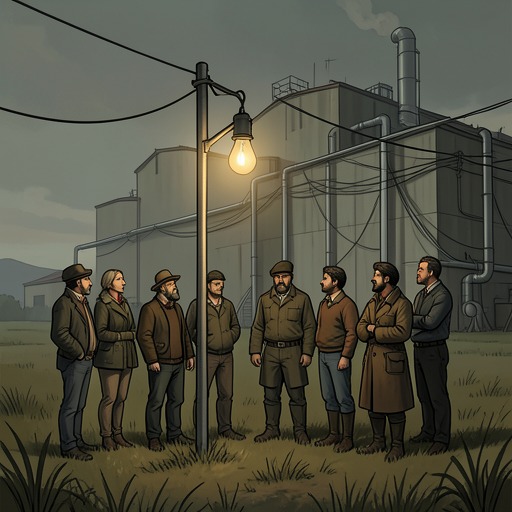
The movement’s familiar appeal is to dismantle the Cities, return to the soil, and reckon with the Spacers, whom its adherents accuse of keeping Earth weak and decadent by pressing robots upon it. In Jessie Baley’s recollection, Elizabeth Thornbowe repeatedly described the Cities as the source of Earth’s troubles and invoked the shame of urban life. She used the language of “soulless monster-machines” for robots and imagined a future in which people would leave the Cities for the soil. Her rhetoric gives the ideology its forceful contrast—land against City, old ways against new, Earth against the Outer Worlds—but does not establish that the idealized past could feed Earth’s population. When Francis Clousarr reduces the doctrine to “Back to the soil,” Baley immediately tests the slogan against the practical question of how soil could feed eight billion people.
Personal Appeal and Local Meetings
Medievalism attracts people who feel out of place in the City’s arrangements. Baley describes its adherents as people who may mistake their own shortcomings for failings of society, and Jessie recalls that Thornbowe did not fit easily into her surroundings. Thornbowe’s hostility toward the City had a personal edge: after Jessie married a policeman, Thornbowe mocked the idea that Jessie would become a genuine City woman. Jessie remembers some of Thornbowe’s pronouncements as attempts to shock or to appear mysterious and glamorous. Her account preserves both the movement’s political language and its social texture: its ideas circulate through workplaces, conversations, jokes, and resentment, not only through formal doctrine.
Jessie’s own entry into the movement grows out of memory and uncertainty rather than a fixed commitment to every claim. After thinking about Thornbowe, she began to see an analogy between Earth’s earlier ways and the new ways the Spacers encouraged. She wondered whether Medievalists might be right that older customs were better, returned to Thornbowe, and eventually joined after Thornbowe consulted someone and came back with approval. Jessie then attended meetings. The sequence shows how a political outlook can recruit through an intimate recollection: a former co-worker’s ideas acquire new force when Jessie reconsiders them in the changed circumstances of Spacer involvement.
The branch Jessie describes met in the motorway, a place she had been reluctant to revisit but which had served as a convenient gathering point. Its local meetings included roughly sixty or seventy people, folding chairs, refreshments, and speeches about the goodness of life in the old days and the eventual removal of robots. The ordinary scale of these gatherings contrasts with the grand historical transformation their rhetoric promises. The movement can thus appear at once socially modest and politically momentous: a local meeting may supply a base of sympathy for a much larger confrontation.
From Sentiment to Political Organization
The novel distinguishes between a broad ground level and a smaller, purposeful elite. After hearing Jessie’s account, Baley theorizes that the mass organization lacks a specific program of its own and could provide support for a future coup, while a more restricted group carries out a planned course of action. He consequently separates the local, almost comic meetings from the elite he believes the investigation must find. His model is an investigative judgment, not proof that every Medievalist knows of or participates in a plot; its importance is that the same ideology can shelter different degrees of organization and intent.
Jessie has encountered talk of applying pressure to the government through large strikes and work stoppages, with the aim of banning all robots and making the Spacers leave Earth. She had understood this as talk until Baley’s investigation became a subject for action. At a meeting, people said they would make an example of Baley and R. Daneel Olivaw and stop the robot invasion; Jessie realized they were speaking about her husband and his partner. Her distress arises from the distance between the apparently speculative promises she had heard and the threat she now recognizes. Her disclosure gives the movement a concrete political consequence: opposition to robots can turn into a campaign directed at particular people.
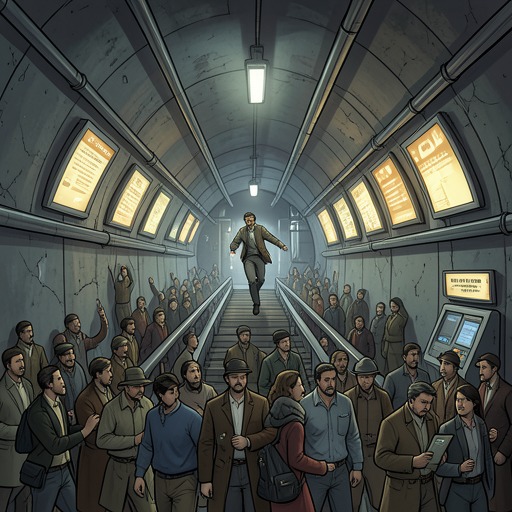
Baley later recognizes that he had mistaken the danger of the local adherents. He had assumed that Medievalists were harmless, soft, dreamy people retreating into an imaginary past, and reasoned that those capable of murder were as unlikely to come from them as from Enderby. The shoe-counter incident had seemed to him to show that the crowd could have caused a riot but had backed away. His reassessment is not that every member is violent; it is that his sentimental picture of the movement had blinded him to a more deliberate organization operating within it.
The movement also becomes a clue in the investigation into Dr. Sarton’s death. Enderby’s old-fashioned spectacles and windows fit the personal signs of Medievalism, but Baley does not rely on those signs alone. He argues that the shoe-counter incident was designed to display the City’s anti-robot feeling and redirect suspicion toward the population at large. The Medievalists’ ability to identify R. Daneel Olivaw as a robot before the incident suggested that someone had given them prior knowledge; among the people Baley knew to possess it was Enderby. In Baley’s reconstruction, Enderby belonged to the organization and exploited the investigation, expecting that Jessie’s membership might let him divert Baley or silence him if he approached the truth. Medievalism therefore becomes not only a belief system but also the political cover and investigative context through which Baley pieces together the case.
Pioneering, Emigration, and the Movement’s Possible Future
R. Daneel Olivaw offers a different interpretation of Medievalism’s central desire. He reads it as a craving for pioneering: a romantic impulse directed toward Earth because Earth is near and possesses the precedent of a great past. On this account, the movement’s longing for the soil is genuine, but it is not necessarily confined to restoring an earlier Earth. The same appetite for a fresh beginning might turn outward toward worlds beyond Earth. Daneel points to Francis Clousarr’s response to a lecture as evidence that the attraction of another frontier could reach someone already drawn to Medievalism.
This reading also changes the meaning of the Spacers’ role. Daneel argues that Spacetown’s presence has itself been the unsettling factor: it crystallized romantic impulses on Earth into Medievalism and helped give them organizational form. The irony is that a movement whose adherents blame the Spacers for imposing robots may have been intensified by the very presence it resists. Daneel proposes that the Spacers withdraw rather than continue irritating the Medievalists until their commitment to Earth becomes irreversible. At the same time, a few less conspicuous individuals or robots, working with sympathetic Earthmen, could establish training schools for emigrants. His proposal does not treat Medievalist sentiment as something to erase; it seeks to redirect its pioneering energy toward colonization.
The resulting possibility is neither a return to an untouched past nor a simple acceptance of Spacer policy. If Medievalists turn toward other worlds, they will still need robots, whether obtained from the Spacers or built by the emigrants themselves. Daneel envisages their developing a C/Fe culture suited to their own needs. The ideology that begins as resistance to robotization on Earth could thus become part of a human-and-robot future elsewhere, transforming its demand to return to the soil into a project of settlement beyond Earth.
Baley’s final appeal to Enderby translates that possibility into political terms. He suggests that Enderby, if he cooperates with the Spacers, might use his standing in New York’s Medievalist organization—or perhaps the wider movement—to steer it toward space colonization: people could return to the soil, but on other planets. Baley says this is also what he himself now wants, following a conversation with Dr. Han Fastolfe. The conclusion leaves Medievalism’s future open, but changes the horizon of its defining slogan. The land it seeks need not be Earth alone, and opposition to the robots need not end in their rejection: what first looks like nostalgia may contain a capacity for pioneering that the novel’s proposed emigration project attempts to release.