Medievalist movement
The Caves of SteelThe Medievalist movement gives political form to Earth’s resentment of robots and the pressure of a society facing rising population, labor displacement, and threatened social status. Though its public appeal rests on nostalgia and hostility toward technological change, the evidence distinguishes broad, sometimes volatile support from a smaller, more organized tier whose aims remain under investigation.
Social and Economic Roots
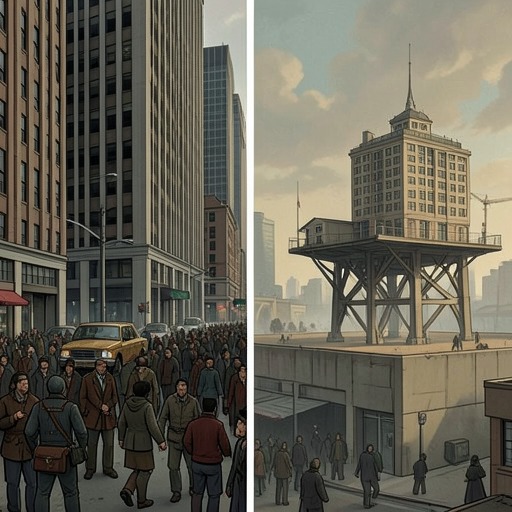
Robots were invented on Earth, but their productive use reached its fullest development in the Outer Worlds. On Earth they had long been restricted largely to mines and farms; only in the last quarter century had they begun entering the Cities, under pressure from the Spacers. The change brought conflict into a society that depended on its Cities even as its population continued to rise and the calories available per person threatened eventually to fall below subsistence.
That strain was sharpened by the contrast with the Spacers: descendants of Earth emigrants living on sparsely populated, robot-dependent worlds, they limited births and kept immigrants from crowded Earth out. Earth’s government described social dislocation as a period of adjustment, but the Medievalist movement grew alongside declassification. As workers feared losing their place in society, the distance between frustration and destructive protest narrowed.
The labor threat was not abstract. In a shoe shop, Earthmade clerk robots could identify styles, prices, and sizes, track stock, calculate future orders, and measure customers’ feet. Their practical competence made them useful, but it also made them plausible replacements for human workers. Baley recognizes that danger in personal terms, thinking of the teenager Vince Barrett, whom R. Sammy had replaced, and imagining that a robot such as R. Daneel might replace him as well. His reflection connects the movement’s hostility to employment and status, not simply to an aversion to machines.
Public Resentment and Protest
The movement’s antagonism drew on experiences of exclusion as well as economic change. When the Spacers established a force barrier around Spacetown and required visitors to identify themselves, submit to searches, and undergo medical examination and disinfection, Baley remembered the Barrier Riots. He had joined the crowd that gathered outside for two days, defying rating privileges on the expressways and shouting slogans while destroying City property. The episode shows how resentment toward the Spacers could become collective action, even when the immediate grievance was access and treatment rather than robots alone.
At a shoe shop, anti-robot feeling surfaced in direct claims that robots took jobs from people and that families consequently had to live in barracks and eat raw yeast mush. Baley understands the speaker more readily than he had expected, even as he stands beside R. Daneel. The contrast is central to the movement’s appeal: a robot can appear individually harmless and yet, as part of a wider labor system, represent a threat to people whose livelihoods and living standards are already precarious.
The movement’s political growth also alarms the authorities because mass hostility can turn quickly into disorder. Baley fears that a crowd’s accumulated anger may become a burst of violence, and later suspects that someone could exploit anti-Spacer feeling by spreading a specific rumor that a robot in the City had threatened people with a blaster. His suspicion is not proof that the Medievalist movement as a whole directs such events; it does, however, show how its existing grievances could be manipulated to intensify conflict.
Local Groups and Organization
Jessie describes a local Medievalist gathering of about sixty or seventy people, held in the motorway. The group used folding chairs and refreshments, listened to repetitive speeches praising life in the old days and calling for the removal of robots and Spacers, and made pledges with secret greetings for members to use outside. She recalls that the speeches were dull and that much of the attraction lay in meeting others and feeling important. Her account depicts a real social network, but not one whose ordinary gatherings necessarily amounted to an operational political program.
Baley therefore separates the movement into two possible levels. He interprets the local meetings as a broad base with no specific program, capable of supplying mass support for a future coup, and posits a smaller elite with a planned course of action. He argues that investigators should look for this elite rather than treat Jessie’s comic, repetitive meetings as the organization’s decisive center. R. Daneel cautions that this analysis depends on accepting Jessie’s account; Baley insists that her story is completely true. The distinction remains his investigative theory, not a demonstrated description of every Medievalist group.
Political Aims and Historical Ironies
The strategy of introducing robots to Earth carries an intended purpose beyond immediate productivity. Dr. Fastolfe explains that Spacetown is trying to unsettle the City economy so that displaced and declassified people may become a nucleus for colonization. In his account, people with little prospect of a future in the City might have reason to leave Earth and help establish colonies; robots could then ease the difficulties of adjusting to unfamiliar worlds. He acknowledges, however, that the plan is not working, because Earthmen’s resentment of robots blocks the proposed transition.
This policy gives the Medievalist movement’s opposition a material basis and a political consequence: the very displacement intended to encourage emigration instead fuels resistance to the technology that the colonization project depends on. The movement thus stands at the fault line between the City’s struggle to preserve employment and social standing and the Spacers’ effort to redirect Earth’s population toward settlement beyond it. Its significance lies not only in its slogans or gatherings but in the unresolved conflict over who bears the costs of technological change and who gets to determine humanity’s future.