Murder of Dr. Sarton
The Caves of SteelMurder of Dr. Sarton is the accidental killing that drives the central investigation and ultimately exposes Commissioner Julius Enderby as the shooter. Enderby intended to shoot R. Daneel Olivaw, mistook the early-rising Dr. Sarton for the robot when his glasses were broken, and killed the scientist instead. The missing blaster and Enderby’s subsequent destruction of R. Sammy made the crime appear to implicate others; the solution turns on reconstructing how the weapon moved and what Enderby could see at the dome.
Background and the Missing Weapon
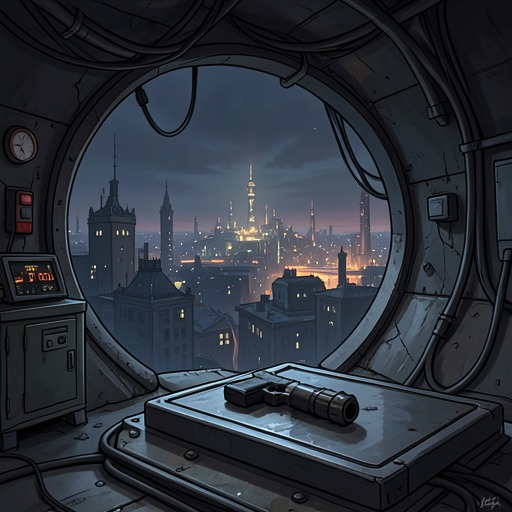
Dr. Sarton was killed at his dome in Spacetown. The crime initially presented investigators with a difficult combination: Enderby had been at the scene, but his innocence was quickly established under the assumptions then in force. He had entered Spacetown through its usual procedure, where blasters were routinely removed, and no blaster was found in his possession. A check of every blaster in Spacetown found none that had been fired for weeks, and an examination of the radiation chambers appeared conclusive. The murder weapon itself was never recovered.
The absence of the weapon encouraged an explanation that required someone to carry it across open country. During the later reconstruction, Elijah Baley recognized that the weapon could have been transferred rather than carried in and out by a human crossing the exposed ground. R. Daneel Olivaw had been at the scene, and, if the possibility of a weapon moving through a robot was excluded, Daneel seemed uniquely positioned to have hidden it. That inference illustrates how the evidence could point in a misleading direction when the investigation treated a robot’s presence as a possible means of concealment but failed to imagine a human using a robot as an intermediary.
How the Killing Was Arranged
Baley’s eventual account connected the crime to R. Sammy, the robot whose knowledge Enderby later considered dangerous. Enderby put a blaster into R. Sammy’s hand and directed him where to go and when. Enderby himself entered Spacetown through the Personal and surrendered his own blaster as required. He then received the other weapon from R. Sammy, used it to kill Dr. Sarton, and returned it to the robot. R. Sammy carried the blaster back across the fields to New York City.
This route explains both why no weapon was found at the dome and why the usual entry procedure did not rule Enderby out. The weapon passed from the robot to Enderby after he had entered Spacetown, then went back out with R. Sammy. The arrangement also accounts for the two robots’ different roles in the case: R. Daneel was present at the murder scene and became a possible suspect in the weapon’s disappearance, while R. Sammy was made the carrier. Enderby later destroyed R. Sammy because the robot knew too much about the killing.
Mistaken Identity at the Dome
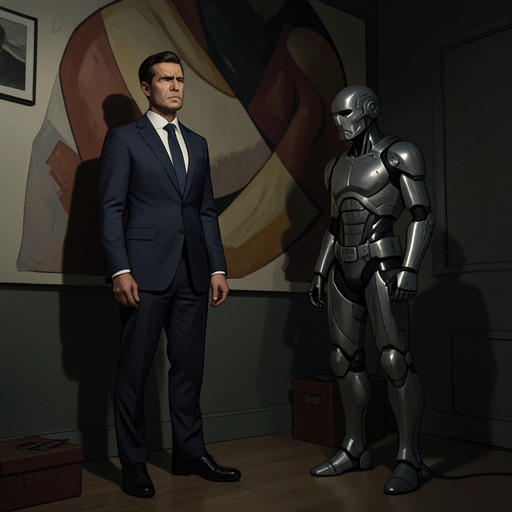
The decisive mistake arose from Enderby’s broken glasses. As Baley reconstructed the scene, Enderby was at Dr. Sarton’s dome, became nervous, removed his glasses to wipe them, and dropped them; they may have been broken when he stepped on them. At that moment the door opened, and a figure resembling R. Daneel faced him. Enderby fired, then gathered the damaged glasses and left. He had killed Dr. Sarton, who had designed Daneel in his own image, but did not realize the figure was the scientist rather than the robot.
Baley supported this account with a visual image of the dome’s main door. The door was open, and a sparkle in the shining grooves of its metal runner revealed the material clue he had been looking for. The image made the reconstruction more than a theory about motive and movement: the broken glasses left tangible evidence at the place where the mistaken identification occurred. The resemblance between creator and creation, normally a matter of design, became the condition that made the fatal error possible when Enderby could not see clearly.
Investigation and Reversal
Before the solution, Enderby’s innocence seemed secure because he lacked a blaster and had entered Spacetown through a procedure that removed weapons. R. Daneel’s presence at the murder scene and the missing blaster instead made him appear capable of concealing it. The later explanation reverses that apparent logic: Enderby’s compliant passage through the entrance was part of how the transfer worked, and the robot at the scene was not the killer but the intended target of the shooting.
The investigation was also interrupted when Spacetown decided, on the basis of information from R. Daneel, to end its inquiry into Dr. Sarton’s murder and begin planning its withdrawal from Spacetown and Earth. Baley was told he would have to clear himself of suspicion in the separate killing of R. Sammy by other means. That decision made the final reconstruction urgent: it established that the murder inquiry was being closed even as Baley’s own position remained vulnerable.
Consequences and Significance
When Baley confronted Enderby with the evidence, Enderby acknowledged that he had not meant to kill Dr. Sarton and described the killing as a mistake. R. Daneel, who had initially rejected Baley’s account on the ground that Enderby’s cerebroanalysis made deliberate murder impossible, then accepted the evidence and congratulated Baley. The distinction between intentional murder and accidental killing is essential to the resolution: Enderby arranged an armed plan against Daneel, but the person actually shot was Sarton, whom Enderby could not distinguish from the robot in the moment of tension.
The case therefore turns on the gap between intention and outcome, but it does not erase Enderby’s responsibility for the chain of actions that produced the death. His use of R. Sammy, his entry into Spacetown, the transfer of the blaster, and the destruction of the robot all belong to the same concealed plan, even though the killing itself was a mistake of identity. For the investigation, the final answer transforms clues that once seemed to clear Enderby or implicate Daneel into parts of a single causal sequence. For the story, Dr. Sarton’s death exposes how human assumptions about robots can distort an inquiry—and how the physical details of a broken pair of glasses can correct it.