R. Daneel Olivaw and Roj Nemennuh Sarton’s creator-and-creation relationship
The Caves of SteelR. Daneel Olivaw and Roj Nemennuh Sarton’s creator-and-creation relationship joins a specific act of design to an unusual investigative partnership: Sarton created a robot whose humanlike appearance would let it move more closely among Earth people, and Daneel was the first such creation. His resemblance to human beings is not disguise for its own sake; it is the means by which the maker’s project could gain access to a society that treated robots and human Spacers differently. Sarton’s murder abruptly turns the unfinished creation into an active participant in the inquiry.
Design and Purpose
The distinction between human Spacers and robot Spacers establishes the conditions behind Sarton’s work. Human Spacers faced objections to entering the City, but robots offered another possibility: they could be designed to adapt to Earthly life. Sarton’s project depended on making a robot closely enough resemble a human that Earthmen might accept it and permit it a closer view of their lives. Daneel’s appearance is therefore tied to the intended work of observation and contact, not merely to an aesthetic choice.
Daneel explains that Sarton had worked for a year on the design and construction of robots of this kind. Daneel was the first, and so far the only, one. The singularity of the experiment makes their relationship more than a general example of Spacer robotics: Daneel is the initial realization of a particular design, and the project remains at an early stage when events force him into public use.
Creation and Appearance
The connection between maker and creation is made visible in a photograph from Spacetown. When Elijah Baley points to Sarton and asks whether the figure is Daneel, Daneel identifies the man as his designer. The reply is unemotional, but its plainness confirms a fact crucial to the investigation: the human-looking robot and the Spacer scientist shown in the photograph are not the same person. Baley’s sardonic question about whether Daneel was made in his maker’s image underscores how readily the resemblance invites comparison, even though the exchange supplies no answer to that biblical allusion.
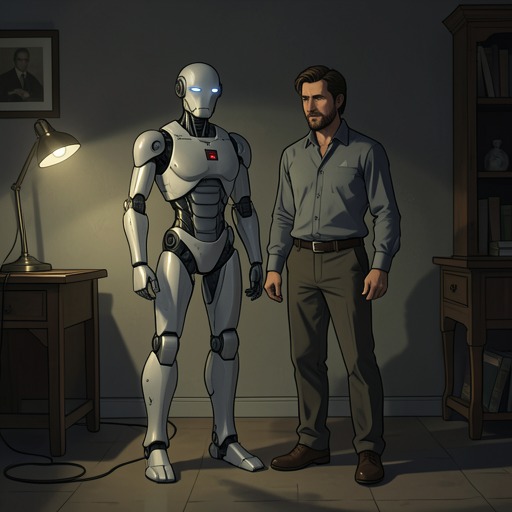
The design is functional as well as visual. Daneel says that a robot’s outward appearance depends on its function, and that his own function requires a very manlike appearance. Other Spacer robots, though humanoid, look different because they serve different purposes. Baley later argues that Daneel appears too convincingly human to be a robot and recalls that his first impression was that Daneel was a Spacer. Daneel confirms the central point: his resemblance to humanity is purposeful, because he was designed to take a temporary place in human society.
Premature Deployment
Sarton’s murder changes the circumstances in which his creation must operate. Daneel says that his education is not complete and that the murder has hurried him into his role prematurely. Thus the design has already been put to work before its creator’s longer process of preparation could be finished. The case brings Daneel into Earth society not as a fully educated observer, but as a first-of-its-kind robot abruptly required to perform the function for which Sarton built him.
This unfinished state gives the creator-and-creation relationship a consequential imbalance: Sarton devised the means for Daneel to approach human life, but after Sarton’s death Daneel must undertake that approach without the education his maker had intended to complete. The evidence establishes the interruption and its timing, without detailing what further instruction Sarton had planned.
Identity and Investigation
The relationship also shapes how others interpret Daneel. Baley’s initial difficulty accepting that Daneel is a robot follows directly from the success of Sarton’s design: Daneel seems to Baley like a Spacer, while Baley’s experience of Earth robots has accustomed him to a much clearer distinction between human and machine. Daneel’s appearance unsettles that distinction, but he does not conceal the purpose of his construction when challenged. He identifies himself as Sarton’s first robot of this type and explains why the resemblance is necessary.
Sarton’s creation consequently becomes part of the murder inquiry’s central problem of recognition. Daneel’s likeness makes him capable of approaching human society more closely, yet it also makes his identity difficult for an Earth investigator to accept. The same feature that promises access produces suspicion: Baley treats Daneel’s convincing humanity as evidence to be examined, while Daneel presents it as the intended result of Sarton’s work. Their relationship matters to the investigation because the design itself lies at the boundary the case repeatedly asks Baley to judge—the difference between a human Spacer and a robot made to resemble one.
Significance
Sarton’s work makes the creator-and-creation bond a practical intervention in relations between Earth people and Spacers. Rather than sending a human Spacer into the City, the project uses a robot adapted to Earthly contact; Daneel is intended to be accepted where a human Spacer might encounter objections. His body is designed as an instrument of access, and his unfinished education shows that successful resemblance alone does not complete the larger work of learning to live within human society.
The relationship is also defined by interruption. Sarton’s murder removes the designer from the project precisely when his first creation is being put into service, leaving Daneel to carry out the role without completed preparation. The result is a partnership whose origins are clear but whose continuation is abruptly altered: Sarton supplies the design and purpose, while Daneel must enact that purpose in the investigation of his maker’s death.