Space colonization
The Caves of SteelSpace colonization is the proposed movement of Earth’s population toward settlement beyond Earth, which the Spacers regard as essential to Earth’s future. In the case’s closing confrontation, Elijah Baley recasts it as a possible common purpose for the Spacers and their opponents: even the Commissioner’s guilt over Dr. Sarton’s death might be turned toward helping resume Galactic colonization. The proposal thus links a planetary future to the immediate pressures of social status, political fear, and personal responsibility.
A long-standing pressure on Earth
The project enters Baley’s thinking against a background of gradual displacement. Julius Enderby tells him that replacement has been taking place for twenty-five years, ever since the Spacers arrived, and warns that mishandling the case could bring closer the point at which their pension-tab booklets are no longer secure. A successful investigation, by contrast, might push that loss farther into the future. Colonization is not framed as an abstract frontier alone: the prospect of Earth’s people being replaced gives it an urgent social and economic context.
Status, insecurity, and the personal stakes
Baley’s own history gives that insecurity a concrete shape. His father, once a nuclear physicist with a rating among the City’s top percentile, was declassified after being blamed for an accident at the power plant. Baley was too young to know the details. His father remained declassified until his death when Baley was eight; Baley and his two older sisters then entered the Section orphanage, Children’s Level. Without the privileges derived from his father’s status, Baley had to make his way through school without that assistance.
The fear of falling in status persists even for those who remain able to live in the City. Demotion could strip away small but consequential advantages: a more comfortable seat, better food, or shorter waits. Baley also knows what a C-6 rating might mean for his family, including rush-hour expressway access, a higher place on the Section-kitchen list, a possible better apartment, and a quota ticket for Jessie to visit the Solarium levels. These details make colonization’s promise inseparable from the pressure to retain status and the fear that a precarious future may narrow still further.
A political bridge in the final confrontation
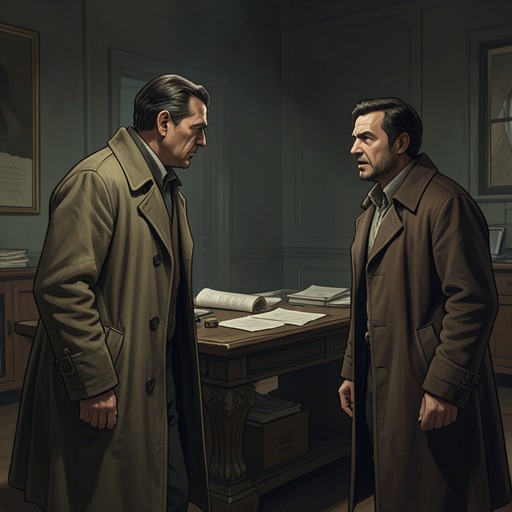
Baley’s closing argument addresses the Commissioner’s commitment to Medievalism. He reasons that Enderby feared the purpose for which R. Daneel Olivaw had been designed: to help Earth’s people turn away from Earth. Baley suggests that Enderby believed destroying Daneel could demonstrate the strength of Medievalism on Earth and discourage the Spacers, whose public opinion already favored ending the Spacetown project. This account makes the Commissioner’s opposition to colonization part of the motive Baley attributes to his actions, rather than treating the political conflict as separate from the murder investigation.
Baley then offers Enderby a way to redirect that commitment. He proposes that Enderby use his influence in the Medievalist organization to steer the movement toward colonization: a return to the soil, but on other planets. Baley says that the Spacers want this outcome so strongly that they might accept Dr. Sarton’s murder as a worthwhile sacrifice if it helped restart Galactic colonization. R. Daneel Olivaw confirms that the Spacers would set aside the past if Enderby cooperated, while warning that they would know of his guilt if he later betrayed them.
Earth’s possible future
Baley has come to support the proposal after speaking with Dr. Han Fastolfe. He tells Enderby that colonization is Earth’s only possible salvation and urges him to consider it without prejudice, or to discuss the matter with Fastolfe. The political bargain leads immediately to a practical request: Enderby is to help stop the R. Sammy matter by having it dismissed as an accident. Baley also makes clear that concealing the truth by removing him would fail because Spacetown already knows it.
Colonization consequently operates at two scales in the scene. It offers a possible direction for Medievalist opposition and a basis for cooperation with the Spacers; at the same time, it is presented as a response to Earth’s replacement fears and to the vulnerability of people whose lives depend on City ratings. The proposed future does not erase the harms and conflicts already exposed by the case. Instead, Baley argues that those conflicts may be turned toward a shared undertaking beyond Earth.