The boundary between human and machine
The Caves of SteelThe human–machine boundary is a central problem of identity and value: a robot can resemble a human, perform human tasks, and provoke human responses, yet remain classified as a machine by its construction and by institutions that deny it human standing. The distinction is tested through appearance, bodily examination, social custom, legal status, and competing accounts of what makes a person human. The novel’s tension lies in how readily people rely on visible and administrative signs even as those signs fail to settle the deeper question.
Appearance, Behavior, and Recognition
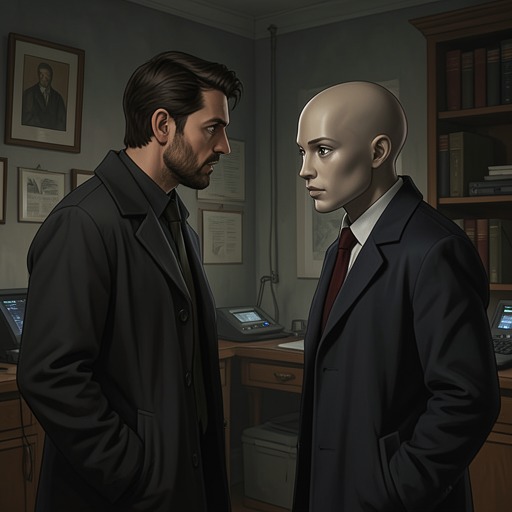
When Elijah Baley first meets R. Daneel Olivaw at the Spacetown Approachway, Daneel wears Earth-style clothing, but his posture, composed expression, high cheekbones, and carefully arranged bronze hair mark him as distinct from an Earthman. The encounter establishes the boundary as something read from outward signs before Baley knows what Daneel is. Daneel’s appearance is persuasive enough to resemble a Spacer, but Baley’s first impression registers difference without explaining it.
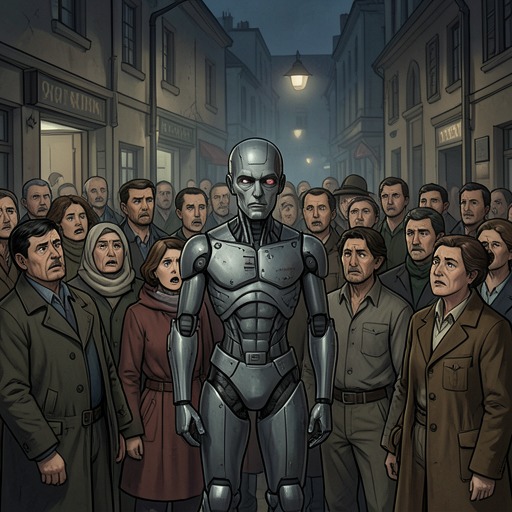
That uncertainty shifts after Baley learns that Daneel is a robot. At a meal, he watches the robot’s precise jaw movements and notices that no Adam’s apple moves when Daneel swallows. Details that had gone unnoticed become evidence once Baley has a category through which to interpret them. Yet the scene also complicates the act of observation: Daneel asks whether it is bad manners to watch someone eat, then points out that eight people are watching the pair closely. Human customs of privacy and scrutiny now apply to a machine, while the crowd’s attention makes the supposedly obvious difference between human and robot a public spectacle.
Bodies and Tests
The boundary is also enforced through procedures that treat bodies as evidence and visitors as possible risks. Before entering Spacetown, Baley is told that City dwellers customarily shower and that Spacetown has no facilities for their use. At a screening station, a surface draws a small blood sample; Baley realizes that his blood is being analyzed and worries that the examination may be more thorough than the yearly checkups he receives from Department doctors. The procedure marks a difference between human populations through bodily testing, while placing Baley under the scrutiny of the very technology associated with the Spacers.
In discussing how to tell a humanoid robot from a human being, Han Fastolfe rejects Baley’s reliance on deductions from mannerisms. He suggests direct tests: a pin, magnified inspection of skin and hair, observation of Daneel’s irregular breathing, measurement of expired air, and attempts to detect blood, a pulse, or a heartbeat. The list turns an abstract classification into a program of examination. A human-looking surface can invite mistaken recognition; biological signs might correct it. But the need to test so many features also shows how little appearance alone can establish.
Design and the Human Form
Anthony Gerrigel’s explanation of humanoid robots gives the resemblance a practical basis. A generalized robot in human form can operate many kinds of equipment, while separate specialized machines with positronic brains would cost far more. Human anatomy is useful as a flexible design because tools and workplaces have already been made to fit human hands, feet, limbs, and measurements. Chairs, tables, knives, forks, and automobile controls all reflect the dimensions and working habits of people. Rather than redesigning technology around radically different machines, roboticists can build robots to work within the existing human-shaped world.
This account makes likeness a matter of engineering and economics rather than proof of shared nature. The more successfully a robot fits the tools and routines of human life, the more easily it can be mistaken for a human; yet functional resemblance does not answer whether it shares human capacities. Gerrigel also confirms that robots made in the Outer Worlds are more humanoid than those made on Earth, linking the degree of resemblance to different technological practices rather than to a simple scale of personhood.
Prejudice, Ability, and Human Worth
Baley’s argument with Francis Clousarr exposes the social and emotional force behind the distinction. Clousarr rejects robots outright; Baley replies that hostility toward them can conceal a sense of inferiority toward Spacers and a need to feel superior somewhere. He compares himself with Daneel, who is taller, stronger, more handsome, and possesses a better memory and more factual knowledge. The comparison makes the robot’s advantages difficult to dismiss, but Baley insists that they do not make Daneel human: a person can damage or command a robot without expecting it to retaliate.
Baley draws the boundary around capacities he believes cannot be manufactured: beauty, ethics, religion, love, and engagement with what science cannot measure. A positronic brain, he argues, must be finite and calculated to its final decimal place, whereas human beings are not exhausted by what can be measured. His account is not a neutral technical demonstration; it is an impassioned defense of human distinction at a moment when Daneel’s abilities make ordinary claims of human superiority feel precarious. The argument therefore reveals both a proposed definition of humanity and the anxiety that makes such a definition necessary.
Law, Status, and the Limits of the Distinction
The boundary has practical consequences beyond appearance or philosophy. Baley objects that Daneel’s kind has no status as a witness in an Earth court. Even if Daneel can remember faces with extraordinary accuracy, Baley says, disclosing that he is a robot would disqualify him as a witness. A machine may possess relevant knowledge and still be excluded by a legal classification that decides in advance whose testimony counts.
The novel thus keeps two questions in view: how a robot differs from a human being, and who has the authority to make that difference decisive. Bodily tests seek measurable signs; engineering explains human likeness as useful design; prejudice converts difference into a hierarchy; and law turns classification into unequal standing. None of these settles Baley’s larger question about what makes a person human. Together, they show the boundary operating less as a single clear line than as a series of judgments, each with its own evidence and consequences.