
The Courier’s Tragedy as Evidence
The Crying of Lot 49The play becomes a contested source whose versions, performance choices, and historical references shape Oedipa’s understanding of Trystero.
increasing Bearing strength in each event
 decreasing
Bearing strength in each eventdecreasingThe Director’s Production
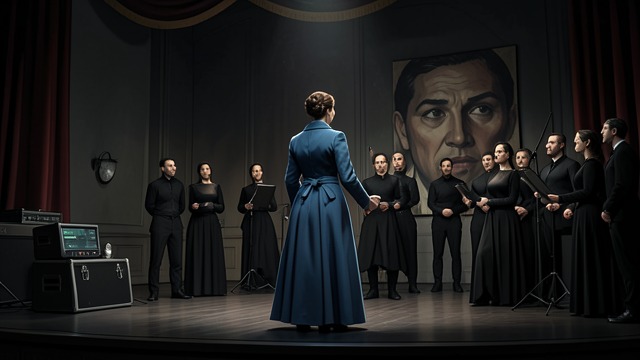
A Staged Postal Mystery
The fourth act
Randolph Driblette’s production gives the audience black-clad assassins and a final reference to Trystero. The scene’s ritual hesitation makes the name feel dangerous before Oedipa knows why.
A theatrical clue
Oedipa connects the performance to the mail and bones discussed around Pierce’s estate. The play becomes a route into the mystery, although its director has altered the historical text.
A Question of Texts
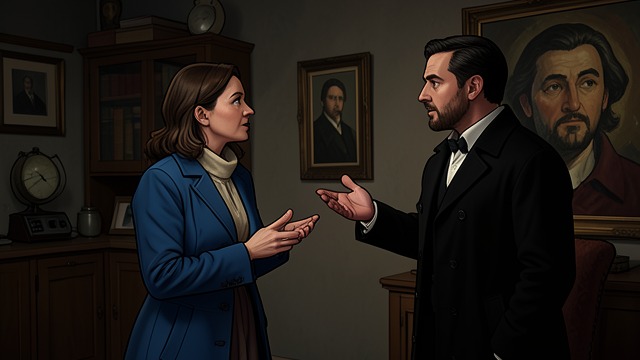
Words and Performance
Driblette’s refusal
Oedipa asks Driblette about the play’s language and learns that he values the performance’s living realization over the printed script. He rejects the idea that the text alone contains its meaning.
A limit on research
His answer frustrates Oedipa’s attempt to treat the play as stable evidence. If performance changes what the play means, then the Trystero clue may depend on choices she cannot verify.
The Variant Line
Conflicting Editions
A different ending
The hardcover edition Oedipa finds lacks the line naming Trystero, substituting a reference to Angelo. A footnote describes competing versions and an uncertain textual history.
The clue destabilized
The paperback and Driblette’s production cannot be straightforwardly reconciled with this edition. The discrepancy makes the supposed historical key look like an editorial, performative, or forged addition.
Bortz’s Historical Context
A Puritan Countertext
An obscene version
Emory Bortz explains that a pornographic version of the play exists in the Vatican Library, while his scholarly edition suppresses the doubtful Trystero line. He connects the textual struggle to moral and religious conflict.
The Other as interpretation
Bortz suggests that Trystero could symbolize a blind force opposed to purposeful order. His account enriches the mystery while remaining a theory rather than a verified explanation.
The Historical Courier’s Tale
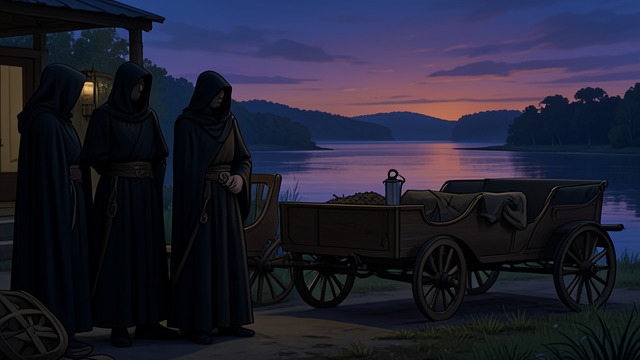
Blobb and the Black Riders
A reported ambush
Oedipa reads an account by Diocletian Blobb describing silent black-cloaked riders attacking a Thurn and Taxis coach near a lake. The leader declares that Trystero prevails and claims a rightful estate.
History or performance
The account links the play’s imagery to an older postal conflict, but its provenance and reliability remain uncertain. The story may be evidence, propaganda, or another narrative shaped to invite belief.
At the first performance Oedipa attends
Immediately after the performance
During Oedipa’s Berkeley visit
During Oedipa’s meeting with Emory Bortz
After Bortz introduces the old source book
