“No hallowed skein of stars…”
The Crying of Lot 49The couplet beginning “No hallowed skein of stars” is the verbal hinge between the revelation of Trystero in The Courier’s Tragedy and Oedipa Maas’s discovery that the revelation changes from edition to edition. Its first appearance gives the name the force of a dramatic unveiling; the variant she finds in the play’s published text instead points to Angelo, while a footnote offers several competing explanations without settling the matter. The line is therefore both a clue and a problem of transmission: it seems to name a hidden history, but its unstable wording prevents that history from being securely read.
The couplet in the play
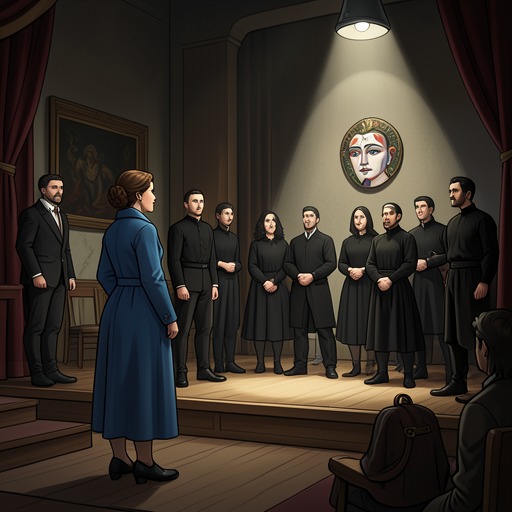
At the end of the fourth act, after a miracle brings the people of Faggio to their knees and they vow vengeance on Squamuglia, Gennaro’s speech names what the preceding action has kept unspoken. The former Thurn and Taxis is now subject to the stiletto, the once-knotted golden horn lies silent, and no protection can ward off the one who has been “set his tryst with Trystero.” The name arrives at the end of the act, after Angelo has avoided saying it and Niccolò has tried to say it. Its delayed appearance gives the couplet the character of a recognition: a hidden power finally receives a name.
The phrase “No hallowed skein of stars can ward, I trow” makes that naming sound like a sentence that cannot be escaped. The image of a protective starry weave is set against a fated appointment with Trystero; the second line turns “tryst” into an encounter the victim has been destined to meet. In the playhouse, the word itself hangs in the air as the act ends and the lights briefly go out. For Oedipa, the name is puzzling at first, not yet powerful. The blackout gives the couplet a theatrical afterimage: the audience hears a name and is left in darkness with it.
A textual variant
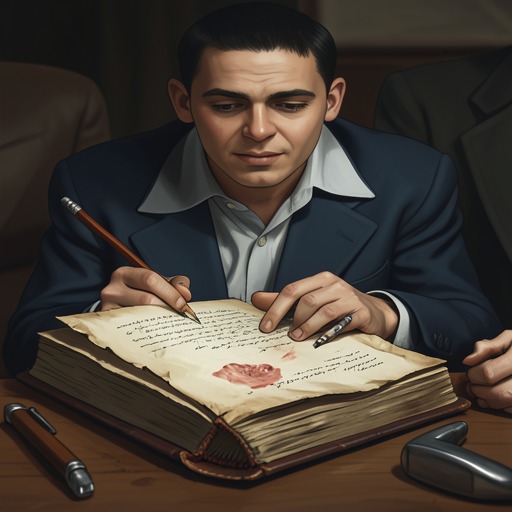
When Oedipa later obtains Plays of Ford, Webster, Tourneur and Wharfinger from the Lectern Press warehouse in Oakland, she searches for the line that brought her to Berkeley. In the sunlight falling through the leaves, she finds the couplet in a materially different form: “No hallowed skein of stars can ward, I trow, / Who once has crossed the lusts of Angelo.” The first line is unchanged, but the second substitutes Angelo for Trystero. Oedipa protests aloud that the line should name the tryst with Trystero, remembering the variant printed in the paperback she bought at Zapf’s Used Books. The difference is not a marginal nuance: it determines whether the couplet announces the secret society or refers instead to Angelo’s desires.
The edition’s footnote multiplies rather than resolves the alternatives. It says that the Quarto of 1687 gives the Angelo line, while the earlier Folio has a lead inserted where the closing line should be. D’Amico proposes that Wharfinger may have written a libellous comparison involving someone at court and that the later restoration was the work of the printer, Inigo Barfstable. The doubtful Whitechapel fragment, dated around 1670, offers “This tryst or odious awry, O Niccolò,” a line the note calls corrupt and difficult to construe. J.-K. Sale’s proposed pun on “This trystero dies irae” is described as persuasive but still leaves the text nearly as corrupt, since the word trystero has no clear meaning there beyond a possible pseudo-Italianate form of triste, meaning wretched or depraved.
Each account supplies a possible history of alteration—theatrical censorship, a printer’s intervention, or textual corruption—but none verifies the Trystero reading in Oedipa’s paperback. Indeed, the note emphasizes that the Whitechapel edition is a fragment filled with doubtful lines and is not to be trusted. The more carefully the variants are catalogued, the less securely the couplet can be assigned a single authentic form.
Oedipa’s unanswered question
Oedipa’s immediate problem is the discrepancy between the paperback and the edition she has searched out. The paperback is supposed to be a straightforward reprint, yet its Trystero line matches neither the Quarto’s Angelo reading nor the account of a missing line in the Folio. The footnote, signed by Emory Bortz, mentions no further edition. Oedipa spends nearly an hour searching the notes and finds nothing that explains where the paperback’s wording came from.
That gap changes the couplet’s function. Onstage, the Trystero ending appears to disclose a name that the play has withheld. In print, the line becomes evidence whose source cannot be established. A variant might preserve a lost or altered version; it might be a corruption; or its presence might point to another edition not acknowledged by Bortz. The text does not choose among those possibilities. What it does establish is the specific contradiction that drives Oedipa’s question: the line she remembers is absent from the scholarly account of the play’s witnesses, yet present in the paperback that first carried the name to her.
Significance
The couplet condenses the novel’s tension between discovery and uncertainty. “Trystero” sounds like the answer to a concealed history, and the play’s dramatic pause makes that answer momentarily palpable. But the textual record refuses to hold still: a name revealed in performance becomes a disputed reading, surrounded by missing lines, conjectural repairs, and editorial explanations. The same words can suggest an encounter with a hidden organization or an episode concerning Angelo, and the evidence available to Oedipa cannot settle which version is authoritative.
The instability is not unlimited. The text gives concrete grounds for Oedipa’s suspicion: the stage ending names Trystero, the Oakland copy prints Angelo, the footnote distinguishes Quarto, Folio, and Whitechapel witnesses, and none accounts for the paperback’s reading. Those details make her question intelligible without proving the answer she seeks. The couplet thus functions less as a solved cipher than as a compact model of the novel’s interpretive predicament: a clue can be exact in its wording and still uncertain in its origin, while the effort to authenticate it opens further possibilities rather than closing the case.