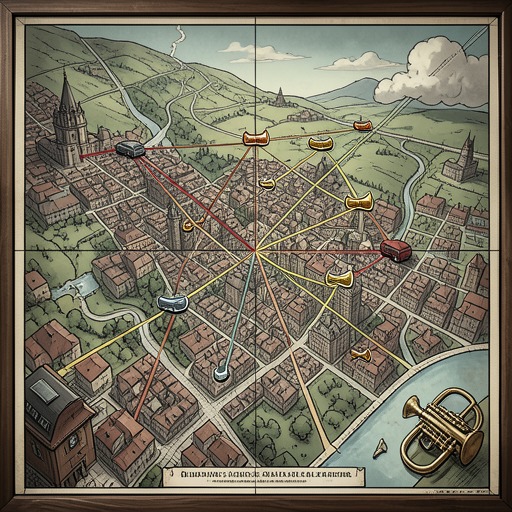
1577 Brussels Commune Event
The Crying of Lot 49The 1577 Brussels Commune Event is the political rupture that introduces Hernando Joaquín de Tristero y Calavera into the account of the clandestine postal organization. A Calvinist committee’s challenge to the established order removes the hereditary Grand Master of the Post and appoints Jan Hinckart in his place; Tristero then claims Hinckart’s position and the inheritance behind it. The episode connects political revolt, disputed legitimacy, and control of communications, while its history reaches the reader through fragments assembled by Oedipa Maas and Emory Bortz.
Political Background
In 1577, the northern provinces of the Low Countries had been fighting for independence from Catholic Spain and the Catholic Holy Roman Emperor for nine years. In late December, William of Orange entered Brussels in triumph after an invitation from the Committee of Eighteen, a group of Calvinist radicals who believed the Estates-General, controlled by privileged classes, no longer represented skilled workers or remained connected to the people.
The committee established what the account calls a Brussels Commune. It controlled the police, dictated decisions of the Estates-General, and removed many prominent officeholders. The event is thus presented not merely as a change of government but as a struggle over who could claim political representation and exercise authority in the city.
The Postal Office and Disputed Succession
Among those displaced was Leonard I, Baron of Taxis, a hereditary Grand Master of the Post for the Low Countries and executor of the Thurn and Taxis monopoly. The committee replaced him with Jan Hinckart, Lord of Ohain and an adherent of William of Orange. Because the contested office controlled a major postal system, the commune’s political reordering also unsettled an established structure of communications and privilege.
Hernando Joaquín de Tristero y Calavera enters the narrative at this point. He claimed to be Hinckart’s cousin, descended from the Spanish and legitimate branch of the family, and the true Lord of Ohain. His claim extended beyond title and land to everything Hinckart possessed, including the recent appointment as Grand Master of the Post. The account leaves his standing unresolved: he may have been a madman, an honest rebel, or, in some accounts, a con artist. His asserted kinship and right of succession are reported as claims, not established facts.
Conflict and Aftermath
From 1578 until Alexander Farnese retook Brussels for the Emperor in March 1585, Tristero waged what the narrative characterizes as guerrilla warfare against Hinckart, if the two men were indeed cousins. As a Spaniard, Tristero attracted little support, and his life was repeatedly in danger. He made four unsuccessful attempts to assassinate Orange’s postmaster. The succession dispute therefore outlasted the commune’s founding moment and took the form of a prolonged, uneven conflict focused on Hinckart and the postal office.
Farnese’s return changed the holders of power again: Hinckart was dispossessed, and Leonard I was reinstated as Grand Master for Thurn and Taxis. The monopoly, however, had been weakened by the instability. The Emperor, Rudolph II, wary of strong Protestant sympathies in the Bohemian branch of the family, temporarily withdrew his patronage, and the postal operation fell deeply into debt. The political reversal restored the old officeholder without restoring the system to its former security.
Historical Account and Significance
The episode is not presented as a directly witnessed scene. Oedipa pieces together the organization’s beginnings from obscure philatelic journals supplied by Genghis Cohen, a footnote in Motley’s Rise of the Dutch Republic, an old pamphlet on anarchism, sermons by Tristero’s brother Augustine, and clues attributed to Dr. Diocletian Blobb. The collage of sources gives the history an explicitly pieced-together quality, while the uncertainty surrounding Tristero’s identity prevents the account from settling into a single authoritative explanation.
The event supplies the origin story’s defining conflict: a clandestine postal movement is associated with a disputed succession created amid revolution and the displacement of a postal monopoly. Later, Mike Fallopian’s history of private mail delivery links the American Civil War to postal reforms beginning around 1845, while Oedipa’s investigation connects the postal motif to a marker describing the 1853 Wells, Fargo massacre. Those later references do not independently verify every part of Tristero’s origin, but they show how the 1577 account becomes one strand in the novel’s broader pattern of political power, independent communication, and contested historical evidence.