Brussels
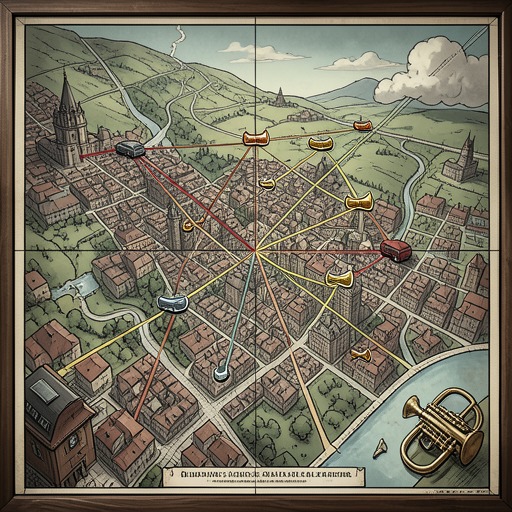
The Crying of Lot 49Brussels is the setting for the political rupture from which the Tristero emerges: in 1577, revolutionary authorities displace the hereditary head of the Low Countries’ postal system, and Hernando Joaquín de Tristero y Calavera claims that the successor’s office and lands rightfully belong to him. In the history Oedipa assembles, the city’s contested government becomes the starting point for a long conflict over inheritance, authority, and control of communication.
Political Upheaval and the Brussels Commune
The northern Low Countries had been fighting for independence from Catholic Spain and the Holy Roman Emperor for nine years when, in late December 1577, William of Orange entered Brussels in triumph. He had been invited by the Committee of Eighteen, a Calvinist junta that regarded the Estates-General as dominated by privileged classes and unrepresentative of skilled workers. The committee established a form of Brussels Commune, controlled the police, directed the Estates-General’s decisions, and removed numerous officials from their positions.
The Postal Office and the Rival Claim
Among those removed was Leonard I, Baron of Taxis, the hereditary Grand Master of the Post for the Low Countries and executor of the Thurn and Taxis monopoly. The revolutionary authorities replaced him with Jan Hinckart, Lord of Ohain, a loyal supporter of Orange. That appointment brought Hernando Joaquín de Tristero y Calavera into the dispute: he claimed to be Hinckart’s cousin, from the Spanish and legitimate branch of the family, and the rightful Lord of Ohain. On that basis, he asserted a hereditary claim not only to Hinckart’s lands but also to his newly acquired postal office.
From Brussels to Clandestine Opposition
After Farnese retook Brussels for the Emperor in March 1585, Leonard I was reinstated and Hinckart was dispossessed. The postal monopoly had meanwhile been weakened by political instability and the Emperor Rudolph II’s temporary withdrawal of patronage, prompted by suspicions about the family’s Protestant Bohemian branch. Against this unsettled background, Tristero appears to have turned his claim into an independent postal system. From 1578 onward, he waged a guerrilla campaign against Hinckart, made four unsuccessful attempts to assassinate Orange’s postmaster, and developed an underground campaign of obstruction, terror, and depredation against Thurn and Taxis routes. He styled himself El Desheredado, or The Disinherited; his followers wore black, and the muted post horn and a dead badger became part of the group’s iconography.
Brussels in Oedipa’s Reconstruction
Oedipa learns this history through an uncertain assembly of sources: obscure philatelic journals, a footnote in Motley’s Rise of the Dutch Republic, a pamphlet on anarchism, sermons by Blobb’s brother, and clues attributed to Blobb. The account therefore presents Brussels not as a place Oedipa visits, but as the historical scene reconstructed through competing and fragmentary records. Its importance lies in the way a local change of office is made to reverberate across centuries: the Tristero’s later American presence is traced back to a claim of dispossession first dramatized in Brussels.