Buchenwald
The Crying of Lot 49Buchenwald is the setting of Dr. Hilarius’s account of his wartime work on experimentally induced insanity, a history he invokes during a present-day armed standoff. The place gives his apparent therapeutic identity a disturbing past: he describes participating in experiments on Jewish prisoners, then years spent trying to believe that he could atone. His testimony makes Buchenwald not simply a historical reference but a point where personal guilt, political violence, and uncertain memory meet.
Setting and Historical Association
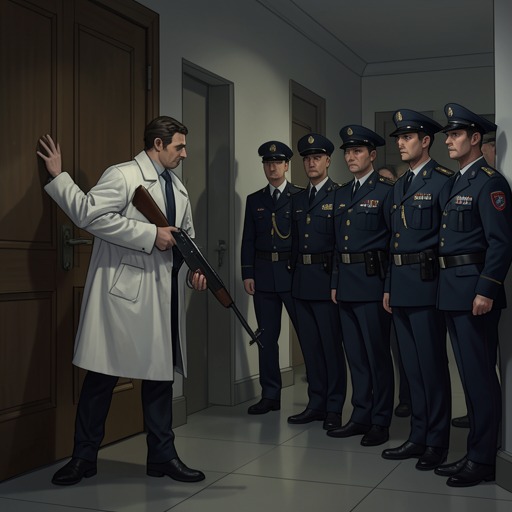
When Oedipa asks where Hilarius worked before his present life, he answers with the place name Buchenwald. She presses him about what he did there, while police hammer on the office door and he searches for more ammunition. The exchange ties the camp to an immediate crisis rather than presenting it as detached background: Hilarius’s account is spoken while he is armed and convinced that authorities have come for him.
Hilarius says he worked on experimentally induced insanity. He describes a program intended to make a catatonic Jewish prisoner seem, in the eyes of liberal SS circles, as good as dead, supposedly on grounds of greater humanity. The experiments he recounts included metronomes, serpents, late-night theatrical vignettes, surgical removal of glands, projected hallucinations, drugs, threats delivered through concealed loudspeakers, hypnosis, clocks running backward, and faces. Hilarius says he was assigned to the work with faces. The list presents experimentation as an organized effort to break down perception and mental life, not as an isolated act.
Hilarius’s Account and Attempted Atonement
Hilarius says the Allied liberators arrived before the researchers could gather enough data. He recalls a few conspicuous successes, including a subject named Zvi, but says there was little that could be established statistically. His recollection thus couples the claimed brutality of the work with the cold language of experimental results, exposing the gap between the prisoners’ suffering and the researchers’ demand for data.
He describes trying to make amends through a belief in Freud’s vision of a world without camps: in his account, the violence of Buchenwald would give way to ordinary, peaceful life. Hilarius says he slept only three hours a night to avoid dreaming and spent the other twenty-one hours trying to acquire faith. He nevertheless concludes that his penance has not been enough. His appeal to atonement does not erase his account of participation; instead, it shows how he has tried to live with it and how inadequate he believes that effort to be.
Buchenwald in the Present-Day Crisis
Oedipa asks whether Hilarius thinks the authorities are trying to return him to Israel for trial, as they did Adolf Eichmann, and asks what he did at Buchenwald. Hilarius nods along with her suggestion, while the police outside seek information and ask whether she can keep him occupied. He is still searching for ammunition. The scene leaves his fear of capture entangled with the history he has disclosed, without establishing that the officers have come for the reason he imagines.
When Oedipa sees that Hilarius has left his rifle on the desk and is trying to open a file cabinet, she picks up the weapon and points it at him. She recognizes that he wanted her to take it. The episode turns their conversation about Buchenwald into a confrontation over agency and danger: Hilarius’s past is revealed through his own telling, but his present behavior also makes the disclosure part of an unstable encounter rather than a settled confession.
Memory, Evidence, and Significance
Elsewhere, an older man’s account of his grandfather connects the Pony Express to violence against Indigenous people and to a signet ring bearing the WASTE symbol. The old man says his grandfather took the ring from someone he killed, but his recollection supplies no firm historical proof. Mike Fallopian likewise describes historical claims as difficult to trace, dependent on old-timers’ stories and potentially weak documentation. These episodes place Hilarius’s Buchenwald testimony in a wider pattern: the past reaches the present through personal accounts whose detail may be compelling even when verification remains uncertain.
The novel therefore gives Buchenwald decisive moral weight without turning Hilarius’s statement into an independently confirmed historical record. The place marks the extremity of the history he claims and the failure of his attempted reconciliation with it; at the same time, the surrounding uncertainty about testimony and evidence cautions against treating any single account as a complete explanation. In the armed scene, the past is neither safely concluded nor easily separated from the present: it returns in Hilarius’s fear, his account of guilt, and Oedipa’s confrontation with him.