Diocletian Blobb
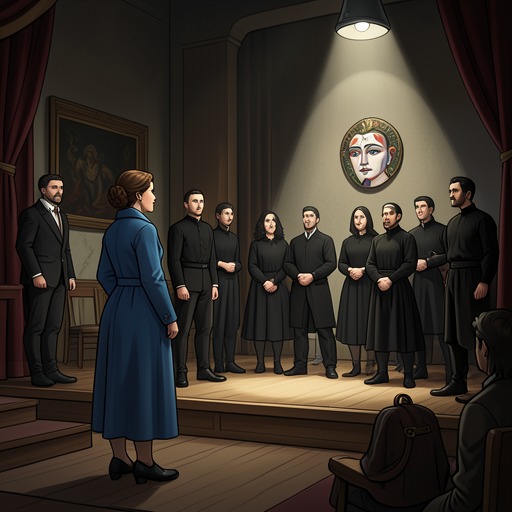
The Crying of Lot 49Diocletian Blobb is an English traveler whose account of an encounter with Tristero appears in an old book consulted by Oedipa Maas. A conspicuous survivor of a silent attack on a Thurn and Taxis mail coach, Blobb becomes a deliberate messenger: the brigands spare him and instruct him to report their power to the English king and Parliament. His account, preserved through the commonplace book of the playwright Wharfinger, gives Oedipa a vivid episode from which she begins assembling the history of Tristero.
The Traveler in Wharfinger’s Book
Blobb enters the novel through a book held by Emory Bortz, who keeps his Wharfingeriana locked away from his children. Its full title is An Account of the Singular Peregrinations of Dr. Diocletian Blobb among the Italians, Illuminated with Exemplary Tales from the True History of That Outlandish And Fantastical Race. Bortz explains that Wharfinger, like Milton, maintained a commonplace book, jotting down quotations and material from his reading; that is how Blobb’s Peregrinations became known. The old volume is therefore not simply a travel narrative placed before Oedipa: its survival depends on a chain of copying and collecting, and on the fragmentary scholarship Bortz has pursued.
Oedipa cannot readily decipher the book’s old-fashioned spelling and typography. Bortz leaves her to try, pointing her toward what he thinks is Chapter Seven; she discovers that the relevant episode is in Chapter Eight. There she reads Blobb’s own report of meeting the Tristero brigands. The slight mismatch between Bortz’s direction and the chapter she needs underscores how Oedipa must work through imperfect guides and scattered texts rather than receive a settled account.
The Attack at the Lake of Piety
Blobb is traveling through desolate mountain country in a mail coach belonging to the “Torre and Tassis” system, which Oedipa recognizes as an Italian rendering of Thurn and Taxis. Near what he calls the Lake of Piety, a score of black-cloaked riders attacks the coach. The struggle is fierce and silent in the icy wind. The raiders use cudgels, harquebuses, swords, and stilettos; they finish those still breathing with silk kerchiefs.
Blobb and his servant escape the violence by separating themselves from the fight from the outset, loudly declaring that they are British subjects and occasionally singing what Blobb calls improving Church hymns. Their conduct contrasts with the mail crew’s peril: they do not defeat or evade the attackers through force, but mark themselves as outsiders whose survival can serve the raiders’ purposes. Oedipa finds their escape surprising, given what she has understood of Tristero’s concern for security.
After collecting the mail sacks, the leader pulls Blobb from the coach and addresses him in perfect English. He tells Blobb that he has witnessed Tristero’s wrath and commands him to tell the king and Parliament what happened, declaring that neither tempest, strife, beasts, desert loneliness, nor the illegitimate usurpers of Tristero’s rightful estate can deter its couriers. The brigands leave Blobb and his servant with their purses intact, then disappear into the mountains, their cloaks cracking like black sails. The attack is thus also a staged proclamation: violence against the postal service produces a surviving witness and a message meant to travel farther than the stolen mail.
A Witness Made into a Messenger
Blobb’s survival is not presented as proof that he has earned the raiders’ mercy. Oedipa asks why Tristero would spare someone she considers an insufferable ass. Bortz proposes that the answer lies in Blobb’s unmistakable manner: even amid cold and bloodlust, the brigands could recognize a mouth likely to carry a report. If Tristero wanted its news to reach England, Blobb would be an ideal instrument. Bortz further suggests that the episode belongs to a period when Tristero enjoyed counter-revolution, and that the political upheaval in England made the country a promising audience. He speculates that the encounter may have been a setup, not a chance reprieve.
That interpretation makes Blobb’s role a pointedly limited one. He is not shown as an ally or member of Tristero; he is a witness selected for the usefulness of his testimony. The brigands’ command transforms his escape into a channel of communication. Their claim to a “rightful estate” also frames the assault as more than robbery: in the message they dictate, attacks on their couriers and their contested inheritance become evidence of an organization asserting a political and postal claim.
From Travel Narrative to Historical Clue
After the encounter, Blobb inquires about Tristero and meets nearly universal silence. He nevertheless gathers fragments, and Oedipa later repeats that process. She combines clues from Blobb with obscure philatelic journals supplied by Genghis Cohen, a footnote in Motley’s Rise of the Dutch Republic, an old pamphlet on modern anarchism, and a book of sermons by Blobb’s brother Augustine among Bortz’s collection. Blobb’s testimony is therefore one source among several, not a complete or independently verified history; its significance lies in the pieces it preserves and the questions they open.
Oedipa’s reconstruction places Tristero’s beginnings amid the 1577 political upheaval in the Low Countries. The attack on a Thurn and Taxis coach supplies a concrete episode in the organization’s conflict with the established postal monopoly, while the brigands’ spoken claim to a rightful estate anticipates the succession dispute around Hernando Joaquín de Tristero y Calavera and Jan Hinckart. Through Blobb’s account, a travel book becomes a political artifact: a record of violence, a carrier for Tristero’s proclamation, and a fragile link in Oedipa’s effort to decide whether the scattered traces form a coherent hidden history.