Fangoso Lagoons
The Crying of Lot 49Fangoso Lagoons is a large development west of San Narciso whose canals, artificial lake, reconstructed social hall, and imported underwater attractions embody Pierce Inverarity’s ability to reshape land as both property and spectacle. It is also a place where Oedipa Maas encounters clues that connect local history, private enterprise, and the possibility of a hidden postal network.
Development and Setting
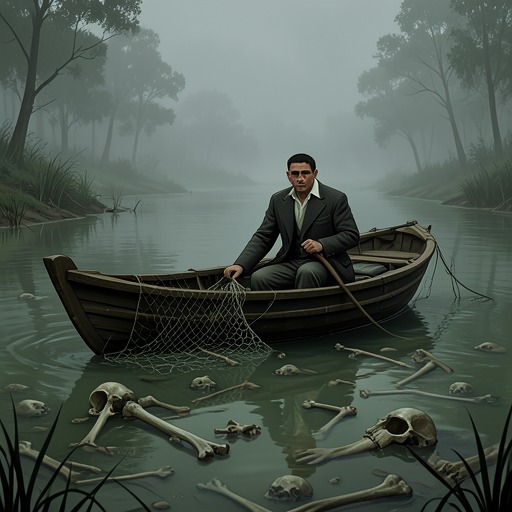
Fangoso Lagoons appears first as a housing project advertised on television. The commercial describes canals with private powerboat landings and a floating social hall set in an artificial lake. Beneath the water are restored galleons imported from the Bahamas, fragments of columns and friezes from the Canary Islands, human skeletons from Italy, and giant clamshells from Indonesia, assembled as attractions for scuba divers. The inventory makes the development seem less like an untouched landscape than a curated collection of distant objects repackaged for recreation.
The project belongs to Inverarity’s extensive real-estate interests. Oedipa recognizes its map on the television screen and is struck by a sense of significance resembling her earlier view of San Narciso from above: curved streets and private access to water seem to promise a concealed pattern of meaning. That promise is unstable. The Lagoons’ apparent natural and historical depth is itself a designed environment, built to entertain visitors and give the development a distinctive identity.
The Visit and Lake Inverarity
Oedipa and Metzger visit the Lagoons with the Paranoids and their companions while waiting for authority to represent Inverarity’s interests in several states. The drive passes thousands of three-bedroom houses spreading over the inland hills; the Pacific seems to lie beyond them, but the journey stops short of the open sea. The contrast matters to Oedipa, who had hoped the Pacific might remain a redemptive presence beyond Southern California’s development. Instead, the party arrives amid earth-moving machines, treeless ground, and sand roads winding down toward Lake Inverarity.
At the lake’s center, a round island of fill supports a social hall reconstructed in an Art Nouveau style, like a European pleasure casino. Oedipa falls in love with the building, even as its setting makes the artifice unmistakable: the island and beach are manufactured within a project under construction. The Paranoids unload their instruments as if searching for somewhere to plug them in, while Oedipa takes eggplant sandwiches from the Impala and Metzger brings tequila sours. The leisurely outing thus unfolds inside a landscape organized by construction, private access, and recreation.
Commerce, Bones, and Hidden History
The Lagoons’ underwater attractions connect the development to a disputed bone transaction. Manny Di Presso explains that some of the Italian bones were sold for display at the bottom of the lake, while others had been used in research and development for a filter program in the early 1950s. He says Tony Jaguar claimed to have recovered them from Lago di Pietà. The bones therefore belong at once to a commercial attraction and to a contested account of their origin and use; the scenic lake conceals a history of extraction and dispute beneath its surface.
A bronze historical marker on the other side of the lake adds another buried story. It recounts that in 1853 twelve Wells, Fargo men fought masked marauders in black uniforms, with the account attributed to a post rider who died soon after. The victims’ only remaining clue was a cross traced in dust, and the attackers’ identities remained unknown. Oedipa wonders whether the mark could instead have been the initial T, recalling a sign associated with the Tristero in The Courier’s Tragedy. She tries to ask Randolph Driblette whether he knew of the massacre, but gets no answer; the marker instead sends her to Zapf’s Used Books to look for the play’s historical context.
Infrastructure and Narrative Significance
Fangoso Lagoons brings together the visible infrastructure of development and the less visible networks that Oedipa is beginning to trace. Its private landings, artificial lake, and managed attractions organize access to the landscape for paying visitors; elsewhere in San Narciso, the Peter Pinguid Society secretly uses Yoyodyne’s inter-office mail delivery because delivery is a government monopoly. The Society’s covert carriers face tight schedules and surveillance by plant security, showing how established infrastructure can be appropriated for unofficial communication. The Lagoons’ marker supplies a parallel uncertainty about mail, violence, and the survival of a suppressed history.
By the end of Oedipa’s investigation, San Narciso loses its apparent separateness and becomes part of a broader American continuity, without clear boundaries. Fangoso Lagoons is one concentrated expression of that world: Inverarity’s real-estate capital remakes land, imports objects and histories for consumption, and leaves behind clues whose meaning cannot be securely separated from the development that displays them. Its promise of an ordered, interpretable landscape is shadowed by the possibility that the history beneath it belongs to a network no map can settle.