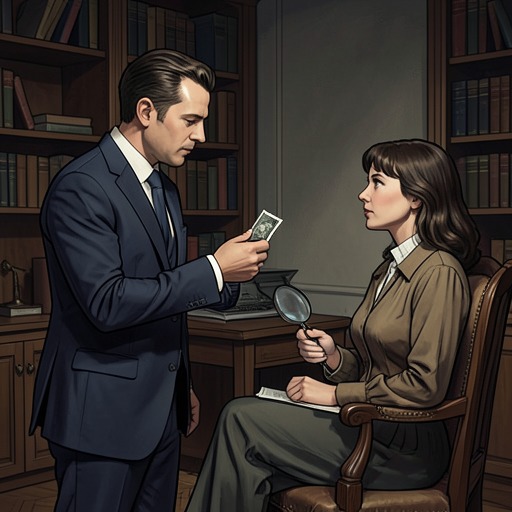
Genghis Cohen Finds the Muted Post Horn Among Pierce’s Stamps
The Crying of Lot 49Genghis Cohen’s investigation of Pierce Inverarity’s stamp collection gives Oedipa Maas her most tangible connection yet between a recurring mark and the history of private postal systems. Examining a suspicious 1940 Pony Express stamp, Cohen identifies a watermark resembling the W.A.S.T.E. symbol Oedipa has seen elsewhere. Its resemblance to the post horn of Thurn and Taxis suggests a deliberately altered emblem—and makes a potentially active secret network look less like an isolated rumor and more like a pattern assembled across stamps, historical accounts, and present-day encounters.
Commission and First Clue
Acting on the terms of Pierce Inverarity’s will, Metzger retained Cohen, a prominent Los Angeles philatelist, to inventory and appraise the estate’s stamps. Cohen contacted Oedipa one rainy morning because he had noticed irregularities. He had consulted an expert committee but had not yet sent the questionable items for examination, pending authorization from Oedipa and Metzger. His procedure was careful and material: he lifted a U.S. commemorative Pony Express stamp from a plastic folder with tweezers, illuminated it with a small lamp, and prepared it for inspection.
Oedipa first saw the stamp’s reverse, where the watermark appeared. It was the same looped, angular W.A.S.T.E. sign that had already surfaced in her investigation. That recurrence matters because the mark was not merely drawn on a wall or encountered as a private doodle: it was embedded in the paper of an item inside Inverarity’s collection. The estate she had been appointed to administer was now connected, through a physical artifact, to the unexplained sign.
The Muted Horn
Cohen next showed Oedipa an old German stamp marked “Freimarke” and “Thurn und Taxis.” He explained that the Thurn and Taxis family had operated Europe’s mail service from about 1300 until Bismarck bought them out in 1867. The stamp’s corners carried the family’s post-horn emblem. Oedipa recognized a resemblance between that horn and the W.A.S.T.E. watermark, noting that the latter seemed to have an extra shape protruding from the bell. Cohen proposed that this addition represented a mute. In this reading, the altered horn is not simply a likeness: it figures an attempt to silence or oppose the older postal power.
The comparison tied the stamp evidence to the play Oedipa had been investigating, whose imagery included a gold, once-knotted horn, and to the black costumes, silence, and secrecy associated in her mind with the hidden group. The connection remains interpretive rather than conclusive, but the sequence gives separate clues a shared visual vocabulary: a historical courier emblem, a watermark, and a sign encountered in contemporary California.
Counterfeit and Deliberate Errors
Cohen judged the Pony Express stamp counterfeit, not an accidental printing error. The issue and the other examples he had examined were normally unwatermarked; the hatching, perforation count, and condition of the paper also indicated that the stamp had been made as a forgery. He had found eight stamps in all, each with a painstakingly introduced error. One even misspelled “Postage” as “Potsage.” The errors appeared deliberate, though Cohen could not say who had made them or why.
The stamp’s front supplied another suggestive detail. It showed a Pony Express rider leaving a western fort, with a single black feather engraved in the shrubbery toward the rider’s direction. For Oedipa, that image resonated with the historical marker at Fangoso Lagoons, which described masked marauders in black uniforms attacking Wells, Fargo men in 1853, and with the account she heard from Mr. Thoth of men who disguised themselves as Indians. Neither parallel proves that the stamps and the old attacks share an origin. Together, however, they extend the possible pattern from the altered horn to the imagery of a rival that could conceal itself behind other identities.
Caution and Continuing Mystery
After seeing the marks, Oedipa told Cohen about the symbol on Mr. Thoth’s signet ring, the sign Stanley Koteks had been doodling, and the muted horn she had seen in the ladies’ room at The Scope. Cohen concluded that, whatever the phenomenon was, it appeared to remain active. Yet he was reluctant to involve the government, suggesting that officials might already know more than they did and asking whether the matter was theirs to pursue. The discovery therefore increased the reach of the mystery without producing a reliable institutional account or a confirmed identification of the people behind it.
The wider historical discussion deepens the significance of Cohen’s find without settling its authenticity as evidence of a present-day organization. Mike Fallopian’s research linked the U.S. postal reforms beginning around 1845 to the suppression of independent mail routes, while a marker at Fangoso Lagoons preserved a much less certain story of a Wells, Fargo massacre. Later, Emory Bortz described how Tristero members who reached America after the 1849–50 reaction would have faced a postal system increasingly hostile to private competition; in his account, the group adapted through silence, impersonation, and opposition masked as allegiance. Against that history, Cohen’s counterfeit stamps look like possible traces of an alternative network, but the novel leaves open whether Oedipa has uncovered an organized historical continuity or assembled uncertain fragments into one.
Significance in Oedipa’s Investigation
The episode changes the character of Oedipa’s inquiry. Earlier clues could be dismissed as isolated signs or unreliable recollections; Cohen’s examination supplies a chain of physical comparisons, technical observations, and repeated motifs. The counterfeit is both evidence and a puzzle: its watermark points toward the muted post horn, while its carefully planted errors raise questions about authorship and intention. Cohen can establish that the stamps are forgeries, but not who produced them or whether the forgery confirms the Tristero’s continued existence.
That unresolved gap is central to the discovery. The stamp collection belongs to Inverarity’s estate, and the mark on its paper joins the estate to a story of private communication and resistance to centralized postal authority. Yet every step from artifact to historical explanation requires interpretation. Cohen’s expertise strengthens what can be said about the stamps’ physical construction; it cannot turn their suggestive emblems into proof of the conspiracy Oedipa fears may surround her.