Hernando Joaquín de Tristero y Calavera
The Crying of Lot 49Hernando Joaquín de Tristero y Calavera is presented as the uncertain founder of Tristero, a clandestine postal network born from a contested claim to power. His story links personal disinheritance to a larger struggle over who controls communication: he challenged Jan Hinckart’s authority, built an organization of exiles, and directed it against the Thurn and Taxis mail routes. Oedipa Maas encounters his history through fragments, so even the origins of the network remain disputed rather than settled fact.
Identity and Claim
The account Oedipa assembles describes Tristero as possibly a madman, an honest rebel, or a con artist. He claimed to be Jan Hinckart’s cousin, descended from the Spanish and legitimate branch of the family, and the true lord of Ohain. On that basis, he asserted a right to everything Hinckart held, including his recent appointment as Grand Master of the Post. The competing possibilities attached to his identity leave open whether his rebellion began in conviction, opportunism, or a claim whose truth cannot be verified.
The dispute arose amid political upheaval in the Low Countries. In 1577, after William of Orange entered Brussels, the Committee of Eighteen established a commune and replaced Leonard I, Baron of Taxis, as hereditary Grand Master of the Post with Hinckart, an adherent of Orange. Tristero’s claim therefore concerned more than a family title: it placed him against a new officeholder whose appointment had displaced the Thurn and Taxis monopoly’s hereditary head.
Rebellion and the Underground Network
From 1578 until Alexander Farnese retook Brussels for the Emperor in March 1585, Tristero waged what the account calls a guerrilla war against Hinckart, if the two men were indeed cousins. As a Spaniard, he found little support, and his life was often in danger. He made four unsuccessful attempts to assassinate Orange’s postmaster. His campaign unfolded during a period when the Thurn and Taxis monopoly itself was weakened: the Emperor had withdrawn his patronage for a time, and its postal operation was deeply in debt.
The instability may have suggested to Tristero the possibility of taking over the wider power structure Hinckart might have commanded. He appears as an erratic public figure, liable to interrupt a gathering with a speech. His recurring claim was that the postal monopoly belonged to Ohain by conquest and that Ohain belonged to him by blood. He styled himself El Desheredado, meaning the Disinherited, making exclusion both his personal grievance and the language of his political challenge.
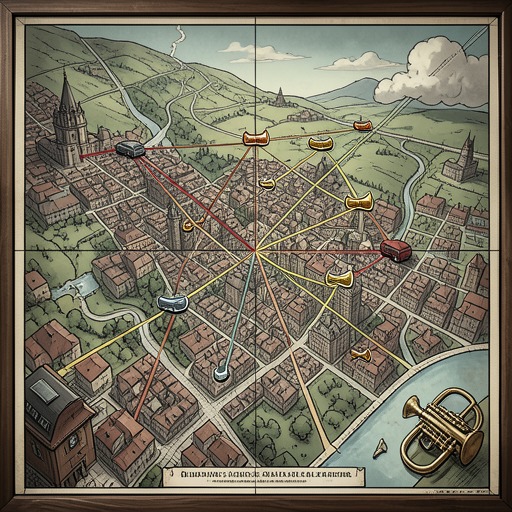
Tristero then established a clandestine system and began a campaign of obstruction, terror, and depredation along the Thurn and Taxis routes. His followers wore black, associated with the night that was said to be the only possession left to them in exile. The organization’s iconography also included the muted post horn and a dead badger with its feet in the air. The badger’s place in the emblem was linked, speculatively, to the name Taxis and to the badger-fur hats worn by early Bergamascan couriers. These symbols gave the network a recognizable identity even as it operated in secrecy.
Later Traces and Historical Reach
Oedipa’s account of Tristero’s origins is pieced together from disparate materials: obscure philatelic journals, a footnote in Motley’s Rise of the Dutch Republic, a pamphlet on anarchism, sermons by Tristero’s brother Augustine, and the clues gathered by Diocletian Blobb. The sources preserve fragments rather than a definitive biography. This uncertain transmission is part of the character’s significance: the founder is known through the same scattered, mediated traces as the network he is said to have created.
The organization’s later history extends his opposition beyond Europe. Emory Bortz suggests that Tristero refugees reached America in 1849–50, where postal reform and the suppression of independent carriers made open competition difficult. By 1861, he says, Tristero had adapted rather than disappeared: its messengers learned Siouan and Athapascan dialects and traveled west disguised as Indigenous people, while the Pony Express crossed the frontier openly. The account characterizes this later method as silence, impersonation, and opposition disguised as allegiance. It does not establish that Tristero personally traveled to America; instead, it casts him as the origin point of a strategy that could survive changes of place and historical circumstance.
Significance in Oedipa’s Investigation
Tristero enters the novel through intersecting signs and histories rather than direct appearance. Mike Fallopian’s research into private mail delivery links postal reform and the suppression of independent routes to a broader parable of power. A marker at Fangoso Lagoons recalls the 1853 killing of Wells, Fargo men by masked marauders in black uniforms, while one victim’s mark in the dust may be read as a cross or the initial T. Oedipa connects that ambiguous trace to the name encountered in The Courier’s Tragedy. These clues suggest a continuity between the European conflict and American attacks on established carriers, but they do not independently prove every element of Tristero’s history.
The same uncertainty shapes Oedipa’s growing investigation. A watermark on a stamp, a muted post horn glimpsed in San Francisco, and the W.A.S.T.E. mailbox make the secret network seem present in contemporary life, while the accumulated historical account offers a possible explanation for its persistence. Tristero’s founding grievance thus becomes a pattern of exclusion and counter-communication: a claim to inherited authority transforms into an underground alternative to dominant postal systems. Whether that pattern describes a continuous organization or a story assembled from suggestive fragments remains unresolved.