Inamorati Anonymous
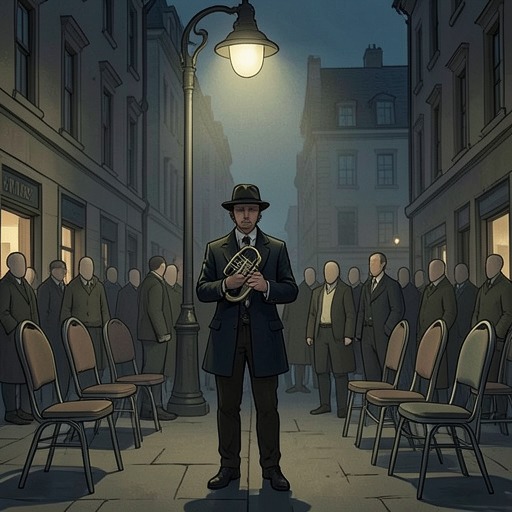
The Crying of Lot 49Inamorati Anonymous is a secretive mutual-aid society organized around abstaining from romantic love, whose members seek help through anonymous, carefully limited contact rather than meetings or lasting relationships. Its emblem, a muted post horn, links it to Oedipa Maas’s investigation of the hidden W.A.S.T.E. mail system. The society’s founder story turns that emblem into a sign discovered through a near-suicide, while its practices make isolation not merely a condition of its members but the principle governing their aid.
Purpose and Membership
A member Oedipa meets in San Francisco explains that an inamorato is someone in love and that love is treated as the worst addiction. The organization aims to help members reach a state in which they no longer need it. He says he had “kicked it young,” while describing older members, including people in their sixties and women older still, who wake at night screaming. The account makes clear that the society addresses distress as well as a general ideal of detachment: its members can be people for whom romantic attachment remains painful and difficult to escape.
The member’s pin identifies him as part of the society. It is not the cerise badge worn by the tourists Oedipa has encountered, but a muted post horn rendered in pale, glimmering alloy. The small emblem gives Oedipa a recognizable sign within the noisy, anonymous night life of San Francisco. It also connects this particular group to the postal imagery that has been accumulating elsewhere in her inquiry.
Rules of Contact
Inamorati Anonymous does not hold meetings. Instead, a member receives a telephone number for an answering service, which can be called when the need for help becomes too great to manage alone. Members do not know one another’s names; the number is a limited channel for reaching assistance, not an invitation to build an ordinary social circle. The society’s structure deliberately resists the recurring personal contact that, in its view, would undermine its purpose.
A helper is dispatched to sit with a member, but the two do not meet twice. The answering service takes care to prevent repeats, and the person who comes to help then goes away. This rule makes aid immediate but temporary: the member is not abandoned in the moment of crisis, yet the encounter is prevented from turning into a new attachment. When Oedipa asks whether a member might fall in love with the person sent to help, the answer is built into the system itself: that person disappears from the member’s life. Anonymity, controlled access, and non-repetition thus operate together as the society’s practical safeguards.
The Founder and the Post Horn
The member traces the society’s beginning to a Yoyodyne executive in the early 1960s, whose corporate position was above supervisor but below vice-president. At thirty-nine, the executive was automated out of his job. Since childhood he had been trained toward a future of presidency and death, and in his work he had signed specialized memoranda he could not understand and accepted blame for programs whose failures needed explanation. His first response to losing his job was to consider suicide, but his training in committee procedure led him to seek other people’s reasons for not committing suicide before deciding.
He placed an advertisement in the Los Angeles Times asking whether anyone in the same predicament had found a reason to go on. He expected that no one who had died by suicide could answer, leaving him with useful replies. While he watched the mailbox with Japanese binoculars his wife had given him as a parting present, regular deliveries brought only advertising. His wife had left the day after he was dismissed. One Sunday, after a dream of jumping from The Stack into rush-hour traffic, a knock brought him an aged, hook-handed man in a knitted watch cap, who handed over a bundle of letters and left without speaking. Most of the letters came from people who had attempted suicide and failed.
The founder’s crisis shifts when he hears his wife return with the Yoyodyne efficiency expert responsible for replacing him with an IBM 7094. He listens from the kitchen as they laugh together in the living room, while his tie is dipped in gasoline in preparation for a suicide by fire. Their conversation about his hesitation and the machine’s speed breaks the suicidal scene into ridicule: he begins to laugh, and the visitors leave to look for the police. After he showers and hangs out his suit, he notices that gasoline has bleached the printing on stamps in his pocket. Peeling one from a letter, he sees the muted post horn watermark through the skin of his hand.
He interprets the image as a sign and identifies love as his great mistake. He vows to avoid every kind of love, not only romantic love between men and women, and founds a society of isolates with the post horn as its emblem. The group’s origin therefore joins the failures of ordinary delivery, the experience of being discarded by a corporation, the shock of intimate betrayal, and a watermark revealed by gasoline. The emblem is at once the discovery that redirects the founder’s life and a mark associated with the hidden postal channel.
Oedipa’s Encounter and the Hidden Network
Oedipa encounters the society while being herded with other tourists into a bar called The Greek Way. Amid the staged tour of San Francisco’s gay night life, she spots the post-horn pin on a man’s lapel and approaches him by claiming to be an agent of Thurn and Taxis. He does not expose the society’s founder; he tells her that the founder is anonymous and suggests she write to him through her W.A.S.T.E. system as “Founder, IA.” Oedipa admits that she does not know how to use it. The advice supplies a possible route of contact but no direct access to the person who established the group.
The member imagines aloud that an entire underworld of people who survived suicide attempts might keep in touch through the secret delivery system and wonders what they tell one another. His speculation extends the society’s account beyond romantic dependence, but the passage does not establish that the organization is actually composed of suicide survivors or that it operates the whole network. Rather, his suggestion gives Oedipa another possible population and purpose to associate with W.A.S.T.E. The founder’s letters had arrived outside the ordinary noon deliveries, and the visible post horn watermark ties that history to the covert correspondence she is trying to understand.
That link remains suggestive rather than conclusive. Oedipa has already seen the W.A.S.T.E. symbol on a latrine wall and later finds it as a watermark among Pierce Inverarity’s stamps; she also follows a W.A.S.T.E. carrier through San Francisco and Oakland. The society’s emblem belongs to the same field of postal signs, but the encounter does not prove that Inamorati Anonymous and every other group or user of W.A.S.T.E. are one organization. Its place in Oedipa’s inquiry is precisely to widen the possible meaning of the network: a secret channel might carry help among isolates, while remaining difficult to distinguish from the other connections she suspects.
Organizational and Narrative Significance
The society’s rules stand in marked contrast to formal organizations Oedipa has encountered. At Yoyodyne, engineers surrender patent rights to inventions produced under their employment contracts, and Mike Fallopian describes a system in which members of the Peter Pinguid Society must send at least one letter each week through Yoyodyne or be fined. Inamorati Anonymous is presented through a different kind of discipline: it does not demand regular group attendance or recurring correspondence between known individuals, but restricts contact to an answering service and one-time assistance. Where corporate procedure assigns people roles and the political society enforces a quota, this group limits intimacy in order to help people endure it.
That design gives the society an uneasy double character. Its promise is care for members facing the distress of love or isolation, yet its method is to preserve anonymity and make every helper temporary. The organization neither repairs loneliness by forming a community of familiar companions nor abolishes need; it provides a controlled point of contact and then restores separation. Its procedures make the tension visible without resolving it.
For Oedipa, the group’s story is another convergence among emblems, mail, and people whose connections are hard to verify. The post horn moves from a stamp revealed by gasoline to a pin worn in a bar, and the anonymous founder may be approached only through W.A.S.T.E. The society therefore offers a concrete example of secret communication organized around a specific human need, while its guarded founder and impersonal procedures preserve the larger uncertainty of Oedipa’s investigation.