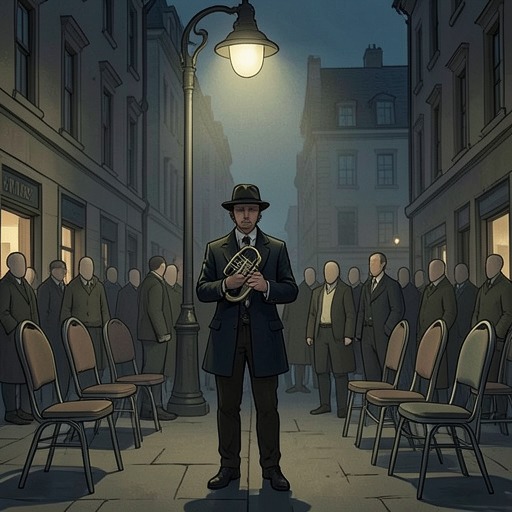
Jesús Arrabal
The Crying of Lot 49Jesús Arrabal is an exiled Mexican anarchist whose encounters with Oedipa Maas bring political revolution, Pierce Inverarity’s unsettling presence, and the novel’s postal mystery into the same frame. He regards the possibility of a spontaneous, leaderless revolutionary world as a kind of miracle; years later, a muted post horn on an old anarchist newspaper makes that figure of speech newly entangled with the signs Oedipa is trying to interpret.
Identity and Exile
Oedipa finds Arrabal in an all-night Mexican greasy spoon off 24th, sitting beneath a television and stirring opaque soup with a chicken foot. He recognizes her from Mazatlán, remembers her as the woman who had been with Inverarity, and beckons her to sit. The scene makes their connection feel both personal and political: Oedipa encounters not a stranger but a figure from a past she has not fully understood.
Arrabal describes himself as being in exile, gesturing around the restaurant. He is part-owner with a Yucatecan who still believes in their Revolution, while Arrabal’s own political affiliations place him outside the country’s settled order. The account identifies the organization he calls the CIA as the Conjuración de los Insurgentes Anarquistas, a clandestine Mexican anarchist outfit traceable to the time of the Flores Magón brothers and briefly allied with Zapata. His restaurant work and revolutionary history occupy the same modest setting: exile is not an abstract label but the condition of his present life.
Earlier Encounter with Oedipa and Pierce
Arrabal and Oedipa had met on a beach in Mazatlán, where he had announced an antigovernment rally that nobody attended. He then spoke with Inverarity, an enemy he believed he had to learn about if he was to remain true to his politics. Inverarity’s neutral manners in the presence of ill will gave Arrabal little to work with; at the same time, Pierce performed the rich, obnoxious American so convincingly that Oedipa saw gooseflesh rise on Arrabal’s forearms, though the reaction came from Pierce rather than the Pacific breeze.
When Inverarity went off to play in the surf, Arrabal asked Oedipa whether Pierce was real, a spy, or making fun of him. She did not understand the question then. In retrospect, she recognizes that Arrabal had noticed something about Pierce she had missed, and remembers him as a kind of nonsexual rival in understanding the dead man. That belated recognition gives the earlier beach episode a different force: Arrabal’s political perception had identified a contradiction in Pierce that Oedipa’s personal familiarity had not exposed.
Anarchist Miracle
Arrabal explains his idea of a miracle by distinguishing it from Bakunin’s account. A miracle, to him, is another world intruding into this one: the two usually coexist, but their contact brings cataclysm. Anarchists, like the church they oppose, believe in another world—not a supernatural realm in the ordinary sense, but one in which revolutions erupt spontaneously, without leaders, as the masses reach consensus as effortlessly as a body coordinates itself.
The ideal is so complete that its actual realization would itself seem miraculous. Arrabal applies this paradox to Inverarity. In Mexico, he says, the privileged person is always redeemed to some finite degree, becoming one of the people; Pierce, by contrast, seemed to Arrabal too perfectly and without flaw to embody the enemy they opposed. If Pierce was not joking, that perfection was as terrifying to Arrabal as a Virgin appearing to an Indigenous person. The comparison does not resolve Pierce into a political type; it preserves the unease of encountering someone who appears to fit an ideological category too exactly to be ordinary.
The Newspaper and the Post Horn
Years later, Oedipa wonders whether, without the reassurance of Inverarity’s apparent miracle, Arrabal might have left his clandestine organization and joined the majority Priistas, thereby avoiding exile. The question arises in the restaurant as she listens to him talk conspiracy. Inverarity’s death remains the link that has brought Oedipa and Arrabal together again, making their precise meeting feel to her like a coded warning rather than an uncomplicated coincidence.
Oedipa’s attention falls on a rolled, ancient copy of the anarcho-syndicalist newspaper Regeneración, dated 1904. Beside its cancellation there is no stamp, only a handstruck image of the post horn. Arrabal wonders whether such marks have been in the mails for sixty years, whether his name has replaced that of a dead member, or whether the paper is a reprint. He sets those questions aside by calling himself a footsoldier who does not know the reasons of higher levels. The newspaper thus joins his revolutionary history to the signs Oedipa is tracing, while leaving the origin and meaning of the mark unresolved.
Narrative Role
Arrabal’s return is brief, but it revises Oedipa’s memory of both him and Inverarity. His earlier failure to explain what disturbed him about Pierce becomes intelligible only after Oedipa has spent years interpreting clues that may or may not belong to a hidden system. The post horn on Regeneración intensifies that uncertainty: it can look like evidence of an old clandestine continuity, yet Arrabal’s questions offer no confirmation of how it arrived or what it signifies.
His account of leaderless consensus also supplies a political counterpart to the novel’s accumulating networks. The anarchist ideal imagines collective coordination without a central commander, while Arrabal himself remains a footsoldier without access to the higher levels’ reasons. His encounter with Oedipa therefore brings the promise of spontaneous solidarity into tension with secrecy, hierarchy, and exile. It gives her another suggestive connection, not a final explanation of the Tristero mystery.