Kinneret Psychiatric Clinic
The Crying of Lot 49Kinneret Psychiatric Clinic is both Dr. Hilarius’s workplace and the setting of his armed crisis. When he barricades himself in his office with a wartime Gewehr 43, claiming that armed men are after him, the clinic’s ordinary role as a place of treatment gives way to a confrontation involving Oedipa Maas, the staff, and the police. Its place in Oedipa’s investigation is less certain: the clinic is one point in a chain of clues and associations that she increasingly fears may be connected to Pierce Inverarity.
Setting and Role
The clinic is referred to in conversation simply as Kinneret. The evidence places it in Oedipa’s life as the workplace of her psychiatrist, Dr. Hilarius, and as a site she returns to after following the W.A.S.T.E. mail carrier. The institution’s medical purpose is present in the staff and the prospect of hospital observation, but the scenes there are dominated by fear, gunfire, and the difficulty of determining what is real.
Nurse Blamm describes Kinneret as full of patients she calls “nutty broads” and says Hilarius could not cope. Her hostile generalization frames the clinic through staff frustration rather than through a neutral account of its work. In the same exchange, she reports that Hilarius had begun breaking up the PBX, placing the crisis inside the institution’s communications system as well as its offices.
Hilarius’s Armed Crisis
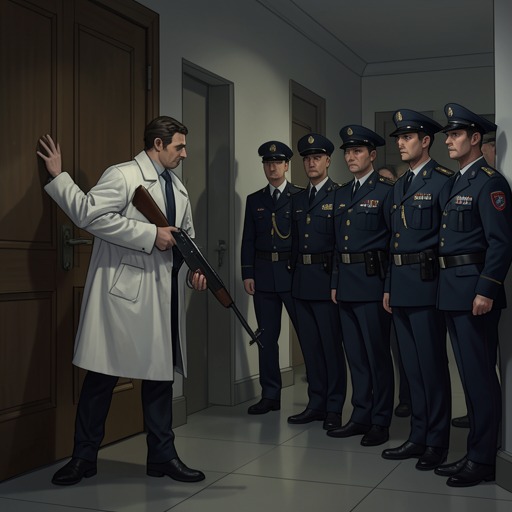
During the confrontation, Hilarius locks himself in his office with a Gewehr 43, a rifle he had kept as a war souvenir. Nurse Blamm tells Oedipa that he has shot at her and at roughly half a dozen other people. She leads Oedipa to her office, where Oedipa notices that the window offers a safe line of retreat; Blamm nevertheless says that Hilarius might need someone and had therefore stayed.
Blamm says Hilarius believes three men with submachine guns are after him, describing them as terrorists or fanatics. Oedipa offers to speak to him, reasoning that she has been away and might seem less threatening. Once inside, she asks where he had made the face that helps her understand what he is talking about. Hilarius answers, “Buchenwald,” while police hammer on the office door. His reply connects the present breakdown to his past work there, but the scene gives no fuller account of that history.
The police ask Oedipa to keep Hilarius occupied, while a television crew hopes to film through the window. She tells the officers that he is armed and that she is inside. Afterward, Mucho says Hilarius is being taken to a community hospital for observation. Oedipa remarks that if Hilarius sees Israelis coming through windows when there are no windows, then he is crazy; the police ask her to remain near Kinneret in case legal action follows.
W.A.S.T.E. Clues and the Investigation
Kinneret enters the mystery before the armed crisis. At a latrine, Oedipa finds a notice inviting people to contact Kirby through W.A.S.T.E. at a Los Angeles post-office box, with a faint, unfamiliar symbol beneath it. She copies the address and symbol into her memo book. Later, at the Yoyodyne plant, she uses Kirby’s name when approaching Stanley Koteks, who has been doodling the same kind of sign; the coincidence draws her into questioning whether the mark belongs to a concealed communications network.
The symbol recurs in a different form when Genghis Cohen examines stamps from Pierce’s collection: Oedipa recognizes the W.A.S.T.E. mark in a watermark. And after searching beneath a freeway for a secret mailbox, she finds a green trash can marked W.A.S.T.E., watches a boy deposit letters, adds a sailor’s letter to Fresno, and follows the carrier through San Francisco, across Oakland, and toward Berkeley. The trail brings her back to John Nefastis’s building. When she later returns to Kinneret, the clinic is therefore also a point in the physical route of her inquiry, though the evidence does not establish that the clinic itself operates or belongs to W.A.S.T.E.
Association, Ownership, and Uncertainty
As Oedipa revisits the investigation, she notices that places connected to its clues—the shopping center containing Zapf’s Used Books and Tremaine’s surplus store, as well as the Tank Theatre—belonged to Pierce. She also notes that Emory Bortz teaches at San Narciso College, heavily endowed by him, and wonders whether the people and couriers she has encountered were Pierce’s employees, willing collaborators, or participants in an elaborate practical joke. The clinic’s crisis intensifies the surrounding uncertainty, but it does not prove that Hilarius or Kinneret is part of such a scheme.
Kinneret thus serves two distinct narrative functions: it makes the psychological danger of Hilarius’s persecution fears immediate, and it sits within a wider pattern Oedipa cannot confidently interpret. The contrast matters. At the clinic, a rifle, reported shots, police, and Hilarius’s own account make the danger concrete; the proposed connection between that scene and the secret postal network remains an inference rather than a confirmed fact.