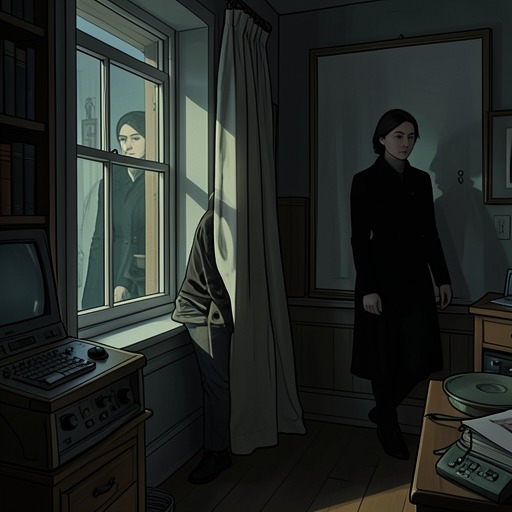
Mazatlán
The Crying of Lot 49Mazatlán is a remembered place in Oedipa Maas’s life with Pierce Inverarity, and later a site where that private history acquires a startling interpretation. A hotel-room memory first returns to Oedipa as she learns she has been named executor of Pierce’s estate; years later, an encounter with Jesús Arrabal in Los Angeles leads her back to the beach where he had once met them both. In the novel’s geography, Mazatlán is less a setting for extended action than a hinge between Oedipa’s intimate past and the unsettling possibility that Pierce embodied something beyond ordinary explanation.
The Hotel-Room Memory
When Oedipa receives the news of her appointment, she tries to summon a feeling of intoxication and instead turns through fragmentary memories of Pierce. Among them is a hotel room in Mazatlán: its door had just slammed, seeming to close forever, and the sound had awakened two hundred birds in the lobby. The remembered moment sits beside other sharply particular images—a west-facing slope at Cornell at sunrise, a Bartók movement, and a narrow shelf above Pierce’s bed holding a whitewashed bust of Jay Gould. Oedipa even wonders, with helpless laughter, whether the bust might have killed Pierce. Mazatlán thus enters the narrative not as a stable, fully described city but as one charged recollection among the objects and scenes through which Oedipa tries to approach the dead man.
That memory is threaded into the news of the will. Pierce had died in the spring, but his law firm had only recently found the document; a codicil dated a year earlier named Oedipa as executor. As she works through an otherwise ordinary afternoon at home, she searches her memory for what might have prompted the appointment. The Mazatlán room belongs to the earlier relationship she is revisiting, while the later call from Pierce—his last voice she would hear—has acquired a new ambiguity in light of the codicil. The place therefore returns at the point when Oedipa’s recollections of a finished affair begin to bear on a present responsibility she does not know how to handle.
The Beach and Jesús Arrabal
Years after the beach encounter, Oedipa finds Jesús Arrabal in an all-night Mexican restaurant in Los Angeles. He recognizes her as the woman he had seen in Mazatlán and invites her to sit. Their reunion supplies the location’s most consequential history: on the beach, Arrabal had announced an antigovernment rally, but nobody appeared. He then spoke with Pierce, whom he regarded as an enemy he needed to understand in order to remain faithful to his anarchist convictions. Oedipa had accompanied Pierce and witnessed the exchange, though she did not grasp what Arrabal saw in him.
Pierce’s manner had left Arrabal unable to decide whether he was real, a spy, or mocking him. Pierce played the rich, obnoxious American so perfectly that Arrabal’s forearms rose in gooseflesh, a reaction the text distinguishes from the Pacific sea breeze. When Pierce went off to sport in the surf, Arrabal asked Oedipa about him. The beach encounter had exposed an uncanny mismatch: Pierce seemed to embody, without apparent flaw, the privileged class Arrabal opposed. Oedipa had not understood the scene then; her later conversation with Arrabal makes the old meeting legible as a challenge to her own understanding of Pierce.
Miracle, Memory, and Meaning
Arrabal explains his response through a conception of miracle unlike the one he associates with Bakunin. A miracle, in his account, is another world’s intrusion into this one; the two worlds usually coexist, but contact between them produces catastrophe. Anarchists, he says, also imagine another world, one in which leaderless revolutions arise spontaneously and people cooperate through a shared capacity for consensus. Yet if that ideal were ever realized perfectly, he too would have to call it a miracle. Pierce’s exact embodiment of the privileged enemy, rather than any conventional act of generosity, makes him terrifying to Arrabal—like a religious apparition.
In the intervening years, Oedipa had remembered Arrabal because he saw something in Pierce that she had missed. At their reunion, as she listens to him talk conspiracy over thick, lukewarm coffee, she wonders whether the force of that encounter had also shaped Arrabal’s political fate: without the “miracle of Pierce” to reassure him, might he have abandoned his clandestine cause and joined the majority priistas, avoiding exile? The thought remains speculation, not an established explanation. But it shows how the Mazatlán meeting continues to work in Oedipa’s mind: what began as a confusing beach conversation becomes a possible turning point in another person’s history as well as a revised image of her own past.
The memory finally becomes part of Oedipa’s sense of coincidence. Pierce, dead and absent, is the link that has brought her and Arrabal together in Los Angeles at this particular moment. She takes that convergence as a coded warning, and her eyes fall on a rolled 1904 copy of the anarcho-syndicalist newspaper Regeneración, marked not by a stamp beside the cancellation but by a handstruck post horn. Mazatlán’s importance therefore reaches beyond the remembered beach: the encounter there helps connect Pierce, Arrabal, political conspiracy, and the novel’s recurring postal sign. Its meaning is not settled. The city anchors a recollection that can be read as an intimate episode, an inexplicable performance, or the first point in a pattern Oedipa cannot confidently distinguish from chance.