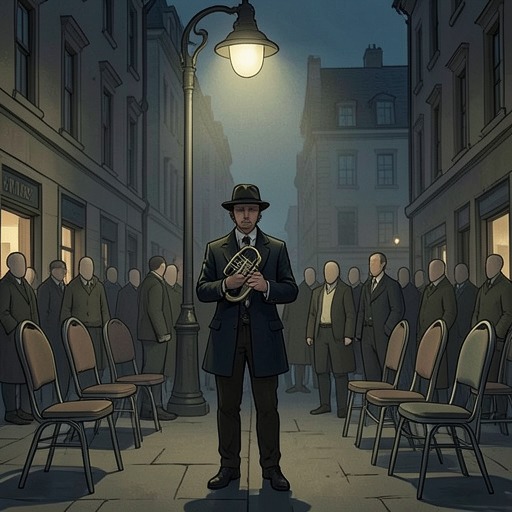
Muted post horn emblem
The Crying of Lot 49The muted post horn emblem is the most persistent visual sign connecting the historical Tristero to the possible underground network Oedipa encounters in the present. Appearing with a dead badger on a purported Tristero stamp and recurring in altered postage designs, it makes the postal system’s concealed presence legible while leaving the truth and reach of that presence uncertain.
Origins and Iconography
In Emory Bortz’s account of Tristero’s beginnings, the post horn enters an iconography devised by Hernando Joaquín de Tristero y Calavera. After the postal monopoly’s political instability created an opening, Tristero styled himself El Desheredado, or The Disinherited, and clothed his followers in black to symbolize the night of their exile. He added the muted post horn and a dead badger, an image Bortz associated with a possible Italian origin for the name Taxis. The emblem thus belongs to a claim of inheritance denied: it marks a rival postal power that defines itself through exclusion and opposition.
The image’s meaning is bound to Tristero’s methods. Its covert campaign obstructed and attacked the established mail routes; later, according to Bortz, Tristero’s messengers crossed the West in disguise, while the organization increasingly emphasized silence, impersonation, and opposition concealed as allegiance. The muted horn suits a system that communicates without openly announcing itself, and its recurrence gives Oedipa a visual thread through a history otherwise assembled from scattered accounts.
Stamps and Historical Recurrence
The emblem appears on an old American stamp that Genghis Cohen receives through the U.S. Mail. Beside the dead badger, it accompanies the motto “WE AWAIT SILENT TRISTERO’S EMPIRE.” Cohen finds the stamp represented in an addendum to his battered Scott catalogue as item 163L1, titled “Tristero Rapid Post, San Francisco, California,” with a Zapf’s Used Books sticker on the catalogue’s end-paper. The object therefore arrives through ordinary mail yet points toward a supposedly unofficial carrier, collapsing the distinction between the public postal system and the network it may conceal.
The horn also belongs to a longer sequence of altered stamps that Oedipa has learned by heart. In her account of the designs, the 1893 Columbian Exposition stamp gives three courtiers expressions of fear; the 1934 Mothers of America issue substitutes poisonous plants for flowers; the 1947 Postage Stamp Centenary issue distorts a Pony Express rider’s head; and the 1954 Statue of Liberty bears a faint, menacing smile. The 1958 Brussels Exhibition issue includes a tiny horse and rider set apart from the other fairgoers. The post horn is part of this larger pattern of barely altered official imagery: the signs are embedded in familiar designs, visible enough to invite recognition but not so conspicuous as to settle what they prove.
Discovery and Interpretation
The emblem’s material appearance has an earlier counterpart in the story of an anonymous founder of Inamorati Anonymous. After gasoline bleaches the printing on stamps in his suit pocket, he notices the muted post horn in the watermark. He takes it as a sign and makes it the society’s emblem. In this episode, the horn is not introduced as evidence of Tristero, but as an image disclosed by the accidental damage to a stamp. Its recurrence across separate accounts intensifies the novel’s pattern of uncertain connections: a mark may acquire meaning through coincidence, interpretation, or an actual hidden history.
That uncertainty is central to the emblem’s function. Oedipa’s investigation begins to connect the mark to private mail delivery, official suppression of independent routes, and the altered stamps Cohen studies. Yet the clues reach her through different kinds of evidence—a historical marker, theatrical material, a catalogue entry, and a stamp—rather than through a single confirming authority. The post horn gives her inquiry a recognizable shape, but recognition alone cannot establish whether each appearance belongs to one coordinated system.
Narrative Significance
As a visual motif, the muted post horn condenses the conflict between official communication and a possible alternative network. Its silence suggests concealment; its placement on or within stamps suggests that concealment can inhabit the very medium used by the dominant postal system. In Bortz’s history, it is a deliberate element of Tristero’s identity; in the founder’s story, it is unexpectedly revealed; in Oedipa’s research, it becomes a recurring clue whose evidentiary force remains unsettled.
The emblem therefore advances the investigation without resolving it. Each recurrence seems to make the network more concrete, while the circumstances of its discovery preserve the possibility that Oedipa is assembling a pattern from ambiguous signs. The muted horn signifies both the promise of a message and the difficulty of knowing who sent it, through which system, and with what authority.