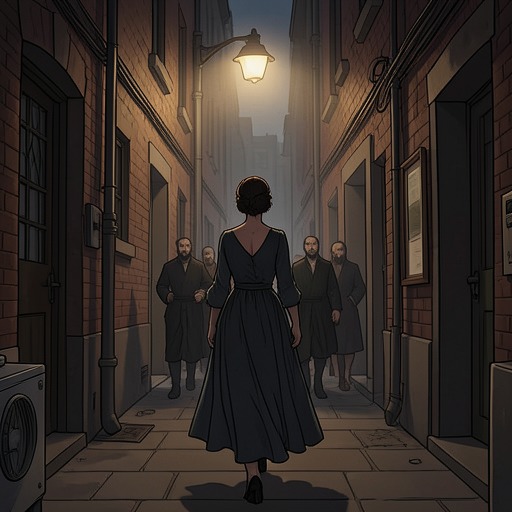
Oedipa Delivers a Sailor’s Letter and Follows a W.A.S.T.E. Courier
The Crying of Lot 49Oedipa Delivers a Sailor’s Letter and Follows a W.A.S.T.E. Courier follows Oedipa Maas as she carries a stranger’s letter into the clandestine postal system and tracks the carrier who retrieves it. The sequence turns the muted post horn from a recurring mark into a working communication channel: Oedipa sees a mailbox, deposits a letter, and follows its movement across the Bay Area. Yet the route ends near a place she already knows, reinforcing both the apparent reality of W.A.S.T.E. and the uncertainty surrounding the network’s independence and purpose.
The Sailor and His Letter
Just before morning rush hour in San Francisco, Oedipa sees an old man sitting in the stairwell of a rooming house. A muted post horn is tattooed on the back of his left hand. He explains that his wife is in Fresno and that he left her so long ago he can no longer remember when. The letter he gives Oedipa appears to have been carried for years. He asks her to put it in the W.A.S.T.E. mailbox, explaining that he cannot make the journey himself after a bad night. His need is immediate and personal, but the request also gives Oedipa a chance to test whether the postal signs and reports she has encountered correspond to an actual delivery system.
On her way to find the mailbox, Oedipa reflects on the sailor’s delirium tremens and on what his suffering suggests about lost experience. She considers how much of a person’s inner life might disappear without leaving a record, then leaves him and follows his directions toward the freeway. The contrast between a letter intended for one estranged spouse and the much larger mystery of hidden communication gives this small delivery a particular weight: the network is not only an emblem or historical conjecture, but a possible means for people to reach one another outside ordinary channels.
Finding the W.A.S.T.E. Mailbox
Oedipa searches for about an hour among the freeway’s concrete underpinnings. She encounters people in the area but does not find the mailbox immediately. At last, in the shadows, she discovers an old green receptacle, nearly four feet high, with a swinging trapezoidal lid. Its hand-painted label reads W.A.S.T.E., with periods between the letters. The modest, easily overlooked container gives a definite physical location to the system she has been trying to trace.
She settles behind a column and waits. A child arrives and drops a bundle of letters into the box; Oedipa then adds the sailor’s letter to Fresno and hides again to observe what happens next. Around midday, a young carrier arrives with a sack, unlocks a side panel, and removes the letters. Oedipa allows him to get half a block ahead before following. Her observation establishes more than the presence of a marked receptacle: letters are deposited there, collected by a courier, and carried onward as part of an operating routine.
Following the Courier
The courier first crosses Market Street and heads toward City Hall. Near the Civic Center, he meets another carrier and exchanges sacks. Oedipa stays with the man she had been following, watching the letters pass through a relay rather than remain in a single carrier’s hands. The transfer suggests an organized route with separate participants, although Oedipa does not learn the carriers’ identities or the system’s larger structure.
She follows him back along Market Street to the transbay bus terminal, where he buys a ticket to Oakland. Oedipa takes the same bus. In Oakland, he travels through neighborhoods she cannot identify, across busy roads, through poorer districts, and up hillsides lined with houses. The sack gradually empties. He eventually boards a Berkeley bus; Oedipa follows again. Halfway up Telegraph Avenue, he gets off and leads her to a pseudo-Mexican apartment house. The pursuit has carried her from the hidden mailbox through a relay and across several cities, but it does not reveal who receives the letters or what destination the carrier has reached.
Evidence and Uncertainty
The next day, after sleeping for twelve hours, Oedipa leaves her hotel and drives to Kinneret to see her psychiatrist, Dr. Hilarius. She wants to tell him what she has seen and to hear that the events are a product of psychosis, not proof of a secret organization. By this point, however, her evidence is concrete: she has seen W.A.S.T.E. stamps and cancellations, a W.A.S.T.E. mailbox, and two W.A.S.T.E. postmen. The delivery and the pursuit have strengthened the case that the system exists in practice, without answering whether it is the work of the historical Tristero or how far its organization extends.
The episode also sharpens the uncertainty that governs Oedipa’s investigation. A secret route is no longer merely a symbol glimpsed on a wall or stamp; she has watched letters enter a box, been collected by a courier, and followed through a chain of movement. But the courier’s eventual connection to an apartment house where John Nefastis lives brings her back to a figure from an earlier stage of her inquiry rather than to an independent explanation. The journey therefore supplies both verification and fresh ambiguity: W.A.S.T.E. operates, yet its relationship to Tristero and to Oedipa’s other discoveries remains unresolved.