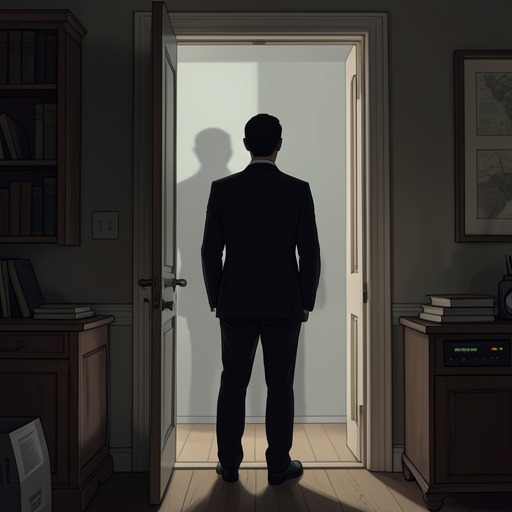
Oedipa Maas
The Crying of Lot 49Oedipa Maas begins as an ordinary Southern California housewife unexpectedly appointed executor of Pierce Inverarity’s complicated estate, but the work draws her into an investigation that reorganizes her sense of reality. Her search for the meaning of the name Tristero gathers clues from postal history, a historical marker, a play, and a muted post horn. Yet the more connections she finds, the less certain she can be whether she has discovered an underground communications network, a scheme connected to Inverarity, or an elaborate pattern produced by her own suspicions. The novel leaves her at an auction, awaiting a bidder who may provide proof but whose identity remains unknown.
Identity and the Inheritance
Oedipa is named executor, or, as she supposes, executrix, of the estate of Pierce Inverarity, a California real-estate magnate. His assets are numerous and tangled enough to make the responsibility more than honorary. The news arrives after she returns from a Tupperware party, and the letter from the Los Angeles law firm says that Inverarity died in the spring and that his will has only just been found. Metzger is named co-executor and special counsel if litigation arises; a codicil dated a year earlier names Oedipa as well. The appointment draws her back toward an earlier relationship with Inverarity while giving her an official reason to enter the far-reaching world he left behind.
The initial shock does not produce a clear explanation of what she feels. At home, under the television’s greenish dead eye, Oedipa tries to feel drunk and instead recalls fragments from her life with Inverarity: a hotel room in Mazatlán, a sunrise at Cornell, music by Bartók, and a bust of Jay Gould perched precariously above a bed. She wonders, in a darkly comic thought, whether the bust could have fallen on Inverarity. The memories establish the personal past that lies behind the legal appointment, but they do not explain what the estate or the man’s death will mean to her.
From the Estate to the Tristero
Oedipa’s investigation acquires its larger shape through encounters and apparent coincidences. At first, the history of private mail delivery comes to her through Mike Fallopian, who is researching the conflict between independent carriers and federal postal reform. He links the Civil War period to the suppression of private routes and sees the history as a parable of power. His account gives Oedipa a political context in which to notice the possibility of a hidden alternative to official communication. The novel describes the beginning of her involvement as the slow, ominous emergence of the Tristero, not as a single revelation that settles what the organization is.
At Fangoso Lagoons, a bronze marker recounts an 1853 attack on twelve Wells, Fargo men by masked marauders in black. Its account depends on a sole post-rider witness, who died soon after, and says the attackers’ identities remain unknown. The only other clue is a mark traced in dust by one of the victims. Oedipa asks herself whether it was a cross or the initial T, recalling the mark associated with Niccolò in The Courier’s Tragedy. She calls Randolph Driblette to ask whether he knew the story and whether it influenced his staging, but the phone rings without an answer. She then goes to Zapf’s Used Books to find the Jacobean plays Driblette had mentioned. The marker does not prove a connection, but it makes the possible recurrence of the T difficult for her to dismiss.
The postal clues meet Oedipa’s private life when an anonymous man describes the origin of Inamorati Anonymous. He recounts how an efficiency expert discovered the muted post horn on a stamp after gasoline dissolved its printing ink. The man treated the image as a sign and founded a society of people seeking to avoid love, with the emblem as its mark. Oedipa asks where the founder is; the answer is that he remains anonymous and can be contacted through her W.A.S.T.E. system. The episode adds another organization and another route for communication to her accumulating pattern, while also showing how a personal crisis can be made into a sign and a system.
Thinking Through an Uncertain Pattern
Oedipa tries to reason about the Tristero amid the disorder of a summer rush-hour drive toward the Bay Bridge. The freeway, with its exhaust, heat, glare, and congestion, affords more room for thought than the apparently calm streets and motel pool of San Narciso. She compares her problem with John Nefastis’s use of Maxwell’s Demon to make two kinds of entropy appear equivalent in equations. In her own case, coincidences seem to bloom wherever she looks, while the word Trystero is the only sound she has to hold them together. The comparison clarifies both her effort to reason and its limits: a shared label can organize separate facts without proving that they have a single cause.
The interpretive difficulty sharpens when Oedipa finds that each apparent access route to the Tristero can also be traced back to the Inverarity estate. Even Emory Bortz, who teaches at San Narciso College, works at an institution heavily endowed by the dead man. The connection prompts Oedipa to consider whether Bortz and other people she has encountered, including Metzger, Genghis Cohen, Driblette, and Koteks, are Inverarity’s employees, loyal associates, or participants in a practical joke. She also considers the competing possibility that she has stumbled on a real network of Americans communicating outside the official system. The alternatives remain open: discovery, hallucination, and deliberate manipulation all fit at least some of what she knows.
Through Bortz, Oedipa hears a historical account of Tristero’s possible survival in the United States. After Tristero refugees arrived in 1849–50, federal postal reform and the suppression of independent carriers left little room for a conventional competing service. Bortz’s reconstruction has the group remain in the country and change its opposition rather than openly challenge the state. By 1861, he says, Tristero messengers were disguised as Indigenous people and sent west after learning Siouan and Athapascan dialects; the network’s methods emphasized silence, impersonation, and opposition concealed as allegiance. When Oedipa asks about a stamp bearing the declaration “We Await Silent Tristero’s Empire,” Bortz distinguishes an earlier, more open period from the later use of stamps made to look almost legitimate. His account supplies a possible history for the signs Oedipa has encountered, but it is an explanation offered within the investigation, not an independently confirmed solution to it.
Loss, Isolation, and the Final Test
Oedipa’s investigation increasingly coincides with the loss of people she had relied on, although the events do not establish that the Tristero caused those losses. At a gathering where Randolph Driblette is being remembered, she learns that he walked into the Pacific two nights earlier. The news comes after the company has struck the set of The Courier’s Tragedy. Driblette had been, in Oedipa’s view, her best guide back to the Tristero; his death removes the person most closely connected to the play that helped direct her search. Oedipa does not receive the explanation she once might have asked for. Instead, she waits in silence, as if another piece of the pattern might become visible.
Her inward account of what remains describes the shrinking of her personal world. Dr. Hilarius, her psychiatrist, has gone mad; Mucho, her husband, is moving further into himself under the effects of LSD; Metzger, her lover, has left with a fifteen-year-old; and Driblette is dead. The sequence makes the investigation inseparable from a more intimate sense of abandonment. At the same time, Oedipa knows that the connections she is pursuing cannot simply be separated from the estate: the properties that house Zapf’s Used Books and the Tank Theatre belonged to Inverarity, as did the estate that supports Bortz’s college. Her question is no longer only what Tristero means, but whether the evidence has been arranged for her and, if so, by whom.
Oedipa’s final action is to contact C. Morris Schrift and ask after his mysterious client. Schrift says only that the client has decided to attend the sale in person and that she might encounter him there. At the auction of Inverarity’s stamp collection, she arrives alone, meets Genghis Cohen, and enters a room of bidders dressed in black. Loren Passerine, the auctioneer, watches her from the podium. Oedipa sits toward the back, trying to identify the person who might be her target, enemy, or proof. When the heavy door is closed and the lock snaps shut, she settles in to await the crying of lot 49. The scene ends before the bidder is identified or the mystery resolved.
Narrative Significance
Oedipa’s arc is driven by investigation without a dependable distinction between evidence and interpretation. The repeated appearance of postal signs and histories permits a coherent account of Tristero to form, while the links back to Inverarity make the same account look like a possible personal scheme. Her comparisons and reconsiderations show that she does not simply accept the most mysterious explanation: she tests alternatives, but cannot settle them with the evidence available. The structure makes uncertainty the consequence of her inquiry rather than a puzzle neatly removed by it.
The estate gives this uncertainty a material and political dimension. Through Fallopian and Bortz, Oedipa encounters a history in which the suppression of private mail routes is an exercise of federal power; through the W.A.S.T.E. clues, she considers whether another system has persisted outside that authority. Her search thus moves between personal inheritance and national history without conclusively joining them. At the auction, the inherited collection becomes the setting for the possibility of an answer, but the narrative stops before it can establish whether the waiting bidder represents a genuine network, Inverarity’s design, or another uncertainty still beyond Oedipa’s reach.