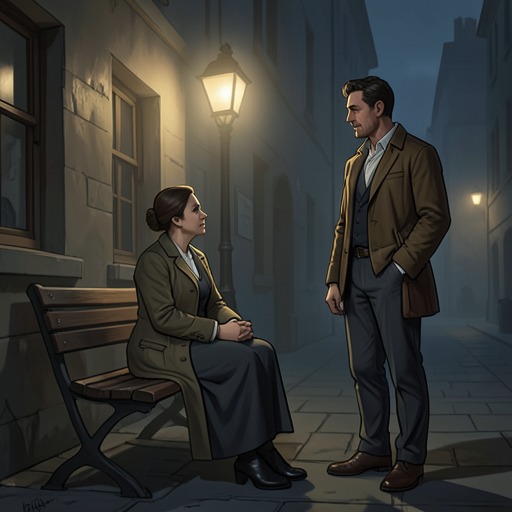
Oedipa Maas and Metzger’s affair
The Crying of Lot 49Oedipa Maas and Metzger’s affair is a fleeting intimacy whose abrupt disappearance becomes part of Oedipa’s mounting sense that the men around her are being stripped away. Metzger leaves her a note disclaiming any relationship beyond their official role as co-executors, while the larger mystery she pursues keeps drawing her back toward Pierce Inverarity’s estate. The affair offers no settled explanation: its ending is both a personal loss and another occasion for Oedipa to wonder whether apparently separate lives have been arranged around her.
The Affair and Its Uncertain Terms
The evidence presents the affair through Oedipa’s retrospective accounting rather than through a sustained courtship narrative. At one point, during her encounter with Stanley Koteks at Yoyodyne, she uses the name Kirby from a message on a latrine wall as a conspiratorial password. The notice had invited readers to contact Kirby through W.A.S.T.E.; Oedipa copies the address and an unfamiliar symbol into her memo book. Metzger is present in the surrounding episode, but the available details do not establish that the message has any connection to their intimacy. Its importance to the relationship is instead structural: Oedipa’s private life unfolds alongside a search in which coincidence and deliberate connection remain hard to distinguish.
The affair is also set against the novel’s growing network of signs. When Genghis Cohen examines a stamp, Oedipa recognizes the W.A.S.T.E. symbol in its watermark. Later she follows a W.A.S.T.E. carrier across San Francisco, Oakland, and Berkeley after depositing a sailor’s letter in a green collection box marked with the initials. These episodes do not demonstrate that Metzger belongs to the secret postal network. They show the investigative world pressing around Oedipa while the personal relationship recedes, its meaning increasingly filtered through the same uncertainty that governs her inquiry.
The Elopement and the Estate
After returning from her journey, Oedipa learns that Metzger has left with Serge’s teenage girlfriend to marry in Nevada. Serge admits that his story about an eight-year-old child had so far been imaginary, though he says he is hanging around playgrounds in hope of news. Metzger, meanwhile, has left a note on the television in Oedipa’s room. It tells her not to worry about the estate: he has transferred his executorship to a firm, which will contact her, and the arrangement has been settled with the probate court.
The note narrows the relationship in strikingly formal terms. Metzger says nothing to recall that he and Oedipa had been more than co-executors. Oedipa concludes that this must mean that was all they were. Her response is not the classically scorned reaction she expects of herself; she has other concerns pressing on her. The affair’s ending therefore arrives not as a confrontation or negotiated separation, but as a note that recasts intimacy as an administrative partnership and a departure that leaves no clear account of what had passed between them.
Loss and Paranoia
When Oedipa later considers the disappearance of the people who have guided or accompanied her, she places Metzger among a series of losses. Her husband, Mucho Maas, is taking LSD and withdrawing into what she imagines as the endless rooms of his own self; Dr. Hilarius has gone mad; and her guide back to the Tristero, Randolph Driblette, has died by suicide. Metzger, in her compressed account, has eloped with a fifteen-year-old. The list makes the affair’s ending one strand in a broader pattern of broken connection, not an isolated romantic disappointment.
Oedipa’s suspicions then take on a more disturbing shape. She discovers that the shopping center containing Zapf’s Used Books and a surplus store, as well as the Tank Theatre, belonged to Inverarity. She reasons that every route to the Tristero can also be traced to his estate, and wonders whether the people she has encountered—including Metzger, Cohen, Driblette, Koteks, and the W.A.S.T.E. carriers—were Inverarity’s men, bought or loyal to a practical joke. The question remains speculation, not established fact. For the affair, however, the suspicion changes the frame: Metzger’s disappearance can be read as an ordinary abandonment, or folded into a pattern Oedipa fears may have been designed for her embarrassment or terror.
Significance
The relationship’s decisive feature is its unresolved status. Metzger’s note reduces it to co-executorship, while Oedipa’s later memory counts him among the men lost to her. Neither account supplies a definitive explanation of the affair’s emotional weight or its relation, if any, to Inverarity’s designs. That gap mirrors the novel’s central problem of interpretation: connections may disclose a hidden structure, or may be coincidences gathered into a pattern by someone desperate to understand what has disappeared.