Oedipa Maas and Randolph Driblette’s connection
The Crying of Lot 49Oedipa Maas and Randolph Driblette’s connection is both an artistic encounter and an investigative dependence: after seeing his production of The Courier’s Tragedy, Oedipa treats Driblette as her best possible guide to the play’s author and the Tristero mystery. His sudden death removes that guide, leaving her to wonder whether his unexplained changes to the script and his final walk into the Pacific were connected, while the story refuses to confirm either his motives or the answer she seeks.
The Director and the Search for an Author
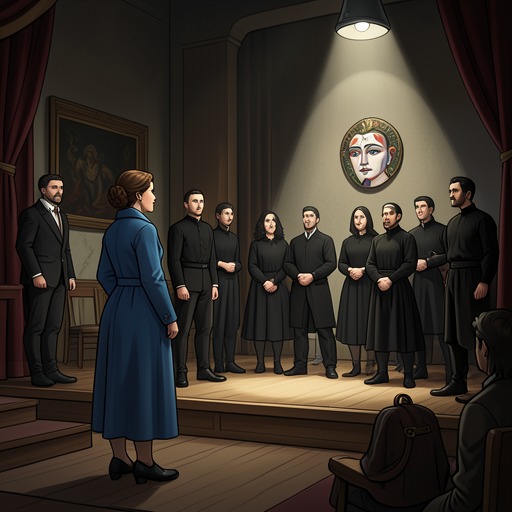
Oedipa’s connection to Driblette begins with his production of The Courier’s Tragedy at the Tank Theatre. Emory Bortz rejects the suggestion that the staging was pornographic and describes it instead as typically virtuous. In his account, Driblette was a peculiarly moral director: he felt little responsibility toward the written word as such, but remained intensely faithful to the invisible field, or spirit, surrounding a play. Bortz considers him exceptionally close to the historical Wharfinger and to the imaginative world that might have surrounded the author’s living mind.
That assessment gives Driblette special importance to Oedipa. Her investigation is not simply a search for the surviving text; she wants to know what the play can disclose about its author and about the hidden history she has begun to trace. Bortz’s description makes Driblette seem uniquely able to call up the historical Wharfinger for her—not through documentary certainty, but through a director’s intimate grasp of the play’s imagined world. He is therefore a possible interpreter as well as the person whose production first made the play’s significance urgent to her.
An Unanswered Question About the Production
The production’s importance to Oedipa is sharpened by her suspicion that Driblette altered the play. At the wake, she asks whether he used only the paperback for his script, recalling that the production contained material she wants to understand. The question bears directly on her effort to determine where the Tristero clues came from: whether they belong to the printed text, to Driblette’s staging, or to some less traceable source.
Oedipa has already tried to reach him. When Bortz speaks about Driblette in the past tense, she registers the shift and remembers the woman who had called her. The news is delivered at the wake: Driblette walked into the Pacific two nights earlier, wearing his Gennaro suit. Bortz adds that it happened shortly after the set of The Courier’s Tragedy was struck. Oedipa can think only that she had tried to call that morning. The brief failure of contact becomes final, and her unresolved question about the script can no longer be put to its director.
Death and the Loss of a Guide
Driblette’s death is part of a wider sense of separation for Oedipa. In an inward reckoning, she imagines her companions being stripped away one by one: her psychiatrist has gone mad, her husband is moving further into an LSD-induced separation from their shared life, her former lover has left with a fifteen-year-old, and now her best guide back to Tristero has died. Driblette’s loss thus has a specific consequence within her investigation, but it also joins a mounting sequence of disrupted relationships that leaves her asking where she belongs.
In the days following the death, Oedipa attends Driblette’s burial with Bortz, Grace, and graduate students. She hears his younger brother’s stricken eulogy and sees his mother weep; later that night, she returns to sit on the grave and drink Napa Valley muscatel, a wine Driblette had kept in quantity. At the grave, the investigative problem becomes personal. Oedipa wonders whether some version of herself vanished with him, and whether she might go on searching with mental capacities whose object has disappeared. Her imagined loss is not only of information but of a relationship that had made the search seem navigable.
The Questions His Absence Leaves Behind
At the grave, Oedipa tries to imagine receiving Driblette’s memories of their last night together, or even of his last five minutes, hoping they might tell her whether his walk into the sea had anything to do with Tristero. She also wonders whether he was removed for the same reason she imagines others around her have been removed, and admits to herself that she needed him. These are conjectures and wishes, not evidence of a plot against Driblette; the narrative gives Oedipa no confirming message from the dead.
She recalls Driblette’s earlier remark from the shower that she could fall in love with him, but cannot establish whether he and the girl who brought the news had been in love, or whether that girl knew why he changed the play. Oedipa considers many possible motives—sex, money, illness, despair, and the pressures of his historical moment—without settling on any. The same indeterminacy surrounds both the added lines and the suicide: she thinks that adding them may somehow have served as a rehearsal for his final departure, but this remains a possibility, not a revelation.
Significance and Unresolved Ending
Driblette’s role in Oedipa’s life is defined by the gap between interpretive promise and unavailable testimony. Bortz believes he could have brought the historical author within reach, while Oedipa needs him to explain the production and perhaps its connection to Tristero. His death makes that hoped-for explanation impossible. The reader is left with Oedipa’s questions rather than an authoritative account of his motives.
The uncertainty also unsettles the apparent boundary between artistic invention and historical evidence. Driblette’s changes might have linked the play to Oedipa’s investigation, but the narrative does not establish why he made them or whether he understood their significance. Oedipa calls to him inwardly and receives silence; she concludes that either she cannot communicate with him or he does not exist for her anymore. Their connection therefore ends not in a solved mystery but in an absence that keeps the mystery active.