Oedipa Maas and Wendell “Mucho” Maas’s marriage
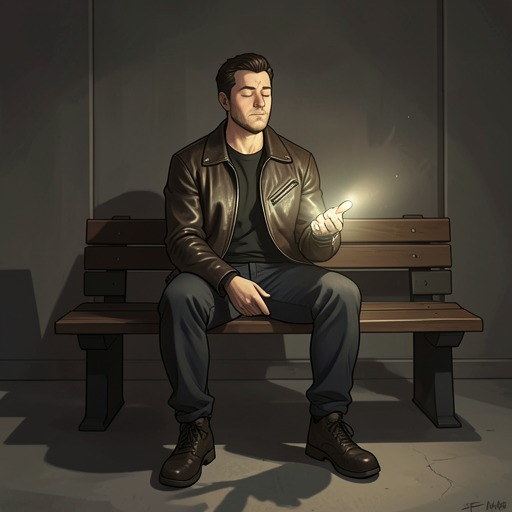
The Crying of Lot 49Oedipa Maas and Wendell “Mucho” Maas’s marriage is marked by a widening separation between Oedipa’s search for meaning and Mucho’s drug-induced conviction that individual identity dissolves into a shared human voice. Their final encounter gives that distance its most intimate form: Mucho describes a world of collective experience, while Oedipa recognizes that the husband she left behind has already become someone she can scarcely reach.
Identity and the Marriage’s Circumstances
Oedipa Maas and Mucho Maas are married, but the evidence presents their relationship at a moment of rupture rather than domestic stability. Oedipa has left for San Narciso to handle Pierce Inverarity’s estate and pursue the clues gathering around the Tristero. The marriage persists across that absence, but the investigation brings Oedipa into a pattern of increasingly consequential encounters, while Mucho’s own life is changing through his contact with Dr. Hilarius and LSD.
The contrast between their paths is not simply that Oedipa travels and Mucho stays behind. Oedipa’s inquiries lead her to suspect that people, places, and objects may belong to a hidden communications network; the uncertainty keeps her searching for connections she cannot verify. Mucho, by contrast, describes an experience in which the distinction between one person and another is itself disappearing. Each spouse is confronting a question of identity, but they arrive at it from opposite directions: Oedipa fears that the pattern around her may be a plot, while Mucho finds affirmation in the idea that separate lives can become one voice.
Separation and the Final Meeting
After the crisis at Dr. Hilarius’s clinic, Oedipa sees Mucho inside a KCUF mobile unit among the patrolmen, ambulances, searchlights, and staring crowd. He is on the scene as a broadcaster, speaking into a microphone. She climbs into the vehicle and greets him; he briefly presses the cough button and smiles before handing her the microphone and asking how she feels about the terrible event. The public emergency therefore becomes the setting for a private reunion, but the exchange does not restore ordinary intimacy. Even the smile seems strange to Oedipa when she wonders how it can be heard.
In their later conversation, Mucho explains that listening to advertising and music has led him to a vision of shared identity. He says that the voices heard in the same words have nearly identical power spectra, and imagines millions of people speaking the phrase “rich, chocolaty goodness” together as one voice. He extends the thought to the Beatles’ song “She loves you”: the singer’s “she” can be any number of people across time, and “you” can mean everybody, including herself. For Mucho, this is not a metaphor to keep at a distance. He tells Oedipa that this collective voice is what he is, too, and describes the human voice as a miracle.
Oedipa responds with alarm as well as impatience. She asks whether this is what Funch means when he says Mucho is coming on like a whole roomful of people. Mucho agrees, looking smooth and peaceful to her, but she feels that she does not know him. The more fully he describes his new conviction, the less available he seems as the particular person she loves and recognizes. Oedipa’s fear is thus not only a disagreement about his ideas; it is the perception that their shared life can no longer give her access to him.
LSD, Treatment, and the Changed Self
Mucho places a small, clear plastic bottle of pills on the table, and Oedipa recognizes them as LSD. He says that Dr. Hilarius supplied them after broadening his program to include husbands. Asked how long he has been taking the drug, he cannot remember. When Oedipa raises the possibility of addiction, Mucho rejects the comparison with conventional drug dependence: he takes LSD because it intensifies his experience of the world, which he finds abundant and without limit. He describes himself as an antenna sending a pattern across a million lives, which are also his own.
His account connects the drug to changes in how he hears and understands music. Songs, he says, do not merely communicate something; in their sound, they are something. He also reports that his dreams have changed. Oedipa responds sharply, bringing up the possibility of another woman, but Mucho denies that there is a girl and turns instead to a recurring nightmare from his time at the car lot. In the dream, an ordinary day would be interrupted by a metal sign identifying the dealership as a member of the National Automobile Dealers’ Association. The sign’s letters, N.A.D.A., also suggested “nada”; he would wake shouting. He says that the dream no longer bothers him.
The relief he describes does not reassure Oedipa. She remembers the nightmare, but concludes that Mucho will no longer be frightened as long as he has the pills. His improved relationship to the dream is inseparable from a broader change she experiences as his dissipation: the man at the table appears peaceful, yet less like the person who shared her life. She cannot quite absorb that the day she left for San Narciso was the last time she would see him in the familiar sense. His transformation is therefore both a change in his inner experience and a loss within the marriage.
Farewell and Unanswered Questions
When it is time for Mucho to return to the station, he points out that Oedipa could have the pills. Their exchange ends not in an agreement about his treatment or a resolution of their differences, but in the practical question of whether he will be arrested. Mucho says he will be a fugitive. At the station, they kiss goodbye, along with the others present; he walks away whistling a complicated, twelve-tone tune. Oedipa rests her forehead against the steering wheel and remembers that she never asked him about the Tristero cancellation on his letter. By then, she thinks, asking would make no difference.
The missed question gives the farewell a second, investigative meaning. Mucho might have offered information about a clue Oedipa is trying to understand, but the opportunity has passed alongside the possibility of reaching him as her husband. The marriage is not shown ending through a formal decision or a final argument. Instead, its separation becomes legible in Oedipa’s realization that Mucho has changed beyond her reach, and in the small unanswered matter she remembers only after he is gone.
The Marriage in the Tristero Pattern
Oedipa’s later reflection places her husband among the men who seem to be disappearing from her life as she investigates the Tristero. She thinks of her psychiatrist as having gone mad, her husband as moving farther into the endless rooms of himself on LSD, and her guides to the mystery as having vanished or become unavailable. The list is Oedipa’s account of her own losses, not independent proof that all these events belong to a single design. Its force lies in the way personal separation and investigative uncertainty accumulate together.
That uncertainty deepens when Oedipa discovers how many apparent routes to the Tristero can also be traced back to Pierce Inverarity’s estate. She wonders whether the people who have helped or crossed her are Inverarity’s agents, acting for money, loyalty, amusement, or a practical joke, and whether the clues instead point to a real alternative communications network. The evidence does not settle the question. Within that unresolved pattern, the marriage becomes one of the clearest measures of what Oedipa cannot confirm: Mucho is undeniably changed, but whether his transformation is simply his own, part of a larger network, or another source of paranoid interpretation remains beyond her knowledge.
The relationship’s ending therefore echoes the book’s central instability without resolving it. Mucho’s sense of shared voices offers a kind of expansive belonging, while Oedipa experiences its cost as the disappearance of the husband she knew. Their farewell leaves both the Tristero cancellation and the marriage’s future unanswered. What remains is a concrete asymmetry: Mucho walks away at peace with a world in which voices merge, while Oedipa sits alone with the question she did not ask and a pattern whose meaning she cannot establish.