Oedipa Questions Randolph Driblette About the Script and Trystero
The Crying of Lot 49Oedipa Questions Randolph Driblette About the Script and Trystero is the backstage encounter in which Oedipa seeks a textual source for the play’s disturbing Trystero references and instead confronts Randolph Driblette’s claim that performance, not a recoverable script, is where the play becomes real. His admissions clarify what he changed, but his refusal to treat words as definitive evidence leaves Oedipa with a sharper mystery rather than an answer.
The Inquiry Behind the Curtain
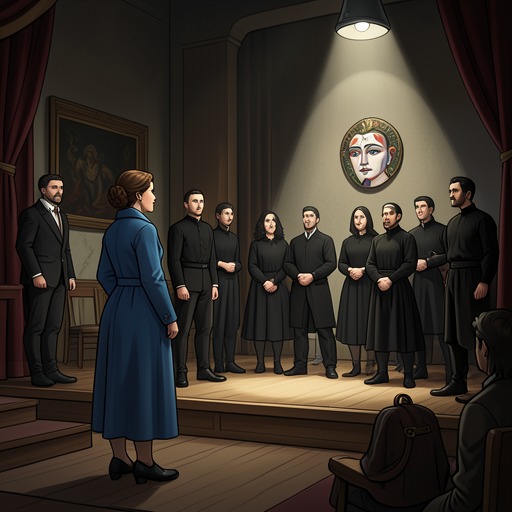
After The Courier’s Tragedy ends, Oedipa asks Metzger to come backstage with her because she wants to speak to Driblette, the play’s director and the actor who played Gennaro. Her investigation begins with a practical question: where did the play’s apparent knowledge of the Trystero come from, and what in the text accounts for the actors’ conspicuous reactions to it? Yet the request for a script is already shadowed by the performance she has just watched. The word Trystero had hung in the dark at the end of an act; the staged mystery has given her something to pursue before she knows what kind of evidence could settle it.
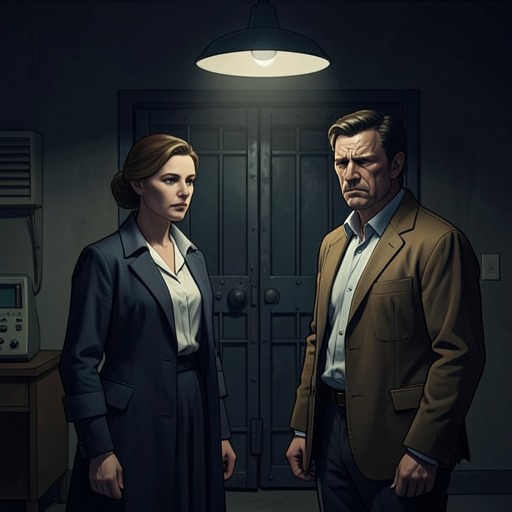
The encounter takes place in the backstage dressing and shower area. Driblette, still in Gennaro’s gray-flannel costume, offers Oedipa his arm to feel the fabric and remarks that he sweats in it, but that nothing else would really be Gennaro. The exchange makes the actor’s body part of the evidence: the role is not just a name in a script, but a person temporarily made present through costume, exertion, and performance. Oedipa watches Driblette’s bright black eyes as she tries to turn that presence back into information she can verify.
Searching for a Source
Driblette initially rejects Oedipa’s premise that the play should be treated as a significant literary document. He says it was written to entertain people, compares it to horror movies, denies that it means anything, and dismisses Wharfinger as no Shakespeare. When Oedipa asks who Wharfinger was, Driblette answers by turning the question back toward Shakespeare and the distance of the past. The exchange offers little biographical certainty; instead, it exposes the gap between Oedipa’s search for an authoritative source and Driblette’s deliberately casual account of the play.
Oedipa asks to see a script, though she does not know exactly what she expects to find. Driblette points her to a file cabinet beside the shower and goes to wash before the next group arrives. The drawer contains only purple, dittoed copies: worn, torn, and stained with coffee. When Oedipa calls out to ask what they were copied from, Driblette answers from the shower that the source was a paperback he found at Zapf’s Used Books near the freeway. It was an anthology called Jacobean Revenge Plays, with a skull on its cover; he cannot supply the publisher. This chain of transmission gives Oedipa a source to pursue, but not a pristine original or a dependable account of how the play reached the stage.
The material condition of the scripts matters to the scene’s uncertainty. What Oedipa can inspect is not an untouched text but a set of battered working copies, while the paperback that preceded them is identified through Driblette’s recollection. Her question about textual origins therefore produces a history of copies and performance rather than a single stable document. The attempt to move backward from stage to script leads only to another layer of mediation.
What Driblette Added
When Oedipa asks why everyone seems to be interested in texts, Driblette asks who else is involved. She answers too quickly, and the conversation shifts from the play’s material sources to the social atmosphere around its interpretation. Driblette tells her not to drag him into scholarly disputes, addressing an indistinct group as “you whoever you all are.” Oedipa recognizes his smile as the same knowing expression he had coached the cast to exchange whenever the Trystero assassins came up. The expression links the backstage conversation to the staged one, making the actors’ shared look seem either like a deliberately planted clue or a theatrical gesture that has escaped its original context.
Oedipa asks whether the look was written as a stage direction or was one of Driblette’s touches. He admits that it was his, and that he also brought the three assassins onstage in the fourth act, although Wharfinger had not shown them. The admission gives her a concrete answer about the performance’s construction: at least two of its most suggestive Trystero-related effects came from Driblette, not the surviving play as he describes it. It does not establish why he added them, whether he was drawing on another source, or whether the additions point to anything beyond his own interpretation.
The Play as Performance
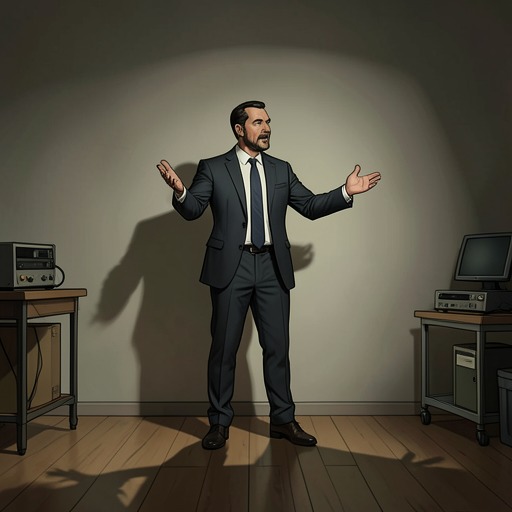
Driblette becomes angry at what he sees as Oedipa’s fixation on words. He argues that the play does not exist in the file cabinet or in the paperback she seeks, but in his head: the actor’s task is to give the spirit flesh. In his account, words are remembered sounds that help an actor pass the barriers around memory; the reality of the play emerges through the performer and the bounded world of the stage. He casts himself as the source projecting that small theatrical universe through his mouth and eyes. The theatrical claim is also a limit placed on Oedipa’s method: if the performance’s reality depends on Driblette, the printed text cannot by itself explain everything she saw.
When Oedipa asks what made him feel differently from Wharfinger about the Trystero, Driblette’s face vanishes back into the steam. Oedipa had not wanted to say the word, and she notices that he has created offstage the same atmosphere of ritual reluctance that surrounded it in the performance. His reaction intensifies the ambiguity. It could suggest that the subject carries weight for him; it could also be part of the same theatrical control through which he shaped the audience’s perception. The scene does not resolve which possibility is true.
Driblette imagines himself dissolving in the shower and being washed down the drain into the Pacific; if he disappeared, he says, the version of the play Oedipa saw would disappear with him. What would remain, in his thought experiment, would be only whatever Wharfinger had not lied about: perhaps Squamuglia and Faggio, perhaps the Thurn and Taxis mail system, perhaps the Adversary. Even those surviving elements would be mere traces, fossils without value or potential. He thus distinguishes between historical remnants and the living imaginative reality he claims to have made onstage, while leaving Oedipa no clear means of separating one from the other.
The Unsettled Exit
Driblette argues that Oedipa could fall in love with him, consult his psychiatrist, or hide a tape recorder in his bedroom, and still fail to reach the truth by collecting clues and constructing one or more theories about the characters, the assassins, or the black costumes. Wharfinger supplied words and a story; Driblette gave them life. His point is not simply that the performance differs from the text, but that the investigator’s accumulation of evidence may never touch the reality she wants to recover. He offers no source for his own additions and no account that would settle whether the Trystero is historical, theatrical, or both.
Oedipa calls after him and says she will call; he briefly reappears, unsmiling, and says they could do that. She leaves the backstage area and only outside realizes that she had gone in to ask about bones and instead they had talked about the Trystero. In the nearly deserted parking lot, she watches Metzger’s headlights approach and wonders how accidental the turn in conversation had been. The question carries the scene’s unresolved tension into the next episode: Driblette may have redirected her, or the topic may have emerged because the play and her investigation had already made it difficult to avoid.
The encounter changes the status of Oedipa’s evidence without disproving it. She learns that Driblette inserted the three assassins and their knowing look, and that the scripts in the drawer descend from a paperback anthology rather than an identified authoritative original. At the same time, Driblette denies that textual research can recover the performed world he created. Oedipa leaves with facts about how the production was made, but without a reliable boundary between the play’s inherited material and the director’s additions—a distinction on which her attempt to trace the Trystero depends.