Oedipa’s paranoid uncertainty
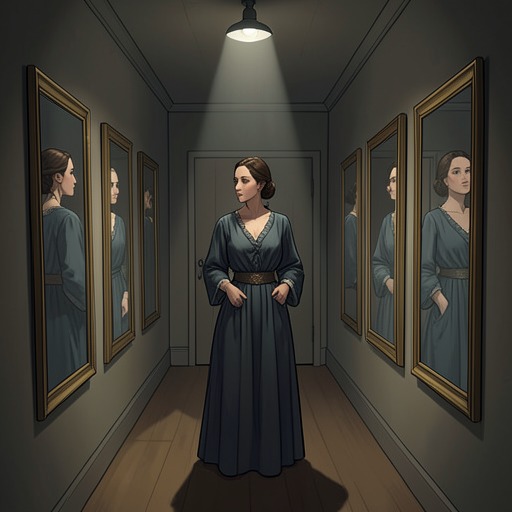
The Crying of Lot 49Oedipa’s paranoid uncertainty is the state of suspended judgment at the center of her investigation: evidence repeatedly suggests that the Tristero is real, yet the same evidence can be folded into an explanation in which Pierce Inverarity engineered an immense private hoax. The uncertainty is not resolved by the novel’s accumulating clues. Instead, as the possible network expands and its links to the estate become harder to ignore, Oedipa is forced to confront two explanations—and the fear that either one may be true.
Signs and Connections
The investigation begins to acquire a material shape through objects and coincidences. In a restroom, Oedipa finds a neatly lettered notice inviting interested people to contact Kirby through W.A.S.T.E., followed by a box number in Los Angeles. Beneath it is a faint symbol formed by a loop, triangle, and trapezoid. She copies both the address and the mark into her notebook. At first she considers whether the notice is sexual, but doubts that interpretation; the symbol remains an unexplained sign rather than a settled clue.
At the Yoyodyne plant, Oedipa encounters Stanley Koteks doodling the same sign. She tests the coincidence by claiming that Kirby sent her, but Koteks slides the envelope he has been drawing on into a drawer. The episode offers a suggestive connection while withholding confirmation of what the sign means or what Koteks knows. The pattern is compelling precisely because its apparent links do not amount to an explanation.
A stamp supplies a further recurrence. While examining material from Inverarity’s collection, Genghis Cohen shows Oedipa the W.A.S.T.E. symbol appearing as a watermark, black and slightly right of center. The mark now connects the restroom notice and Koteks’s doodling to a physical object in the estate’s stamps. Cohen is cautious: he has referred the items to a committee, and friends who have seen them are also proceeding carefully. The watermark makes the pattern harder to dismiss as a single chance encounter, but it does not establish who made the stamp or why the mark is there.
A Network in Plain Sight
Oedipa’s uncertainty intensifies when she acts on the postal system rather than merely collecting its symbols. Under a freeway she finds an old green trash can, nearly four feet high, with a swinging trapezoidal top and the initials W.A.S.T.E. painted on it. She drops a sailor’s letter addressed to Fresno into the box, then waits. A young man arrives, unlocks a side panel, and removes the letters. Oedipa follows him as he crosses Market Street, changes sacks with another carrier near City Hall, returns along Market, and buys a bus ticket to Oakland. She buys one too.
The pursuit continues through Oakland and onto a Berkeley bus. The carrier’s sack gradually empties; he eventually leads Oedipa to a pseudo-Mexican apartment house where John Nefastis lives. The trail brings her back to a person and place already involved in her search, making the postal route look less like a stray sign than part of a connected system. Yet the episode is still bounded by what Oedipa personally witnesses: she follows one carrier and sees exchanges, but does not learn who directs the routes, how extensive the network is, or what its organization claims to be.
The apparent connections become more troubling when Oedipa reviews the estate’s assets. Inverarity owned the shopping center containing Zapf’s Used Books and Tremaine’s surplus store, as well as the Tank Theatre. The possible routes to the Tristero, she realizes, can also be traced back to the estate. Emory Bortz teaches at San Narciso College, which Inverarity heavily endowed; other people involved in the investigation—including Metzger, Cohen, Driblette, Koteks, the tattooed sailor, and the W.A.S.T.E. carriers—could, in Oedipa’s fear, all be Inverarity’s employees or willing collaborators. These are questions she asks herself, not established disclosures that they were bought or recruited.
The Four Explanations
Oedipa tries to sort the apparent pattern into alternatives, but each account creates a different form of dread. She may have stumbled, without drugs, onto a hidden network through which Americans communicate while reserving their routine deceptions and spiritual poverty for the official delivery system. The network might even provide an alternative to the felt absence of surprise in ordinary life. In that account, W.A.S.T.E. is not a prank but evidence of a concealed social reality.
A second explanation makes the same evidence an enormous plot: forged stamps and old books, surveillance, post-horn images scattered through San Francisco, bribed librarians, professional actors, and financing drawn from the estate. The scheme would be so elaborate that, even if intended as a practical joke, it would seem to demand a meaning beyond embarrassment or terror. Oedipa also recognizes that this explanation could itself be fantasy. Her remaining possibility is that she is hallucinating the whole pattern and is mentally ill. She does not know how to distinguish a real conspiracy from an imagined one mounted against her.
The alternatives do not remain an abstract puzzle. Oedipa hopes that mental illness is the explanation, because it would at least make the experience a condition she could name. Instead, she becomes numb and feels unable to rely on anyone for help. She endures sleepless nights, sometimes sleeps for eighteen drugged hours, struggles to attend to estate business, and suffers episodes of nausea, headaches, nightmares, and menstrual pain. She even gives the name Grace Bortz when seeking a pregnancy test and then misses her follow-up appointment. Her physical and practical distress shows the cost of uncertainty without proving whether the threat is external or internal.
The Estate and the Hidden Other
Inverarity’s possible role keeps changing in Oedipa’s mind. He might have financed a conspiracy against her, or discovered the Tristero himself and encoded it in his will so she would find it. She also considers whether the will was meant to harass a former mistress, or whether Inverarity somehow sought to survive death as a paranoia. None of these possibilities is confirmed. His death remains compatible with both an ordinary explanation—he simply died—and Oedipa’s suspicion that the estate has been arranged to deliver her into a mystery.
Yet the possibility that the Tristero is real opens beyond Inverarity. If San Narciso and the estate are no different from any other town and estate, Oedipa reasons, she might have encountered the network anywhere in the Republic, through any of its lightly concealed entrances. She imagines abandoned Pullman cars, squatters, drifters, roadside walkers, and people sleeping amid telephone wires as possible members of a dispersed community, though she cannot establish that they are connected. The figure of the network expands from a suspected organization into a question about people who seem exiled within the country they inhabit—and about what, if anything, they might inherit.
This imaginative expansion does not relieve the uncertainty; it raises its stakes. Oedipa wonders whether the probate judge could recognize a legacy shared among nameless people, and whether she might be condemned as a redistributionist for proposing it. She even considers that she could be drawn into the Tristero’s own twilight and waiting if it exists. The possibility that the network carries a different inheritance remains inseparable from the possibility that she is projecting significance onto scattered signs and dispossessed lives.
Binary Choices and an Open Ending
The pressure of the mystery takes the form of a repeated either-or. Oedipa sees possible meanings arranged like zeroes and ones: behind the hieroglyphic streets there may be transcendent meaning, or only the earth; a pattern may contain truth, or merely a power spectrum. At Vesperhaven House, there may be a dignified accommodation with death, or only death and its tedious preparations. Applied to her own investigation, the alternatives are either a true paranoia or a real Tristero. If there is no Tristero beyond the appearance of Inverarity’s legacy, there is only America; Oedipa wonders whether she could then remain relevant to it only as an alien, caught in the very paranoia she fears.
Her uncertainty is therefore not simply a failure to solve a puzzle. Each explanation organizes the same signs into a different world, while no decisive test arrives to establish which world she occupies. Near the end, she hears that the mysterious client she has been trying to identify will attend the stamp auction in person and may be encountered there. The prospect of a meeting points toward possible clarification, but the evidence presented leaves the central choice unresolved: the Tristero may be a genuine clandestine network, a conspiracy tied to Inverarity, or an interpretation Oedipa cannot verify from within her own increasingly unstable search.