Pony Express
The Crying of Lot 49The Pony Express is a nineteenth-century mail service whose image becomes one of the clues through which Oedipa Maas tries to understand Tristero. It appears in a story told by an elderly resident, in a marker commemorating a deadly encounter, and on a stamp bearing a suspicious watermark and engraved detail. In the account later pieced together by Oedipa and Emory Bortz, the service’s western routes also provide the setting against which Tristero’s concealed messengers supposedly operated. The novel’s scattered references make the Pony Express at once a recognizable institution and a measure of how little its records can settle about the past.
Historical Context and Postal Competition
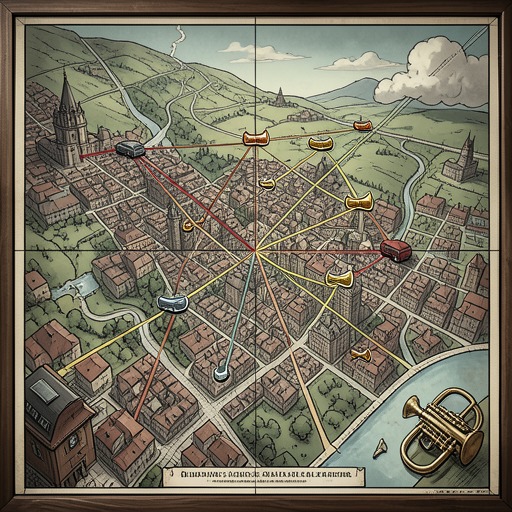
In a conversation about private mail delivery, Mike Fallopian places the Pony Express within a longer conflict over who could carry the mail in the United States. His historical research connects the American Civil War with postal reforms that began around 1845. He argues that federal measures suppressed surviving independent routes and were designed to drive private competitors toward financial ruin. The account makes postal delivery more than a matter of transportation: control of the routes becomes an instance of institutional power.
Bortz later extends this interpretation to Tristero’s supposed arrival in America. He says that the federal government’s rate reductions around 1845 put most independent routes out of business, leaving little room for refugees arriving from Europe in 1849–50 to resume private mail operations openly. In his reconstruction, Tristero did not disappear but changed its opposition: by 1861, while the Pony Express was crossing the West, Tristero’s messengers allegedly trained in Siouan and Athapascan dialects and traveled disguised as Indigenous people. Bortz characterizes the method as silence, impersonation, and opposition disguised as allegiance. This is his account of a clandestine rival, not an independently verified history of the Pony Express.
Stories and Historical Traces
The Pony Express enters Oedipa’s investigation first through memories and fragmentary public evidence. At an old people’s home, Mr. Thoth recalls dreaming about his grandfather, who rode for the Pony Express during the gold-rush era. The grandfather’s horse, he remembers, was named Adolf. Mr. Thoth’s recollection leads Oedipa to ask about attacks on riders, joining a family story to the mystery of hostile messengers.
A bronze marker at Fangoso Lagoons supplies another account. It says that, in 1853, a dozen Wells, Fargo men fought masked marauders in black uniforms; a post rider was the only witness, and died soon afterward. The marker records a cross traced in the dust by one of the victims and says the attackers’ identities remain unknown. Oedipa wonders whether the mark was a cross or the initial T, recalling the letter associated with Tristero in The Courier’s Tragedy. The marker gives her a possible connection, but its lone witness, unresolved attribution, and uncertain sign leave the connection open to doubt.
Mr. Thoth’s recollection offers a more intimate but no more conclusive trace. He says his grandfather described nighttime attackers whom he called false Indians, and produces a signet ring said to have been taken from one of them. The WASTE symbol appears on the ring. The family memory thus seems to link the Pony Express era’s stories of masked raiders with Oedipa’s present-day clues, but the ring and the old man’s account do not independently establish who the attackers were or what organization they belonged to.
Stamps, Watermarks, and the Present-Day Mystery
The Pony Express also appears as an image on a 1940 United States commemorative stamp that Genghis Cohen examines for Oedipa. Cohen uses tweezers, benzine, a black tray, and a magnifying glass to inspect its watermark; Oedipa sees the WASTE symbol on the stamp. This material clue echoes the sign she has encountered elsewhere, turning an official-looking postal object into another possible carrier of secret meaning.
Cohen then shows her an apparently old German stamp marked Thurn und Taxis. He identifies it as a counterfeit, not an error, and says that he has found eight stamps, each containing an intentionally worked-in mistake. One bears the image of a Pony Express rider galloping away from a western fort, with a single black feather painstakingly engraved in the shrubbery ahead of him. Another has the transposed wording U. S. Potsage. The deliberate defects resemble messages or taunts, but Cohen cannot say who made the stamps or why. Their combination of Pony Express imagery, postal emblems, and anomalies gives Oedipa further material for her theory without resolving its authorship.
The Pony Express as Counterpoint
In Oedipa’s provisional account, Tristero’s history extends from its opposition to the Thurn and Taxis postal system in Europe to a supposed American campaign against the Pony Express and Wells, Fargo. She imagines its earlier messengers as outlaws in black or as people disguised as Indigenous travelers; she also connects the organization to a present-day California network. Yet the account remains conditional. Its supporting traces include a marker with an unknown enemy, an elderly man’s recollections, a ring, suspicious stamps, and documents gathered from scattered sources.
The Pony Express is therefore a useful counterpoint in the novel’s investigation of communication and power. Its routes stand for a visible, named mail service, while Tristero’s alleged routes are hidden behind disguises, coded signs, and uncertain testimony. At the same time, the supposed clandestine network is reconstructed through the very materials that preserve and circulate information: a commemorative stamp, a watermark, a marker, and remembered stories. The contrast never settles into a confirmed history. Instead, the Pony Express helps expose the gap between a public record and the secret alternative Oedipa fears she may be discovering.