Randolph Delbright suicide
The Crying of Lot 49Randolph Driblette’s suicide is disclosed at a wake as both a concrete loss and an unanswered question. He walked into the Pacific two nights before Oedipa Maas learned of his death; the timing followed the striking of the set of The Courier’s Tragedy, but neither the reason for his suicide nor its possible connection to Tristero is established. Driblette’s absence removes a guide Oedipa had hoped could bring her closer to the play’s hidden history, leaving her investigation with fewer witnesses and no reliable explanation.
The news at the wake
Oedipa encounters the news while asking whether what she had seen at Tank Theatre was pornographic. Emory Bortz instead describes Driblette as a peculiarly moral man, faithful not merely to the words of a play but to its invisible surrounding spirit. He suggests that Driblette, more than anyone else he knew, might have summoned the historical Wharfinger that Oedipa wants to understand. The praise makes Oedipa’s realization that Bortz is speaking of Driblette in the past tense the turning point of the exchange.
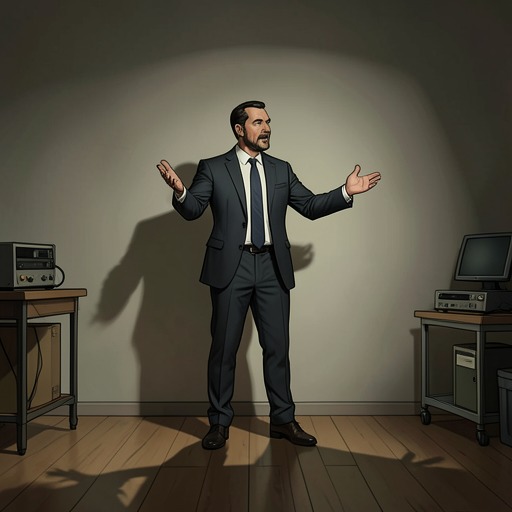
The others look toward Oedipa when she asks about that tense. A young woman finally tells her that Driblette walked into the Pacific two nights earlier, wearing his Gennaro suit, and that the gathering is a wake. The girl’s eyes had been red, and the news recasts the gathering Oedipa has entered: it is not a conversation with her absent source but a mourning for him. Oedipa can think only that she tried to call him that morning.
Bortz places the death after the set of The Courier’s Tragedy had been struck. The temporal sequence is specific, but it does not explain the act. Oedipa’s response also marks a change in her habitual questioning: where a month earlier she would have asked why, she now stays silent, waiting for some illumination that does not arrive.
The loss of a guide
Driblette’s death has an immediate consequence for Oedipa’s search. She had regarded him as her best guide back to Tristero, in part because his performance of The Courier’s Tragedy had included two additional lines whose source and purpose remained unclear. His death makes it impossible for her to ask him directly what he intended or whether he understood the significance of what he had inserted. What had seemed like a question of theatrical choices becomes inseparable from the loss of the person who might have answered it.
Oedipa experiences the death as part of a wider unmaking of the people around her. In her private account, her therapist has gone mad, her husband is withdrawing under the effects of LSD, and Metzger has eloped with a fifteen-year-old. Driblette’s death completes the immediate pattern she perceives: the people who might have helped her interpret events are disappearing, changing, or becoming inaccessible. The passage gives this pattern as Oedipa’s distress, not as evidence of a coordinated cause.
In the days after the news, Oedipa moves between libraries and discussions with Emory Bortz and Genghis Cohen, worrying somewhat about their security in light of what has happened to the others she knows. The investigation continues, but Driblette is no longer available to join it. His burial becomes part of this aftermath: the remaining companions can accompany him to the grave, but they cannot restore the conversation she wanted to have.
Burial and unanswered questions
The day after reading Blobb’s Peregrinations, Oedipa attends Driblette’s burial with Bortz, Grace, and graduate students. She hears his younger brother’s helpless eulogy and sees his mother crying in the afternoon smog. That night, she returns to sit on the grave and drink Napa Valley muscatel, which Driblette had once stored by the barrel. The sequence moves from public mourning to Oedipa’s solitary effort to imagine a continuing connection with the dead man.
At the grave, she wonders whether some version of herself vanished with Driblette. She imagines that her mind might continue working with capacities that no longer exist, like an amputee’s sense of a missing limb, and considers whether she might eventually replace what has gone by means of an external substitute. These possibilities express her fear of loss; they do not establish that the death has altered her in any supernatural or literal way.
Oedipa tries to imagine receiving Driblette’s memories of his last night, or at least his final five minutes, so she could learn whether his walk into the sea had anything to do with Tristero. She asks herself whether those responsible for the removal of Hilarius, Mucho, and Metzger might also have been responsible for Driblette’s death, but the suspicion remains a question in her mind. The evidence supplies no confirmation that anyone caused or arranged his suicide.
She recalls Driblette’s earlier words from the shower, in which he had said that she could fall in love with him, and wonders whether he and the young woman at the wake had been in love. She also asks whether the young woman knew why Driblette had added the two lines, and whether Driblette himself knew. Oedipa’s questions multiply rather than converge: sex, money, illness, despair, and the history of his time and place are all possible elements, but no one can trace a motive. The change to the script, like the suicide, remains without a clear explanation.
Meaning without confirmation
Oedipa briefly imagines that adding the two lines might have served Driblette as a rehearsal for his final walk into the Pacific. The thought offers a possible connection between the theatrical alteration and the death, but she cannot verify it. She waits for a sign that the image she has imagined has reached her, calls Driblette’s name inwardly, and receives silence. The scene ends not with a revelation about his motive but with the possibility that communication is impossible—or that there is no continuing presence to answer.
That failure echoes the book’s larger uncertainty about the relation between signs, interpretation, and intention. Driblette had been presented as unusually faithful to a play’s spirit, yet even he cannot now explain what his own additions meant or whether they anticipated anything. Oedipa is left with the script, the timing of his death, and her own interpretations, none of which can settle the question. His suicide therefore closes off a potential source of testimony while making the uncertain relation between Tristero, performance, and personal motive more pressing.
Event classification
The death is disclosed retrospectively in a scene at Driblette’s wake: the narration follows Oedipa’s encounter with the news, while the young woman reports that he walked into the Pacific two nights earlier. His suicide is classified as a death event in the main narration, with no identified narrator separate from the novel’s impersonal third-person narration. It reveals that Driblette is dead and that his death followed the striking of The Courier’s Tragedy set; it does not reveal why he died or confirm a connection to Tristero.