Stanley Koteks
The Crying of Lot 49Stanley Koteks is a Yoyodyne engineer whose encounter with Oedipa Maas joins two apparently separate systems of secrecy: the company’s appropriation of its engineers’ inventions and the clandestine W.A.S.T.E. postal network. He is a useful source of technical and organizational information, but not a reliable guide to the network’s meaning. His concealed doodling, sharp criticism of corporate “teamwork,” and abrupt refusal to discuss W.A.S.T.E. give Oedipa concrete connections to follow without resolving whether those connections form a coherent plot.
Identity and Introduction
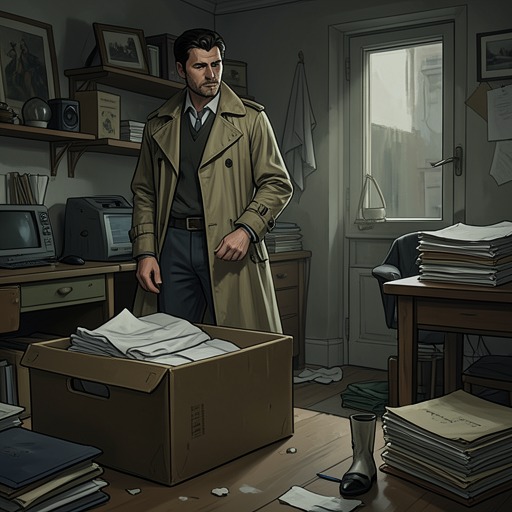
Koteks appears after Oedipa gets lost during a tour of the Yoyodyne plant. She has wandered away from a mockup of a space capsule into an expanse of fluorescent offices, where engineers look up as she passes but do not speak. After several minutes of growing panic, she comes upon Koteks, who at first glance seems too young to work there. He is wearing wire-rim bifocals, sandals, and argyle socks, but it is his activity that distinguishes him: he is not working, but doodling with a thick felt pencil.
The scene introduces Koteks as both an employee inside a highly organized industrial workplace and someone momentarily turned away from its official tasks. When Oedipa greets him, she impulsively says that Kirby sent her—a name she has just seen on a ladies’ room notice inviting readers to make contact through W.A.S.T.E. Koteks slides the large envelope he has been doodling on into a drawer and shuts it. He asks whether she is lost, then notices her badge. The act of concealing the envelope precedes Oedipa’s knowledge of what he has drawn, making his desk a small, suggestive threshold between routine corporate space and an unspoken alternative.
Work and Grievance
Oedipa presents herself as a Yoyodyne stockholder, and Koteks immediately asks whether she can influence company policy or make suggestions that will not be discarded. She lies that she can, wanting to see where the exchange leads. Koteks names his grievance: he wants the company to drop its clause on patents. Under the Yoyodyne contract, he explains, every engineer gives up the patent rights to any invention he may produce. In his view, the arrangement stifles creative engineers, wherever they may be.
His objection is not merely to a single contract term. When Oedipa asks whether employees are allowed to speak so critically, Koteks attacks “teamwork” as a means of avoiding responsibility and calls it a symptom of society’s gutlessness. His complaint turns the company’s cooperative language inside out: the collective enterprise, as he sees it, does not reward shared effort but dissolves individual accountability and claims the products of individual ingenuity. Oedipa’s brief, false claim to influence policy lets him make that conflict explicit, while offering no evidence that she can change it.
The patent dispute also gives Koteks a connection to the Nefastis Machine. He tells Oedipa that John Nefastis, now at Berkeley, is someone who still invents things, and produces a Xeroxed copy of the machine’s patent. The drawing shows a box marked with a bearded Victorian figure, with pistons connected to a crankshaft and flywheel. Koteks’s account identifies the figure as James Clerk Maxwell and explains Maxwell’s Demon: a hypothetical intelligence that sorts fast-moving air molecules from slow ones, producing a temperature difference that could drive an engine without apparent work. The machine thus arrives in their conversation not as an abstract reference but as a patented invention, an example of what an engineer can make—and, in Koteks’s complaint, of the creativity the company’s contract threatens to contain.
W.A.S.T.E. and the Limits of Disclosure
The W.A.S.T.E. name enters Koteks’s story before Oedipa meets him. On a ladies’ room wall she has seen an invitation addressed to people seeking “sophisticated fun,” directing them to contact Kirby through WASTE at a Los Angeles box number. Beneath it is a faint symbol made of a loop, triangle, and trapezoid. Oedipa copies the address and mark into her memo book. At the time she suspects the notice might be sexual, but doubts that interpretation of the symbol.
At the plant, her improvised claim that Kirby sent her prompts no explanation. Later, Koteks gives her the address of Nefastis, first saying Berkeley and then correcting himself to San Francisco; he adds that Nefastis lives somewhere along Telegraph. Oedipa asks whether the WASTE address is no longer good, pronouncing the acronym as the ordinary word “waste.” Koteks’s expression hardens. He insists on the initials, with their periods, and tells her they should not go further into it. When she says she saw the name in a ladies’ room, he stops engaging with her, opens a book, and advises her to forget it.
That shift from conversation to refusal is the clearest evidence of Koteks’s guarded relationship to W.A.S.T.E. He has already let slip that he knows a current address associated with Nefastis and is alert to Oedipa’s recognition of the initials, but he neither confirms his own membership nor explains the organization. His warning makes the name feel consequential while withholding the information that would establish why. The distinction between WASTE as a word and W.A.S.T.E. as an acronym becomes a boundary: Oedipa has stumbled across a sign, but Koteks will not tell her what lies beyond it.
The Network Around Him
Koteks’s importance to Oedipa’s investigation rests partly on the way his clues can be followed and partly on the way they remain uncertain. The symbol from the ladies’ room reappears as a watermark on a stamp in the collection associated with Pierce Inverarity. Oedipa recognizes it when Genghis Cohen swabs the stamp with benzine and sets it on a black tray. The recurrence links the bathroom notice to a material object among the stamps, but it does not establish that Koteks supplied the stamp or explain the organization behind the mark.
Another route leads from the W.A.S.T.E. mailbox to a carrier Oedipa tails across San Francisco and Oakland and then to a Berkeley bus. The carrier eventually leads her to the pseudo-Mexican apartment house where Nefastis lives. This pursuit returns her to the inventor Koteks had named, making his earlier technical information part of the same accumulating web of places and people. Yet the links remain uneven: Koteks provides a name and an address, the carrier supplies a route, and the watermark supplies a repeated emblem. None, by itself, proves that the people involved are acting together.
That uncertainty becomes acute when Oedipa revisits the Inverarity estate. She discovers that Pierce owned the shopping center containing Zapf’s Used Books and Tremaine’s surplus store, as well as the Tank Theater; she also notes that Emory Bortz teaches at a college heavily endowed by Pierce. In the same spiral of suspicion, she asks herself whether Bortz, Metzger, Cohen, Driblette, Koteks, the tattooed sailor, and the W.A.S.T.E. carriers might all be Pierce’s men—bought, loyal, or participating in an elaborate practical joke. This is Oedipa’s conjecture, not a fact established about Koteks. His presence in that list shows how readily a genuine clue can become part of a much larger theory once the apparent routes to Tristero also lead back to Inverarity’s property and influence.
Narrative Role and Significance
Koteks is neither a simple corporate informant nor a confirmed representative of W.A.S.T.E. He supplies unusually concrete information about Yoyodyne’s patent clause and the design and principle of the Nefastis Machine, but becomes guarded when Oedipa asks about the postal initials. The contrast makes him a hinge between two forms of hidden structure: an openly signed contract that transfers engineers’ patent rights, and a clandestine communications system whose operation remains obscure.
His scene also demonstrates the difference between discovering a pattern and proving its cause. Koteks’s envelope, his knowledge of Nefastis, his insistence on the punctuated acronym, the watermark Oedipa later recognizes, and the carrier’s journey toward Nefastis all give her investigation substance. But the available evidence does not show that Koteks caused the later discoveries, controls the mail network, or belongs to a conspiracy organized by Pierce. His narrative force lies in that unresolved position: he opens a door with information, closes it with a warning, and leaves Oedipa to decide whether the connections she can trace describe an actual system or the shape her suspicion gives to coincidence.