The Auction of Inverarity’s Stamp Collection
The Crying of Lot 49The Auction of Inverarity’s Stamp Collection brings Oedipa’s investigation to the threshold of a public test without providing its answer. After learning that an unknown, unusually secretive bidder may be trying to keep the Tristero forgeries from unauthorized hands, she goes to the sale of lot 49 to discover who he is. The auction room closes around her as the sale is about to begin; the novel ends before the lot is cried and before the mystery is resolved.
Background and Stakes
The auction is part of the final disposition of Pierce Inverarity’s stamp collection. Genghis Cohen tells Oedipa that the Tristero forgeries are to be sold as lot 49. The designation turns a private collection into the immediate focus of her search: the stamps may be artifacts of an underground postal system, but the sale could also place them in the hands of an unknown buyer.
The possibility of a hidden network has accumulated through fragments of postal history and suggestive signs. Mike Fallopian’s research connects the American Civil War with the postal reforms begun around 1845, arguing that federal efforts suppressed surviving independent routes and drove private competition toward financial ruin. At Fangoso Lagoons, a historical marker recounts an 1853 attack on Wells, Fargo men by masked marauders in black; the only witness died soon afterward, and the account says that the attackers’ identities remained unknown. Oedipa wonders whether a cross traced by a victim might instead be the initial T, echoing a mark in The Courier’s Tragedy. These details do not prove a single explanation, but they give the postal clues an American history of competition, suppression, and uncertain evidence.
Emory Bortz offers a possible account of the Tristero’s survival. In his interpretation, Tristero’s members, arriving in America after the European reaction of 1849, found a postal system in which independent carriers had little room to compete. By the Civil War, he argues, they had changed their opposition rather than joined the Union cause: their messengers crossed westward disguised as Indigenous people, learning Siouan and Athapascan dialects, while the organization emphasized silence, impersonation, and opposition disguised as allegiance. This account gives the bidder’s secrecy a political context, but it remains part of the history Oedipa is trying to assess, not a confirmation of the bidder’s identity.
The Mysterious Bidder
Cohen explains the distinction between floor bidders, who attend in person, and book bidders, whose bids are submitted by mail and entered in the auction firm’s book. The people represented by book bids are not publicly identified. This ordinary practice of concealed identity makes the unknown bidder difficult to distinguish from any other private client; what makes this case exceptional is the secrecy reported by the bidder’s agent.
The agent, C. Morris Schrift, is described as reputable. He has told the auctioneers that his client wants to examine lot 49 before the sale and is prepared to pay the postage and insurance and return it within twenty-four hours. The auctioneers would normally allow an advance examination when the prospective buyer is known, but Schrift will not disclose his client’s name and says only that the person is an outsider. The auction house refuses the request. The attempt to inspect the stamps therefore establishes a concrete point of contact between the unknown buyer and the lot, but it supplies no name and no direct proof of motive.
Cohen’s inference is that the client may be from Tristero, may have seen lot 49 described in the catalogue, and may want to keep evidence of Tristero’s existence out of unauthorized hands. Oedipa already has much the same suspicion when she asks what Cohen thinks. The hypothesis raises the stakes of the auction: the sale might transfer evidence, expose it, or allow someone associated with the suspected network to control it. Yet even this seemingly plausible explanation depends on reading secrecy as evidence, the very interpretive move that has accompanied Oedipa’s investigation throughout.
Oedipa Decides to Attend
After Cohen reports that the mysterious client has decided to attend the auction in person, Oedipa contacts Schrift herself. He offers no identifying information, only the possibility that she may encounter the client at the sale. The answer converts the bidder from a distant name concealed behind an agent into a person who may be present in the same room, without making that person any easier to recognize.
The next day, Oedipa goes to the auction alone, arriving a few minutes early. The sale takes place on a Sunday afternoon in what is perhaps the oldest building in San Narciso, a structure dating from before World War II. In the lobby she meets Cohen, who is embarrassed to admit that he has been tempted by some Mozambique triangle stamps. His small confession contrasts with Oedipa’s purpose: she has not come to collect stamps or bid, but to watch for the stranger.
When Cohen asks whether she has come to bid, Oedipa says she is only being a busybody. The label is pointedly modest beside the extraordinary weight she has placed on the sale. She is not certain how she will act if the bidder reveals himself. She has only a vague idea of provoking a scene serious enough to bring the police and identify the man that way, and she wonders whether she would actually go through with it. Her plan is neither a reliable investigation nor a settled decision; it exposes how little control she has over the encounter she has come to force.
The Sale Begins
Before entering the auction room, Oedipa whispers to a man that his fly is open. She is still uncertain what she will do when the bidder appears. The small, practical remark precedes her return to the larger question of whether she can turn suspicion into proof; neither gesture nor intention resolves it.
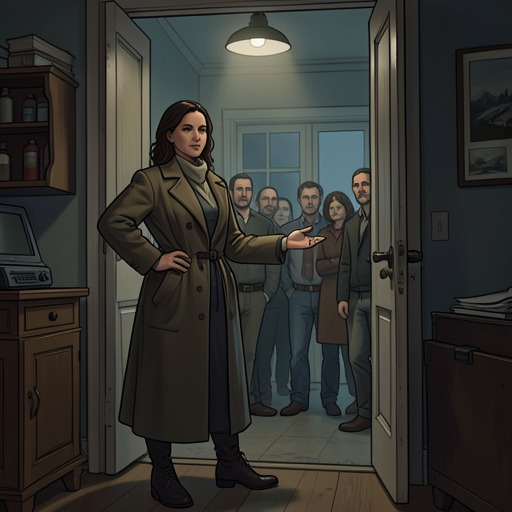
Cohen offers his arm and says it is time to start. Inside, men in black mohair watch Oedipa as she enters, each trying to conceal his thoughts. Loren Passerine stands at the podium, his practiced smile fixed on her. Oedipa reads his expression as though it might mean that he is surprised she has come, but it does not establish what he knows. She sits alone toward the back, studying the backs of the other attendees and trying to guess which one might be her target, her enemy, or her proof. Those possibilities remain superimposed: the bidder could be an adversary, a source of evidence, or simply one more person whose significance she cannot verify.
An assistant closes the heavy door between the lobby and the auction room. The lock snaps shut, shutting out the lobby windows and the sunlight as well as separating Oedipa from the space she has just occupied. Passerine spreads his arms in a gesture Oedipa associates with a distant ritual, and the auctioneer clears his throat. The sale is ready to begin, but the narrative stops at Oedipa’s wait for lot 49 to be cried. No bidder is identified, and the sale’s outcome is withheld.
Significance and Unresolved Ending
The auction gathers the novel’s competing possibilities into a single event. Lot 49 may be evidence of an actual clandestine postal network; the anonymous client may be acting to protect it; or Oedipa may be assigning coherence to clues that cannot establish a final account. The auction’s conventional procedures—catalogue, sealed identities, agents, postage, insurance, and a public sale—offer a setting in which a hidden organization might leave a trace, yet those same procedures preserve anonymity and restrict what can be known.
The ending therefore turns the sale into a test that begins but does not yield a verdict. Oedipa reaches the room where she expects the mystery to become visible, but the suspected bidder remains indistinguishable among the attendees, and the lot has not yet been cried when the book closes. The unresolved pause preserves both the possibility of revelation and the possibility that the signs will not add up to a provable whole.