The Tank
The Crying of Lot 49The Tank is a small arena theater in San Narciso and the venue for the Tank Players’ production of The Courier’s Tragedy. Oedipa Maas arrives expecting a play and leaves with a question: a name heard in the theater, Trystero, has entered her search for a possible hidden postal network.
Setting and Production
The Tank lies between a traffic analysis firm and a temporary wildcat transistor outfit, a setting that places the theater amid the shifting commercial landscape of San Narciso. The company performing there is known as the Tank Players. Their audience is only partly filling the house when Oedipa and a reluctant Metzger arrive, and it has not grown by the time the performance begins.
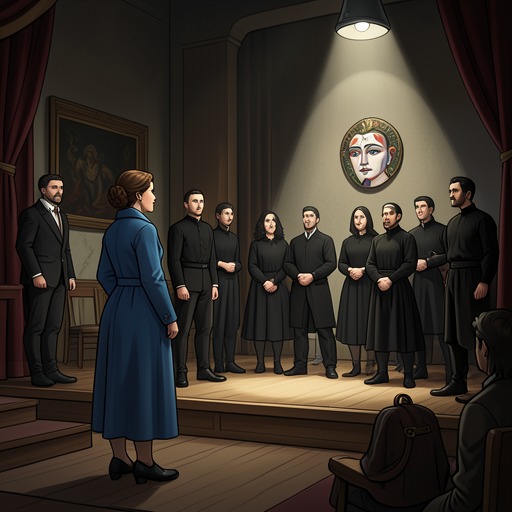
The production nonetheless commands Oedipa’s attention. Its costumes are gorgeous and its lighting imaginative; although the actors speak in a transplanted Middle Western stage version of British English, within five minutes she is absorbed in the landscape Richard Wharfinger made for his seventeenth-century audience. The theater thus becomes a place where an elaborate, remote stage world can take hold in a sparsely attended modern room.
The Play and Its Stage World
The performance presents a court poisoned by ambition and violence. The evil Duke of Squamuglia has murdered the good Duke of Faggio by poisoning the feet of an image of Saint Narcissus, which the Duke regularly kisses at Mass. The illegitimate Pasquale then rules as regent for his half-brother Niccolò, the rightful heir, while plotting to kill him. In the second act, a prolonged torture and murder of a prince of the church is interrupted by schemes to turn public opinion against Pasquale; the play also recounts how the Lost Guard, about fifty knights of Faggio, vanished near the Squamuglia frontier before the good Duke was poisoned.
The Tank’s theatrical intensity is punctured by a small, unplanned response: when the lights go out, someone across the arena says, “Ick.” Metzger asks whether Oedipa wants to leave. She refuses, saying she wants to find out about the bones, and waits through the play for the fourth act. The episode sets her curiosity against the audience member’s dismissal and Metzger’s wish to go, making her attention to the play’s strange details the immediate reason she stays.
Trystero and Oedipa’s Investigation
At the end of an act, the word Trystero hangs in the dark. It puzzles Oedipa, though its power over her has not yet taken hold. The name is not resolved within the theater; its appearance instead turns the performance into an investigative lead, linking the play’s invented court history to the clues Oedipa is pursuing beyond the stage.
The fifth act shifts from intrigue to an anticlimactic bloodbath: Gennaro visits the court of Squamuglia with an array of violent deaths, including a lye pit, land mines, and a trained falcon with poisoned talons. Metzger later compares the sequence to a Road Runner cartoon in blank verse. Nearly everyone onstage is left dead, with the colorless administrator Gennaro among the few survivors. This grotesque theatrical ending contrasts with the unresolved significance of Trystero, which remains the detail Oedipa carries out of the performance.
Backstage and Dramatic Function
The program identifies Randolph Driblette as both director and the actor playing Gennaro, the winner at the end of the bloodbath. Oedipa asks Metzger to come backstage because she wants to speak with Driblette; he is anxious to leave and waits in the car. After watching him disappear, she circles the annular corridor twice before choosing a door in the shadowed space between two overhead lights.
Inside, a girl wiping fake blood from her face directs Oedipa toward a brightly lit mirror area. Oedipa passes through the crowded, unsettled backstage space until she reaches Driblette, still in his gray Gennaro costume, and tells him the performance was great. The route from dark auditorium to illuminated dressing room carries her from watching a mystery unfold to pursuing the person who staged it. The Tank is therefore both a performance venue and the first concrete setting in which Oedipa tries to question the play’s maker about the clue that has caught her attention.