Tristero’s Guerrilla Campaign Against Thurn and Taxis
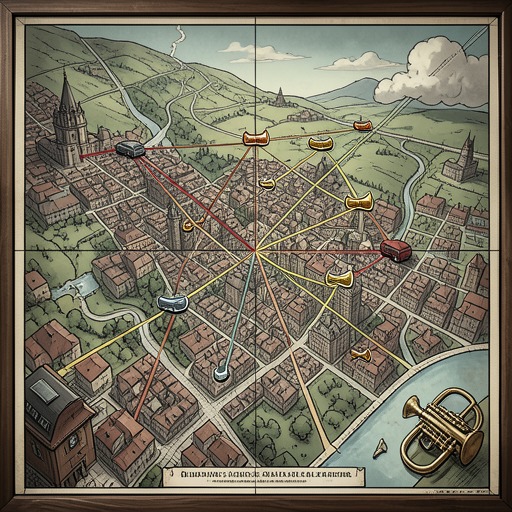
The Crying of Lot 49Tristero’s Guerrilla Campaign Against Thurn and Taxis is the origin story of a private struggle over succession that develops into an underground attack on a powerful postal monopoly. Reconstructed by Oedipa Maas from scattered historical and literary sources, it makes the muted post horn and Tristero’s later clandestine communications part of a longer history of dispossession, opposition, and adaptation.
Political and Postal Background
The campaign’s setting is the Netherlands during the Dutch Revolt. In 1577, after nine years of conflict with Catholic Spain and the Catholic Holy Roman Emperor, the Protestant noble William of Orange entered Brussels at the invitation of the Committee of Eighteen. The committee, made up of Calvinist hardliners, argued that the Estates-General had ceased to represent skilled workers and had lost contact with the population. It established a Brussels Commune, took control of the police, directed the Estates-General’s decisions, and removed holders of high office.
Among those displaced was Leonard I, Baron of Taxis, the hereditary Grand Master of the Post for the Low Countries and executor of the Thurn and Taxis monopoly. The committee replaced him with Jan Hinckart, Lord of Ohain and an adherent of Orange. This political upheaval destabilized control of the postal service and created the opening for Tristero’s claim. The dispute is thus not simply a family quarrel: it centers on who has the right to administer a major communications network, and on how political power can confer or remove that right.
Tristero’s Claim and Campaign
Hernando Joaquín de Tristero y Calavera claimed that he was Hinckart’s cousin, descended from the Spanish and legitimate branch of the family, and the true lord of Ohain. On that basis, he asserted that Hinckart’s possessions—including his new appointment as Grand Master of the Post—rightfully belonged to him. The account leaves Tristero’s character uncertain: he might have been mad, an honest rebel, or a con artist. His disputed identity and inheritance claim remain inseparable from the cause he pursued.
From 1578 until Alexander Farnese retook Brussels for the Emperor in March 1585, Tristero waged what the historical account calls a guerrilla war against Hinckart, if the two men were in fact cousins. As a Spaniard, Tristero attracted little support, and his life was repeatedly in danger. He nevertheless made four unsuccessful attempts to assassinate Orange’s postmaster. The change in the political order eventually dispossessed Hinckart, and Farnese restored Leonard I as Grand Master, but the restoration did not immediately reestablish the monopoly’s former stability.
The Thurn and Taxis operation was weakened by political and financial pressures. The Emperor Rudolph II, wary of the Bohemian branch’s strong Protestant sympathies, temporarily withdrew his patronage, and the postal enterprise fell deeply into debt. The account suggests that Tristero may have recognized the opportunity created by this weakened, continent-spanning system. Rather than abandoning his claim when the political balance changed, he appears to have redirected it into an independent postal organization.
Organization, Signs, and Methods
Tristero is portrayed as an unstable public figure who might appear at a public gathering and begin speaking. His recurring subject was disinheritance: he argued that the postal monopoly belonged to Ohain by right of conquest, and that Ohain belonged to him by right of blood. He called himself El Desheredado, or The Disinherited. The name turns a personal claim into the defining identity of a movement whose followers, in his account, shared exile and exclusion.
His followers wore black, which represented the night—the only possession he said remained to them in exile. The organization’s imagery also included the muted post horn and a dead badger depicted with all four feet in the air. One proposed explanation links Taxis to the Italian word tasso, meaning badger, and to badger-fur hats worn by early Bergamascan couriers; the text presents this as an explanation some people offered, not as a settled fact. These signs give the campaign a recognizable identity while associating it with the postal routes it sought to obstruct.
Tristero’s methods shifted from personal attempts on a political opponent to a covert campaign along the monopoly’s infrastructure. His followers carried out obstruction, terror, and depredation on the Thurn and Taxis routes. In Oedipa’s later reconstruction, this history anticipates a much more concealed style of opposition: by the nineteenth century, Tristero’s American messengers are described as disguising themselves as Indigenous people and as emphasizing silence, impersonation, and the appearance of allegiance to the very system they opposed. The connection suggests a movement that survived by altering its methods rather than preserving one visible form of revolt.
Later Echoes and Uncertain History
Oedipa’s account is assembled from sources that do not offer a single authoritative record: obscure philatelic journals supplied by Genghis Cohen, a footnote in Motley’s Rise of the Dutch Republic, a pamphlet on anarchism, sermons by Blobb’s brother Augustine, and clues in Blobb’s own book. The history therefore reaches the reader as a reconstruction, pieced together from fragments and qualified claims. Even its founding figure’s identity and motives remain open to competing explanations.
The later traces make that uncertainty consequential. At Fangoso Lagoons, a historical marker describes an 1853 attack in which twelve Wells, Fargo men fought masked marauders in black uniforms; the only witness was a post rider who died soon afterward, and one victim left a cross—or perhaps a T—traced in the dust. Oedipa connects the mark to the T associated with Tristero in The Courier’s Tragedy, but the marker does not establish who the attackers were. Elsewhere, a W.A.S.T.E. notice and a symbol on a lavatory wall, Stanley Koteks’s concealed doodle, and a watermark Oedipa finds on a 1940 Pony Express stamp turn the campaign’s postal imagery into clues in her investigation. The signs recur, but their recurrence does not by itself prove who made them or whether every apparent link belongs to one coordinated organization.
The campaign’s central opposition is consequently both political and interpretive. Tristero claims inheritance from a system that excludes him, then attacks that system’s routes; its later descendants, as reconstructed in the account, continue by hiding within or imitating official communications. Yet the same chain of clues can be read as evidence of a real alternative network or as material gathered into a pattern by Oedipa’s increasingly uncertain inquiry. The campaign supplies a historical model for clandestine resistance, but the book preserves doubt about how confidently that model can explain the present.