Tristero’s War Against Jan Hinckart and the Thurn and Taxis Postal System
The Crying of Lot 49Tristero’s War Against Jan Hinckart and the Thurn and Taxis Postal System is the account of a disputed inheritance that became a clandestine struggle over control of postal authority. From 1578 until 1585, Hernando Joaquín de Tristero y Calavera opposed Jan Hinckart and the Thurn and Taxis monopoly through repeated assassination attempts and a campaign of obstruction along its routes; the conflict also gave Tristero’s followers the symbols and language of exile that recur in the organization’s later history.
Political Upheaval and a Disputed Inheritance
The conflict begins amid the political upheaval of 1577 in the Low Countries. After William of Orange entered Brussels, the Committee of Eighteen established a commune that displaced officials and challenged the Estates-General. Leonard I, Baron of Taxis, hereditary Grand Master of the Post and executor of the Thurn and Taxis monopoly, lost his position to Jan Hinckart, an adherent of Orange. The change in office created the opening around which Tristero built his claim.
Tristero presented himself as Hinckart’s cousin from the Spanish branch of the family and as the rightful lord of Ohain. On that contested genealogical basis, he claimed an inheritance that included Hinckart’s new appointment as Grand Master. The account leaves his legitimacy unresolved: he may have been a madman, an honest rebel, or a con artist. His war therefore rests on a claim that is central to his cause but never established as fact.
The Campaign Against Hinckart
From 1578 until Alexander Farnese retook Brussels for the Emperor in March 1585, Tristero pursued what the narrative calls a guerrilla war against Hinckart. He received little support because he was Spanish, and his life was often in danger. He nevertheless attempted four times to assassinate Orange’s postmaster; all four attempts failed.
The campaign unfolded while the Thurn and Taxis system itself faced political and financial instability. After Farnese displaced Hinckart, Leonard I was reinstated. Meanwhile, Emperor Rudolph II had withdrawn his patronage for a time because of the Bohemian branch’s strong Protestant leanings, and the postal operation fell deeply into debt. The weakened monopoly offered a possible opening for a rival system, though the account presents Tristero’s perception of that opportunity as conjectural rather than certain.
From Inheritance Claim to Underground Opposition
Tristero’s public theme was disinheritance. Calling himself El Desheredado, or the Disinherited, he argued that the postal monopoly belonged to Ohain by right of conquest and that Ohain belonged to him by right of blood. His followers wore black, a color he associated with the night—the only possession left to exiles. The muted post horn and an image of a dead badger joined this visual language; the badger’s association with the name Taxis is offered as one explanation for the emblem.
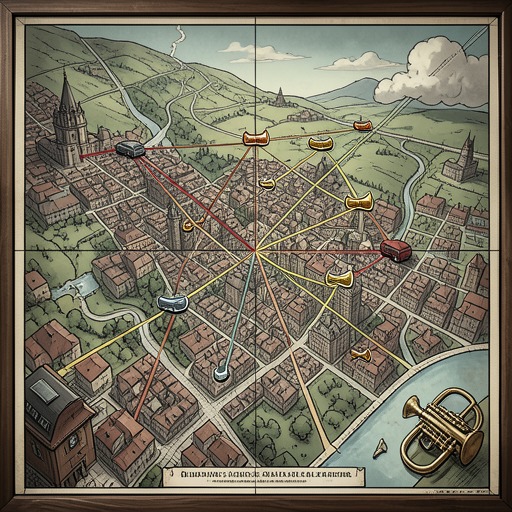
Tristero then turned the inheritance dispute into an organized assault on the established routes, beginning a covert campaign of obstruction, terror, and depredation. The war is thus not simply a contest between two claimants to office: it is also the point at which Tristero’s demand for recognition takes the form of a competing postal network designed to undermine the monopoly whose authority he claimed by right.
Later Echoes and Historical Significance
The novel reconstructs this episode much later through fragments assembled by Oedipa Maas from philatelic journals, historical writing, an anarchist pamphlet, sermons, and clues gathered by Diocletian Blobb. That layered account keeps the organization’s origins uncertain even as it supplies a detailed chronology. The dispute over one appointment becomes an origin story for a tradition of clandestine communication and opposition.
The later American history attributed to Tristero echoes the original conflict without simply repeating it. After its members fled to America in 1849–50, they faced a country where postal reform and federal suppression had already weakened private mail carriers. By 1861, according to Emory Bortz’s reconstruction, Tristero had adapted: its messengers disguised themselves as Indigenous people, learned Siouan and Athapascan dialects, and carried mail west while presenting opposition as apparent allegiance. These later tactics give the European war a broader significance: Tristero’s survival depends on changing its methods as official power shifts, while preserving the founding language of dispossession and resistance.