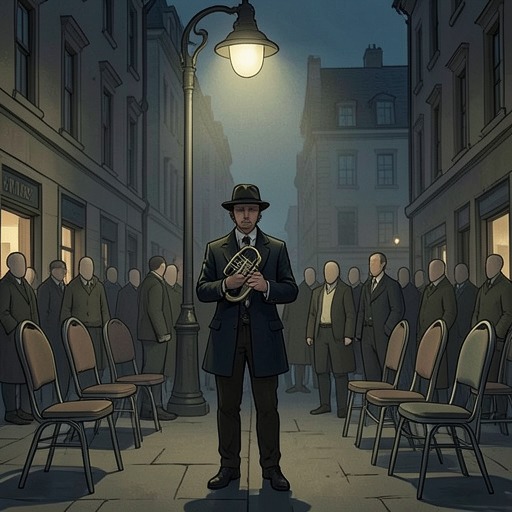
W.A.S.T.E. mailbox
The Crying of Lot 49The W.A.S.T.E. mailbox is the visible collection point of a clandestine postal route: an old green can beneath a freeway, marked with the initials W.A.S.T.E. Oedipa finds it after a distressed sailor asks her to deliver a letter to his estranged wife in Fresno. She deposits the letter, then follows the carrier who retrieves the accumulated mail, tracing a chain of handoffs that carries her across San Francisco and Oakland to Berkeley. The mailbox gives material form to a communication system that otherwise reaches her through signs, rumors, and scattered encounters, but following its mail does not resolve who controls the network or where it ultimately leads.
Discovery and Physical Form
The mailbox enters Oedipa’s search through a sailor’s request. She meets him in a rooming house, where he explains that his wife is in Fresno and gives Oedipa a letter he appears to have carried for years. He cannot make the delivery himself and tells her that she will find a W.A.S.T.E. receptacle under the freeway. The instruction is practical but incomplete: Oedipa is new to the area and does not know where the mailbox is, while the sailor offers only the direction and the assurance that there is always one.
After an hour searching among the freeway’s concrete supports, Oedipa finds a can with a swinging trapezoidal top, nearly four feet high and painted old green. The initials W.A.S.T.E. are hand-painted on its lid, with periods between the letters visible only on close inspection. Its ordinary appearance—an object used to throw away trash—conceals a different function. The mailbox is neither an official post box nor an elaborate piece of equipment; its unremarkable shape and exposed location make the secret route legible only to someone who knows what to seek.
The Letter and the Route
Oedipa waits in the shadow of a column near the can. She sees a child drop a bundle of letters into it, then adds the sailor’s letter to Fresno. Later, a young carrier arrives with a sack, unlocks a side panel, and removes the mail. Oedipa gives him a head start and follows him, turning the mailbox from a destination into the starting point of a moving postal trail.
The carrier crosses Market Street and heads toward City Hall, where he meets another carrier and exchanges sacks. Oedipa chooses to continue after the one she had been following. He returns along Market Street, reaches the trans-bay bus terminal, and buys a ticket to Oakland; Oedipa boards as well. There, she tracks him through neighborhoods she cannot identify, along busy roads and up hills lined with houses. As his sack gradually empties, he boards a Berkeley bus. Halfway up Telegraph, he gets off and leads her to an apartment building. Oedipa recognizes it as the place where John Nefastis lives. The route has carried her back to a person already connected to her investigation, without making clear whether this return is a meaningful link or an unsettling coincidence.
Network, Signs, and Uncertainty
The mailbox belongs to a wider pattern of clues that Oedipa has begun to associate with underground mail. At the Scope, she recalls that a historical marker at Fangoso Lagoons described a 1853 attack on Wells, Fargo men by masked marauders. The sole witness had reported a cross traced in the dust, and one victim had also left a cross; Oedipa wonders whether the mark could instead be the initial T, recalling a sign in The Courier’s Tragedy. Elsewhere, a W.A.S.T.E.-like symbol appears on a bathroom wall, and the same emblem turns up as a watermark on a stamp in Pierce Inverarity’s collection. These repetitions encourage her to connect the mailbox to Tristero, but their recurrence does not, by itself, establish how the clues relate.
The historical account Oedipa hears supplies a possible political background for an independent mail network. Mike Fallopian is researching private mail delivery in the United States and sees a relationship between the Civil War and postal reforms beginning around 1845. He regards the suppression of surviving independent routes as a parable of power. Later, Emory Bortz describes Tristero as having adapted to official pressure: after its European history and migration to America, it allegedly persisted in conspiracy, using impersonation and apparent allegiance as cover. The mailbox’s use as a discreet alternative channel fits that account, although Oedipa’s investigation never makes the organization’s full structure certain.
Meaning and Narrative Role
The mailbox converts an abstract possibility—mail delivered outside authorized channels—into a concrete object and a sequence of observable actions. A concealed mark can prompt speculation, but here letters actually enter the can, a carrier retrieves them, and sacks pass from one person to another. The physical route offers evidence of operation while withholding a comprehensive explanation: Oedipa can follow one delivery chain but cannot infer from it alone the identity, scale, or ultimate purpose of the people involved.
That tension shapes the mailbox’s importance in Oedipa’s search. Her act of delivering the sailor’s letter is an ordinary service to someone unable to carry it himself; her decision to follow the carrier turns that service into an investigation. Yet the trail’s endpoint at Nefastis’s apartment does not settle the mystery. The mailbox therefore functions both as a genuine point of communication and as a test of interpretation: it brings Oedipa closer to a working network, while leaving her unable to distinguish a coherent hidden system from a set of signs whose connections remain uncertain.