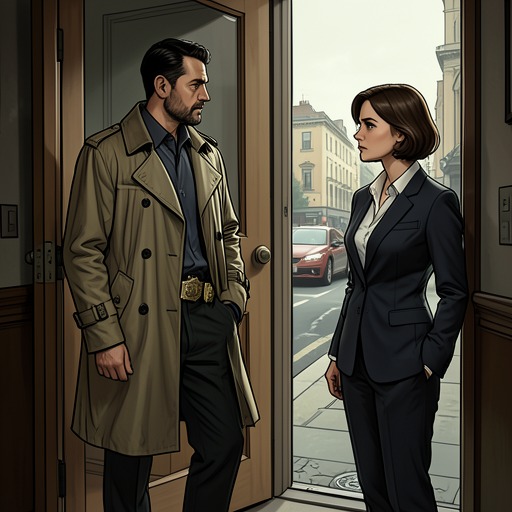
Confrontation and arrest of John Bristow
The Cuckoo's CallingThe confrontation and arrest of John Bristow is the climax of Cormoran Strike’s investigation: a case that began with disputed witness accounts and a death treated as suicide ends with Strike confronting the murderer, identifying evidence in his mother’s safe, and surviving Bristow’s attempt to kill him. The struggle puts the detective’s reconstruction of the crime to its final test, while the safe’s combination links Bristow’s present deception to the death of Charlie Bristow years earlier.
From disputed accounts to a reconstructed crime
The confrontation rests on clues that had first appeared as gaps and inconsistencies in other people’s accounts. Eric Wardle’s recollection of the night included Derrick Wilson’s entry into Lula Landry’s flat with a master key. Later, Strike asked Wilson to retrace the order in which he had searched the rooms. On the stairs, Wilson remembered slipping backward on drops of water—an incident he had forgotten until the route was physically retraced. The detail gave Strike a concrete trace to incorporate into his reconstruction, rather than relying only on witnesses’ changing stories.
Strike had also questioned the account surrounding Tansy Bestigui’s sighting of Lula falling past a window. The police file mentioned cocaine in the Bestiguis’ bathroom, but Strike’s sharper concern was the seconds immediately after the fall and the uncertain positions of Tansy and Freddie Bestigui. Tansy repeatedly maintained that Freddie had been asleep in bed, yet Strike did not consider either Bestigui’s location at the crucial moment established. The apparent solidity of Freddie’s statement did not settle the question; the apartment’s layout and the sequence of events still needed testing.
The decisive reconstruction supplied a reason for Wilson’s otherwise puzzling trace. Strike concluded that John had taken several white roses from a vase in Flat Two, dried their stems, and carried them upstairs to Lula’s flat. Some water remained on the stems and fell onto the stairs, where Wilson later slipped. The flowers were not merely a prop in the approach to Lula’s door: their water connected John’s route through the building to Wilson’s recovered memory, turning a small physical detail into part of the explanation of how the crime had been staged.
The safe and the attack
When John insisted that Strike had no proof, Strike answered that the police should by then have a warrant to search his mother’s safe. John scoffed at the prospect of a search for a discarded hoodie, but Strike clarified that the safe was the object of the search and revealed that he had given the police combinations to try. He singled out 030483 as the most likely code. The exchange makes the confrontation a contest over what counts as proof: John treats the missing hoodie as an insurmountable weakness, while Strike directs attention to a recoverable object that John has retained and protected.
John lunged at Strike with a knife. In the dark office, Strike tried to control John’s wrist while struggling to locate the weapon; John’s weight and the cramped space left Strike at a disadvantage. The fight moved across the room, and the desk was knocked over as Strike tried to get free. His prosthetic leg came loose during the struggle, further limiting his movement. The scene’s stakes shift abruptly from the interpretation of clues to immediate survival: Strike’s reasoning has exposed John, but it cannot by itself prevent him from attacking.
As John raised the knife again, Strike seized his prosthetic leg and used it to strike him. Robin arrived in time to shout for Strike to stop, warning that he would kill John. Strike rolled away from John, who was no longer moving, and dropped the prosthesis. Robin was already telephoning for the police and an ambulance. Her arrival interrupts the assault and converts the scene from a private confrontation into an emergency response; the account records a call for help, not the details of John’s subsequent custody.
Evidence, arrest, and aftermath
The epilogue takes place ten days later. The British Army has cut short Lieutenant Jonah Agyeman’s second tour in Afghanistan because the Metropolitan Police urgently require him in Britain, and the death of his sister has attracted international attention. Strike meets Jonah at the Tottenham pub after the arrest of his sister’s murderer. The public may imagine Jonah returning to expect wealth, but Strike finds him still in shock, a contrast that keeps the consequences of Lula’s death in view even after the suspect has been confronted.
Jonah asks whether John will escape conviction. Strike reassures him, explaining that the newspapers do not yet know that the police found Rochelle Onifade’s mobile phone in his mother’s safe. John had reset the safe’s code so that only he could open it. Strike identifies the combination as 030483: Easter Sunday, 1983, the day John killed Charlie. The clue revealed during the office confrontation thus gains its full evidentiary meaning in the epilogue: the safe concealed not only a connection to Rochelle’s death but also a date that memorialized John’s earlier crime.
The scene’s resolution is therefore more than the defeat of an attacker. Strike’s reconstruction turns overlooked traces—the water from the roses, Wilson’s forgotten slip, and the safe’s combination—into a coherent account that the police can pursue through physical evidence. At the same time, the ending preserves a consequence beyond the arrest: Jonah has been brought back from Afghanistan amid public attention and grief, while Robin is withdrawing from the case and the work. The investigation closes, but its effects remain unsettled for those left behind.