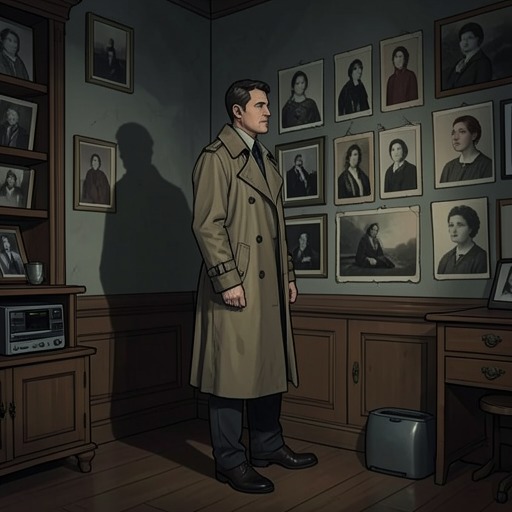
Deleted photo files from Lula’s laptop
The Cuckoo's CallingThe deleted photo files from Lula Landry’s laptop are a recovered collection of 212 social photographs, removed on March 17 and restored from the computer’s hard drive by Strike’s technician, Spanner. Their contents are ordinary rather than incriminating, but their unexplained deletion gives them investigative importance: the photographs connect Lula to a wide social circle and prompt Strike to ask who might have wanted them removed.
Recovery and the Significance of Deletion
While examining Lula’s laptop, Spanner noticed that a large photo file had been deleted on March 17. He explained that software could recover material people assumed had vanished from a hard drive, and gave Strike a memory stick containing the recovered files. The deletion had been performed casually: Spanner observed that pressing “delete” was not enough to conceal data securely. The files were therefore not irretrievably lost, and their recovery turned an apparently empty space on the laptop into evidence Strike could inspect.
The date and scale of the deletion made the discovery worth pursuing, but did not establish who had removed the file or why. Strike rejected Spanner’s suggestion that the police might have deleted it. The distinction matters: the photographs themselves were not proof of criminality, while the act of deleting a large collection raised a separate question about concealment and motive. Strike retained the recovered material rather than having it restored to the laptop, preserving it as a distinct set of files for examination.
What the Photographs Show
Strike opened the memory stick’s contents with Robin present. Robin briefly feared that the images might reveal something abusive or otherwise disturbing, but after looking through them Strike described them as ordinary social snapshots. The sequence included groups of laughing girls, fellow models, and occasional celebrities, showing Lula within the informal, crowded social world around her rather than disclosing an obvious secret.
Several images showed Lula with Evan Duffield. In some, one of the pair appeared to have held the camera at arm’s length; both looked as though they might be drunk or stoned. Other pictures showed Lula beside Guy Somé, where she appeared more formal and subdued than in the photographs with Duffield. The contrast gives the collection a documentary value beyond its status as a set of social pictures: it preserves different versions of Lula’s public and private associations without explaining them away.
Many images placed Lula with Ciara Porter: the two hugged in bars, danced in clubs, or giggled together on a sofa in a crowded flat. Strike also recognized Rochelle Onifade in a group photograph, where her sullen face could be glimpsed beneath Ciara’s arm. Kieran Kolovas-Jones had been drawn into the same picture and stood at its end, smiling. These details made the archive useful as a record of overlapping relationships, including people who might otherwise have appeared only in separate strands of the investigation.
Investigative Use and Limits
After he had gone through all 212 pictures, Strike asked Robin to identify the famous people in them. His proposed next step was to find out who might have wanted the photographs removed from Lula’s laptop. The request turns the images into a practical lead: identifying recognizable figures could help establish which connections, if any, might explain the deletion.
The recovered file does not itself answer that question. Its photographs show friends, celebrities, models, and scenes of social life, not a clearly incriminating act; the evidence supports neither a definitive reason for the deletion nor an identification of the person responsible. Its importance lies instead in the tension between an unremarkable appearance and a suspicious history of removal. As Strike’s investigation repeatedly tests claims against physical traces and incomplete records, these pictures add faces and associations while leaving the central question open.