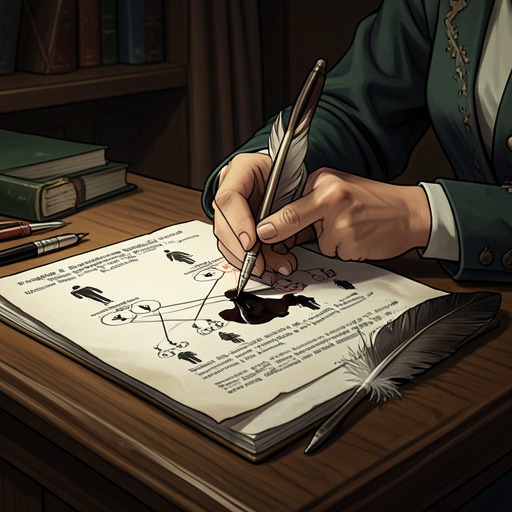
Discovery of Lula Landry’s will
The Cuckoo's CallingThe discovery of Lula Landry’s will is the turning point that converts an uncertain inheritance question into direct evidence against John Bristow. Handwritten on Yvette Bristow’s blue notepaper, witnessed by Rochelle Onifade and concealed beneath the removable lining of a white handbag, the document names Lieutenant Jonah Agyeman as the sole beneficiary of Lula’s entire estate. Its recovery overturns the story John has told about his sister’s intentions and helps expose the murder hidden behind the apparent accident.
Background: An inheritance that does not fit
Lula’s will matters because the question of whom she intended to benefit had already surfaced in the investigation. Ciara Porter told Strike that Lula had spoken that afternoon of leaving “everything” to her brother, a statement that sounded consistent with John Bristow’s position as her surviving adoptive brother. Yet that brief report offered neither a document nor enough context to settle what Lula meant by “brother,” and its significance was easy to underestimate while the case was being treated as a death by suicide.
John himself insisted that Lula would never have left everything solely to him. He argued that doing so would explicitly exclude their mother and send a deeply hurtful message; their father had already left their mother financially secure, he said, so the question was one of family meaning as much as money. His confident appeal to the emotional consequences of a will made the document more than a financial record: it was a declaration of whom Lula recognized and chose to include. John’s explanation also made it all the more important to establish what the will actually said.
The financial stakes were substantial. Guy Somé recalled that Lula had been poised to front an accessories range under a five-million-pound contract, and believed she had been urged to negotiate for as much as possible. He associated her success with the Jagged dress she had worn for a Vogue shoot and described her as someone who wanted a surrogate family. In that context, a will disposing of her entire estate could carry both practical and symbolic weight: the question was not simply who might inherit, but which family ties Lula chose to affirm.
The concealed document
Strike found the will while searching Yvette Bristow’s wardrobe for the new handbags Lula had acquired on the day she died. The white bag had an African-print lining that could be unzipped and removed like a scarf. Beneath it, a stiff, cloth-covered board shaped the base; lifting the board revealed pale blue paper covered in untidy handwriting. Strike slipped the folded paper into a clear plastic evidence bag without reading it, then continued searching the wardrobe. The will was not plainly visible among the handbag’s contents: its concealment depended on looking beyond the bag’s attractive exterior and examining how it was constructed.
The manner of discovery connected the document to a wider reconstruction of the crime scene. When Strike asked Derrick Wilson to demonstrate the order in which he had searched Lula’s flat, Wilson remembered slipping backwards on the stairs where there were drops of water. Strike later explained that John had carried white roses from the Bestiguis’ flat to Lula’s door, leaving a few drops behind after wiping their ends. Wilson’s forgotten fall showed how small traces could expose the route through which the killer had moved; the hidden paper in the handbag likewise became legible only when Strike examined an overlooked detail of its lining.
The will’s physical details supplied the bridge between an inheritance dispute and a specific hidden object: Lula’s handwriting, Yvette’s blue notepaper, Rochelle’s role as witness, and the detachable lining of the white handbag. The discovery did not rest on John’s interpretation of his sister’s wishes or on a witness’s recollection of a conversation. It produced a document that could be handed to the police and read for itself.
What the will revealed
When Strike confronted John with the discovery, he first told him that he had gone into his mother’s wardrobe to inspect the new handbags Lula had received on the day of her death. John reacted in disbelief at the intrusion. Strike then explained that one bag had detachable linings and that beneath the lining of the white bag he had found a handwritten will on Yvette’s blue notepaper, witnessed by Rochelle. He had already given it to the police.
The beneficiary was not John. The will left Lula’s entire estate to her brother, Lieutenant Jonah Agyeman of the Royal Engineers. That name made the document’s reference to a brother radically different from John’s assumption: Lula had a half-brother John did not appear to know. The will thus revealed not only an intended recipient of her property but also a concealed branch of Lula’s family and an identity that the investigation had not yet established in John’s understanding.
This discovery also gave a sharper meaning to Ciara’s account that Lula intended to leave everything to her brother. The statement had been accurate, but its apparent simplicity had invited the wrong identification. John had treated himself as the natural referent and used that assumption to argue that Lula could not have meant to cut their mother out. The will demonstrated that Lula had meant another brother—one whose very existence changed the family map on which John’s reasoning depended.
From family evidence to the confrontation
The document also changed the force of John’s involvement in the investigation. Until the will was found, his account of what Lula would or would not have done could be heard as the intimate knowledge of an adoptive sibling. Once the document named Jonah, John’s confidence that he understood the meaning of Lula’s intention became evidence of how incomplete—or misleading—his account was. The will did not by itself narrate the murder, but it undermined a central assumption about Lula’s plans and made the hidden truth about her family impossible to dismiss.
In the final confrontation, Strike used the document’s circumstances to challenge John further. John declared that he had had enough and wanted the investigation terminated, telling Strike to keep the money already paid and saying that he had to think of his mother. Strike asked whether he did not want to know what had been found in her wardrobe. When John asked what the will said, Strike named Jonah as the beneficiary and told him to look at a picture on the computer monitor outside. The request connected the name on the paper to a person John could see, making the will’s revelation concrete rather than abstract.
The search for the will led Strike to Yvette’s safe as well as her wardrobe. He told John that he had given the police combinations to try and, if necessary, they could bring in an expert. The combination Strike considered most likely was 030483. As he explained that the police should search the safe, John lunged at him with a knife. The concealed document had therefore done more than correct the record of Lula’s intended heir: it helped drive the investigation to a further source of evidence and precipitated the violent confrontation in which John tried to kill Strike.
Significance
The will turns inheritance into a test of who has the right to define Lula’s family. John’s claim rests on the visible bond of adoption and on his conviction that he can speak for what would have hurt their mother. Lula’s document instead gives legal and emotional force to a less visible connection: Jonah, her half-brother, whom the will identifies as the person she chose. The paper does not erase the relationships formed through adoption; it reveals that those relationships did not exhaust Lula’s sense of kinship.
Its concealment also gives the object a structural role in the mystery. The will is at once a private expression of choice, a piece of physical evidence and the means by which an apparently settled account of motive and inheritance begins to come apart. A pale blue sheet under a handbag’s false-looking base alters the interpretation of an earlier witness statement, exposes a family secret and points the detective toward the safe at the center of the final danger. The discovery matters because the document speaks more precisely than the assumptions built around it: Lula’s estate was not left to the brother who claimed to know what she would do, but to the brother her will names.