Evan Duffield
The Cuckoo's CallingEvan Duffield is a musician and actor whose public persona, drug history, and tumultuous relationship with Lula Landry make him both an obvious suspect in her death and a figure whom the investigation cannot simply explain away. His fame turns private grief into public spectacle: he is alternately idolized, condemned, and treated as though his addiction made his downfall inevitable, while the evidence about the night Lula died remains more complicated than the image surrounding him.
Identity and Public Image
Duffield first attracts Cormoran Strike’s attention as Lula’s boyfriend, described by John Bristow as an addict and a chronic self-publicist, and as a bad influence from whom the family had hoped she was finally separated. That judgment comes from someone protective of Lula and aware that she and Duffield have got back together; it establishes the family’s hostility, not a neutral account of their relationship. Bristow acknowledges that he may have been overbearing, and that Lula repeatedly felt he did not understand her.
Duffield’s public profile grew after he appeared in a critically acclaimed independent film as a heroin-addicted musician who stole to support his habit. His band released a well-reviewed album in the wake of that attention, then broke up acrimoniously around the time he met Lula. The role, his own drug use, and the ensuing celebrity became difficult to distinguish: he seemed to be playing a version of himself, and the media repeatedly presented his frailties as part of his appeal.
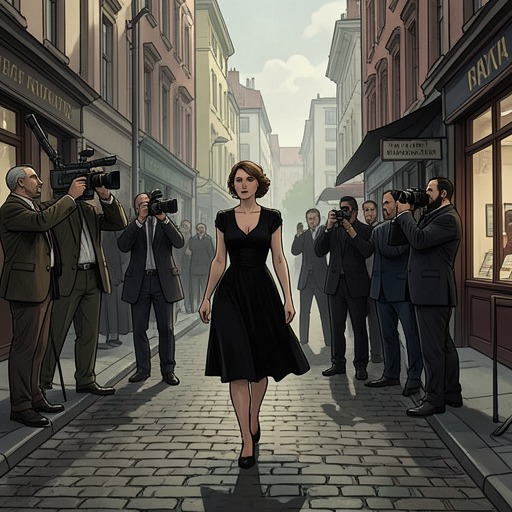
The press’s images of Duffield shift with his circumstances but preserve his recognizability as a spectacle. At Lula’s funeral he appears in black, with dark hair and sharply defined features, flanked by people who seem to guide him through the crowd. Later, at a club, Strike sees him with dyed-blond hair, dark makeup, and a skull-patterned scarf, surrounded by companions and an orbit of attention. Even his apparent disorientation does not erase the labor of presentation: he has applied his eyeliner carefully. His visibility is at once a form of power and an exposure to photographers he tries to evade.
Relationship with Lula Landry
Duffield and Lula’s relationship is marked by separation and renewed attachment. Shortly before Lula’s death, she had thrown him out of her flat. Derrick Wilson recalls hearing Duffield hammering on the door and trying to get back in; when Wilson went upstairs, Duffield collected the clothes Lula had put outside and left. Wilson describes him as apparently under the influence. The episode helps explain why the building’s porter later thought Duffield might have returned to Lula’s flat, but it does not establish that he did so on the night she died.
The family had thought the relationship was over and was pleased by the separation. By the time of the argument in Uzi on the night Lula died, however, they were together again. Duffield tried to stop her leaving the nightclub, and witnesses saw the confrontation; Lula broke away and left alone. His conduct was alarming enough that people later assumed he was responsible, but the immediate appearance of guilt was not the same as proof.
Lula’s friend and makeup artist remembers her checking her phone repeatedly during the afternoon before her death. She inferred that Duffield was frustrating Lula again, though Lula did not say so directly. This small, observed detail places their relationship in the ordinary rhythm of waiting for a message, against the larger public drama that would follow. It also shows the limits of what others knew: people around Lula interpreted her silences and moods, but those interpretations were not necessarily her own explanation.
The Night of Lula’s Death and the Investigation
After the argument at Uzi, Duffield followed Lula a few minutes later wearing a wolf-head mask. His driver confirmed taking a passenger of Duffield’s height and build, dressed in what appeared to be Duffield’s clothes and speaking in his voice, to Kentigern Gardens. Duffield had explained that he wore the mask to avoid photographers; the disguise made the account harder to verify by sight, even as the driver supported his version of events. The driver then took the passenger onward to d’ Arblay Street and left him there.
The mask feeds public suspicion as well as investigative uncertainty. Online discussion asks where the masked men seen running from Lula’s flat went, and why Duffield wore a different outfit from the one in which Lula had returned home. These questions circulate amid many other theories and do not themselves establish that Duffield entered the flat. Strike examines the statements more closely: Duffield admits trying to prevent Lula from leaving the club, and the bruising on her upper arms was likely caused by him, but the driver’s account and other statements place him elsewhere after the visit to Kentigern Gardens. Some witnesses saw only a man in a wolf mask, while a woman and Duffield’s dealer claimed to have seen him at the dealer’s building.
The investigation also weighs Duffield’s heroin use against the proposed scenario. Strike has experience with substance abuse and considers heroin’s effects inconsistent with the sustained aggression and coordination that would have been needed for the alleged killing. This does not make Duffield’s behavior harmless: his attempt to detain Lula at the club and the marks on her arms remain part of the record. It does, however, challenge the assumption that a volatile public image or an ugly argument is sufficient to explain her death.
Eric Wardle’s account captures the tension between suspicion and the police conclusion. He describes Duffield as uncooperative and says he entered rehabilitation the day after Lula died. Wardle recounts Duffield’s explanation that he followed Lula in the mask, but stresses that the driver could identify the passenger only by height, build, clothing, and voice. The case against Duffield is therefore built from a genuine argument, a history of conflict, and an unusual disguise, while the available statements also support his movements away from the flat afterward.
Grief, Uncertainty, and the Public Story
When Strike meets Duffield, the performer’s bravado is undercut by visible nervous movement. Asked whether Lula was murdered, he initially answers no, then says that murder makes more sense to him than suicide. He believes Lula would not have died without leaving him a note and continues to wait for one, as though its arrival might make the death comprehensible. He remembers being so intoxicated at the funeral that he could not walk, and says that he cannot remember the service; recovering that memory, he thinks, might help him accept what happened.
His uncertainty does not amount to knowledge of a murder. Duffield cannot settle on an account, and his sense that suicide does not fit his understanding of Lula is personal rather than proof. The novel sets that grief beside the confident public judgments that have accumulated around both of them: the detective initially treated Lula’s lithium use as decisive evidence of suicide, while online commentators turned unanswered questions into competing theories. Duffield is similarly reduced to a label—addict, celebrity, suspect—although the evidence of his grief resists the notion that his life can be read from those categories alone.
That public image has its own feedback loop. Lula and Duffield are both strikingly photogenic, and their relationship amplifies the attention directed at each. After her death, Duffield becomes still more securely famous, with admirers and detractors alike imagining his decline as inevitable. A video of him speaking while apparently intoxicated about death and leaving a party early is absorbed into that image. The attention turns vulnerability into performance and performance into evidence, encouraging audiences to mistake a persona for a full account of the person.
Work, Loyalty, and Narrative Significance
Duffield’s connection to Lula also reaches beyond romance and suspicion into professional and personal loyalties. During a lunch with Freddie Bestigui, Duffield notices an email containing Lula’s name on Bestigui’s BlackBerry and reads it. When he tells Strike about this, he says he does not want to be fired and needs the job. The disclosure reveals that Duffield’s access to information is entangled with precarious work, and that he is willing to cross a boundary to learn something about Lula. It does not by itself establish what he did with the information.
Guy Somé, who had been close to Lula, reacts to her death by saying he had assumed she might be pregnant and hoped the father was not Duffield. He says Lula would not have become involved with him while Somé was in the country, and describes himself and Lula as being like family. His account adds another perspective on the renewed relationship: Duffield is disliked not only by Lula’s family but by someone who felt protective of her and believed his opinion mattered to her. Yet Somé’s certainty about Duffield’s capacity for violence is an expression of his judgment, not evidence that Duffield killed Lula.
Duffield’s narrative role rests on this unresolved gap between conduct and conclusion. He has behaved aggressively toward Lula, followed her after a public argument, and concealed his face behind a mask; those facts make him a plausible suspect. But his itinerary is supported by statements, Strike sees a practical problem in the proposed account, and Duffield’s own disordered grief offers no hidden confession. As the investigation proceeds, he exposes the danger of treating celebrity, addiction, and spectacle as substitutes for proof: his reputation directs suspicion, but it cannot determine what happened at Kentigern Gardens.