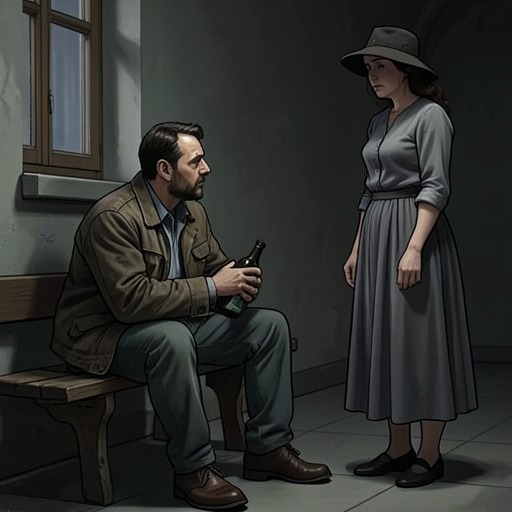
Evan Duffield’s recovery from drug addiction
The Cuckoo's CallingEvan Duffield’s recovery from heroin addiction is presented as recent, precarious, and entangled with grief: when interviewed about Lula Landry’s death, he reports five weeks and two days clean, then breaks down while speaking about the woman he says he loved and hoped to marry. The account places his progress alongside the risk of relapse and the way his drug history shapes how others interpret him.
Recovery and the interview
During a visit with Ciara Porter, Evan tells Cormoran Strike that he has been clean for five weeks and two days. The precise count makes recovery a day-by-day achievement rather than a settled change. He also mentions that his parents have an injunction against him, explaining that his father was chiefly responsible after Evan stole their television a couple of years earlier. His report of sobriety thus appears alongside evidence of strained family relations and past conduct, not as a claim that the difficulties surrounding him have disappeared.
Evan soon challenges Strike for not asking questions, reminding him that the investigation concerns Lula’s murder. His impatience redirects the conversation toward the death and his connection to Lula. The interview does not treat recovery as a separate subplot: it is the fragile condition in which he is asked to revisit a painful relationship and give an account of what happened.
Grief and the risk of relapse
As the discussion turns to Lula, Evan’s manner changes. He speaks of having provoked and taunted her, but the account also registers his realization that she will not return and that their relationship can no longer be repaired. He bends forward and hides his face before saying that the loss has affected him deeply, that he loved her, and that he wanted to marry her. He then leaves the room, ending the conversation rather than continuing to discuss the death.
Ciara describes him as a mess, while Strike observes that Evan has been off heroin for a month. Ciara confirms his abstinence but says she does not want him to fall off the wagon. Her concern makes clear that his recovery is not presented as secure merely because he can name the time he has stayed clean. The interview itself places pressure on that progress: speaking about Lula brings grief to the surface, and Ciara watches for the possibility that it could undo his recent sobriety.
How recovery is understood
Evan’s account puts two facts in close proximity: he is maintaining abstinence, and he is overwhelmed by Lula’s death. The contrast resists a simple portrait of recovery as either triumph or failure. His words establish the depth of his attachment; his withdrawal from the room shows the limit of what he can bear in the interview. The text does not establish that grief causes a relapse, or that he relapses at all. Instead, Ciara’s expressed fear preserves the uncertainty around whether his recovery can withstand the loss.
Elsewhere, the investigation shows how easily personal histories can narrow judgment. The detective responsible for Lula’s case was convinced from the outset that she had died by suicide because she was taking lithium; Eric Wardle dismisses Tansy Bestigui as a liar after the evidence about the locked windows contradicts her account; and a police officer reasons that a suicide victim would not usually pack a bag. These judgments are not evidence about Evan’s recovery, but they form a wider context in which labels and assumptions can shape how people’s testimony is heard. Evan’s sobriety is a concrete fact about his recent conduct, while his grief and past addiction do not, by themselves, establish what he knows about Lula’s death.