Kentigern Gardens CCTV footage
The Cuckoo's CallingKentigern Gardens CCTV footage is a fragmentary visual record that helps Cormoran Strike reconstruct movements on the night Lula Landry died. The footage is neither a complete account of the crime nor a self-interpreting answer: snow, shadows, covered faces, and gaps between camera views leave identities uncertain. Its value lies in the precise times and routes it preserves, and in the questions those images force the investigation to reconsider.
Acquisition and Format
A DVD marked by Eric Wardle as CCTV 2 Runners is included among the material sent from Scotland Yard with the police file. The package also contains witness statements, forensic and medical records, phone records, visitors’ book pages, and a summary of findings from Lula Landry’s laptop. The footage is therefore one part of a broader evidentiary record, not a standalone explanation of the death.
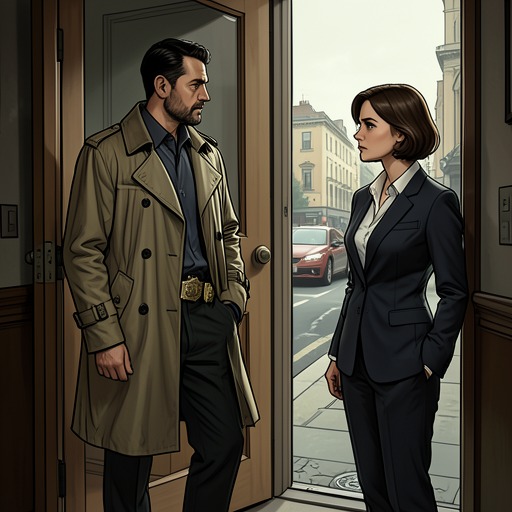
Cormoran Strike cannot watch it immediately: the DVD drive on his secondhand computer does not work, so he puts the disc in his overcoat pocket. Later, while visiting Lucy, he takes it inside, inserts it into the television’s player, and reviews the recording. The change of setting matters to the scene: he examines the evidence away from his office, using a domestic television to revisit a police recording that the investigation has left open to interpretation.
Street Recording and the Two Runners
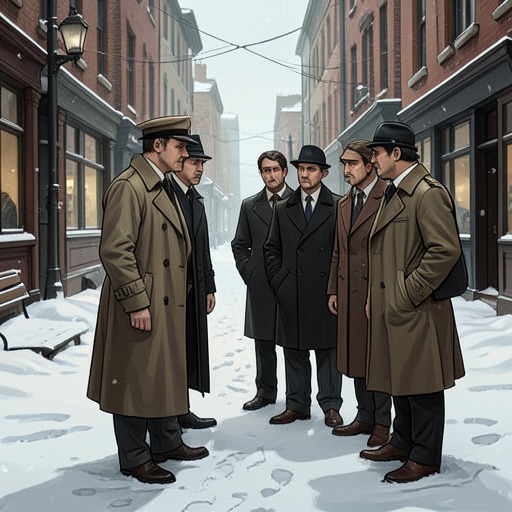
The first outdoor sequence is grainy black-and-white footage of the intersection of Bellamy Road and Alderbrook Road. Snow drifts across the camera’s 180-degree view. At 1:39 a.m., a tall, heavily dressed man enters the frame alone, his head covered and a white scarf concealing the lower part of his face. He appears to consult something taken from his pocket, then turns onto Bellamy Road and leaves the camera’s range. A mark on his jacket is too blurred to identify reliably.
The recording jumps forward to 2:12 a.m. Two men run into view. The taller runner is recognizable as the earlier pedestrian by the white scarf over his face; he runs back along Alderbrook Road. A smaller, slighter man follows, hooded and hatted, but falls behind. As the second man passes beneath a streetlamp, the design on his sweatshirt becomes briefly visible. He then turns sharply into a side street, which Strike identifies from Eric Wardle’s earlier account as Halliwell Street.
Strike replays the brief sequence several times. He sees no clear communication between the runners—no call, glance, or other visible indication that they are coordinating—and initially reads their flight as each man acting for himself. Yet the recording also places them together in the same snowy street at an unusual hour, behaving in a broadly similar way. The police had treated the first runner’s apparent connection with another man as a reason to doubt that he was a killer; Strike recognizes that this reasoning assumes the men were friends and that their association exonerates rather than implicates them. The footage makes complicity possible without proving it.
The sweatshirt design gives Strike a further, limited clue. On a freeze-frame he can make out what may be a first word ending in “ck” and a second beginning with “J,” but the image remains too blurred for a confident reading. The sequence therefore supplies an observation to pursue, not a secure identification.
Bus Images and Limits of Identification
The DVD continues with a separate view inside a bus. A girl boards; her face is shadowed and distorted by the camera angle, but her blonde ponytail is distinctive. A tall, hooded man boards after her, with a white scarf covering his face. His appearance resembles that of the man later seen walking toward Kentigern Gardens, though the recording does not establish that they are the same person. The clearest identifying detail is the stylized GS logo on the man’s chest.
The footage then cuts to Theobalds Road. A man walks quickly along it; if he is the same person shown boarding the bus, he has removed the white scarf. His build and gait seem similar, and Strike thinks he is deliberately keeping his head bowed. These visual continuities invite comparison across the recordings, but the concealed face and the gaps between scenes prevent certainty. The GS emblem is conspicuous evidence of clothing, not by itself proof of the wearer’s identity or role in the crime.
Place in the Investigation
The recordings complicate the apparent chronology around Kentigern Gardens. Strike’s questions elsewhere focus on the brief period after Lula entered the building, when photographers had left and security guard Derrick Wilson had abandoned the lobby desk because he was ill. The front door was not transparent, and an outsider would have needed the entry code; Strike notes that a code might nevertheless have been known beyond the intended users if it was not changed regularly. The street footage contributes timings and possible routes to this access problem, but it cannot show who knew the code or what occurred inside the building.
Other details in the evidence file illustrate why camera images have to be checked against physical traces and testimony. Wilson later recalls slipping on water on the stairs while retracing his search of the flat; Strike links the drops to the water left behind when John Bristow carried roses upstairs. That reconstruction comes from the remembered search and the drops, not from the street recording itself. Likewise, the CCTV’s blind spots leave room for movements beyond its view. Its importance is thus both evidentiary and structural: it gives the investigator times, appearances, and directions precise enough to test against other evidence, while making visible how much of the night remains unseen.