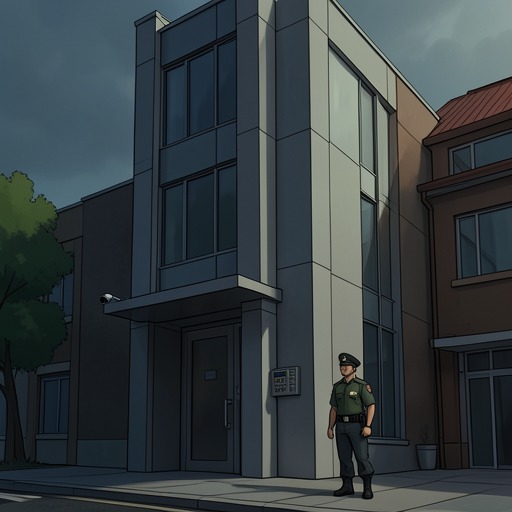
Kentigern Gardens entrance camera
The Cuckoo's CallingThe Kentigern Gardens entrance camera is a door-monitoring device that let the building’s desk staff see who was seeking entry but did not record what it showed. Its limited function matters to the investigation of Lula Landry’s death: it could support a witness’s memory of her departure, yet it could not provide a durable visual record of the people or movements around the entrance. In a building that appeared heavily protected, the distinction between being watched and having a record made proved consequential.
Position and Function
The entrance camera was linked to a monitor at the desk, where staff could see people buzzing to be let in. Derrick Wilson recalled seeing Lula leave with Ciara Porter at about seven in the evening. He remembered that Freddie Bestigui had entered as the two women were going out, and that Lula appeared offended by something he said. Wilson then saw the women get into their car on the monitor. His account provides a specific example of the device’s practical use: it helped the desk staff observe activity at the entrance as it happened.
The camera was not a recording system. When asked whether the footage could be viewed, Wilson shook his head and explained that Freddie Bestigui had opposed recording devices at the door. He had bought a flat before the others were finished and had input into the arrangements. Strike consequently described the device as a high-tech peephole, a characterization Wilson affirmed. The distinction is central: the camera offered a live view to someone at the desk, but left no stored footage that investigators could later replay.
Access and Gaps in Security
The camera operated alongside other means of controlling entry. Residents generally did not use the keypad: because staff could see them on the camera, they would normally be admitted from the desk. The keypad was intended for occasions when nobody was at the desk, such as when staff were in a back room or helping upstairs. Deliveries and other visitors were also usually let in by staff. Flats had individual keys and alarm systems, but those measures did not eliminate the importance of the shared entrance and the people monitoring it.
Strike’s reconstruction focused on the short period after Lula entered the building, when the photographers had left and Wilson had abandoned the desk because he was ill. The front door was not transparent, so a person outside could not simply see that the post had been left unattended. Nor did the camera, which provided no recordings, establish who had been present during the gap. Strike and Robin considered whether someone might have known the entry code, since it could be familiar to people if security staff did not change it regularly. The device therefore belonged to a system whose apparent safeguards depended on staffing, access habits, and information about the keypad as much as on the camera itself.
The Building’s Wider Surveillance
When Strike and Robin later inspected the building with Wilson, they saw the underground car park and its row of inner entrances to the houses. The arrangement presented routes between the houses and multiple possibilities for moving unseen through the complex. Robin then noticed numerous cameras mounted at regular intervals along the upper walls, feeding footage to monitors. Their presence raised a question about whether those cameras had been watched on the night of Lula’s death; the inspection did not establish that they had captured, or been monitored for, any relevant movement. The entrance camera’s live-only function thus contrasted with the broader surveillance network without resolving what that network had actually observed.
The entrance camera also contrasts with the public-street cameras on Alderbrook Road, which recorded images later examined by Strike. One recording showed a man at the Bellamy Road intersection at 1:39 a.m.; another segment showed two runners at 2:12 a.m. These images supplied investigators with a record to review, whereas the Kentigern Gardens door camera supplied Wilson with a view in the moment but left no footage behind. The contrast clarifies why the camera could corroborate a recollection of Lula’s departure yet could not settle questions about access or movements at the entrance later that night.
Investigative and Thematic Significance
The limits of the entrance camera become especially important in a case surrounded by competing accounts and speculation. Online discussion about Lula’s death included questions about who had called off the photographers and why two men seen running from her flat had not come forward. Those questions were not answered by the entrance camera: it neither recorded the door nor provided a retrospective account of who entered or left. Likewise, Strike’s examination of the police file drew attention to uncertainties in the Bestiguis’ statements and to the need to test accounts against the building’s layout and the sequence of events, rather than treating security measures as proof that movements were impossible.
The device’s significance lies in that gap between surveillance and certainty. A camera may make a building appear protected, but this one did not preserve its observations, and its usefulness depended on a staff member being present at the monitor. The investigation repeatedly distinguishes what someone saw, what a recording could establish, and what remained conjecture. At Kentigern Gardens, the entrance camera was an observer without a memory: it could help Wilson identify a moment as it happened, but it could not later supply investigators with the evidence needed to reconstruct the night.