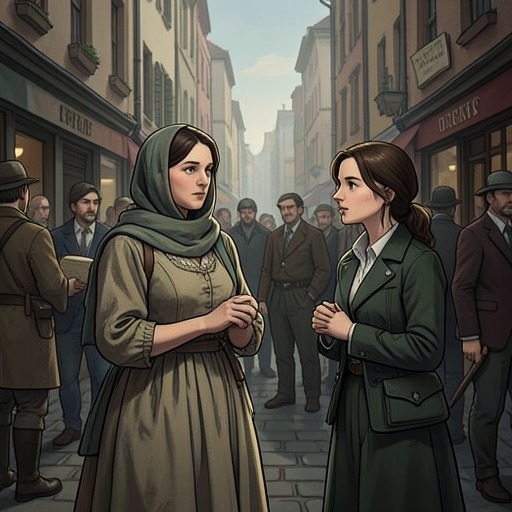
Lula Landry's search for her biological father
The Cuckoo's CallingLula Landry’s search for her biological father is a thread linking private family history to the investigation of her death. Through her mother Marlene Higson’s account and the digital traces recovered from Lula’s computer, the search appears as both a practical effort to identify a man and a developing interest in African history and identity. It never produced a confirmed reunion, but it exposed how much remained uncertain about Lula’s birth and how that uncertainty affected the people around her.
Background and Family History
Lula was adopted by the Bristow family, but her origins were not fully known within the household. When Cormoran Strike asked her adoptive mother, Yvette Bristow, whether she had known anything about Lula’s background at the time of the adoption, Yvette said she had known nothing; Alec Bristow might have known more, but, if so, he had never told her. The family’s knowledge was therefore incomplete, and the possibility that Alec had kept information to himself left a gap at the center of Lula’s history.
Marlene Higson recalled that Lula had tried to find her father by looking up college records. Marlene could not provide a dependable account of where the man had studied and was unsure whether Lula had identified the right institution. She remembered Lula repeatedly asking what her father had looked like and where he had studied, while Marlene’s own recollection of his name and details was uncertain. The search was thus built from fragments: Lula’s questions, Marlene’s partial memories, and records that might or might not point to the right person.
From Records to a Name
The computer evidence gave the investigation a more specific lead. A password on Lula’s account had been reset five days before her death to Agyeman, a Ghanaian surname. Lula had bookmarked the homepage of the School of Oriental and African Studies, and a saved version of the page included a link to the obituary of Professor J. P. Agyeman, an emeritus professor of African politics. The connection made the surname more than an unexplained password: it placed an identifiable academic and a possible paternal line within the range of Lula’s research, though it did not prove that the professor was her father.
Her browsing history showed that Lula had searched Amazon for Professor Agyeman’s books during the month before her death. She was also looking at books on African history and politics. The evidence records sustained inquiry rather than a single search, but it does not establish that she applied to the School of Oriental and African Studies or completed a formal identification of her father. The distinction matters: the digital trail reveals direction and intensity, not a resolved family relationship.
Identity, Africa, and Adoption
Guy Somé connected Lula’s interest in Africa to what she had learned from her birth mother. He recalled that Marlene had told Lula her father was African and said Lula then became intensely interested in Africa, discussing study and voluntary work there. Somé doubted Marlene’s account and believed she had told Lula what Lula wanted to hear. His skepticism highlights the instability of the information on which Lula’s search rested: the claim about her father’s origins came through a mother whose account others questioned, while the available records offered clues rather than certainty.
Somé’s recollection also shows how the search entered Lula’s public and creative life. He said that he had given African names to the bags in the campaign associated with her and that she had been fascinated by Africa. His account is shaped by his own perspective, but it supports a connection between her private questions about ancestry and the interests visible in her work and ambitions. The search was not simply an attempt to fill in a name; it became part of how Lula imagined possible study, travel, and service in Africa.
Consequences and Narrative Significance
The search also intersected with the family’s account of Charlie Bristow’s death. Tony Landry remembered being present during a family visit on Easter Sunday when the household was looking for Charlie after he had defied Yvette’s instructions and gone toward a quarry. Tony went directly to the quarry and found Charlie’s body. This remembered history later formed part of John Bristow’s suspicion that Lula’s interest in her origins had stirred up a dangerous past. Strike considered whether John saw her effort to investigate her birth as a threat or as an unwelcome disturbance of the adoptive family’s settled story; that was Strike’s interpretation of John’s fixation, not a fact established by the search itself.
A later revelation clarified why the paternal question had remained hidden from Lula’s adoptive family. Jonah Agyeman told Strike that his father had disclosed, shortly before dying, that he might have another child with a white woman who had disappeared. He had not been sure that Marlene was telling the truth about being pregnant, and he had not told his wife, urging Jonah not to upset her. Jonah said that Lula contacted him unexpectedly while he was on leave; she did not want to hurt anyone and, he believed, sounded all right. His account establishes that the possibility Lula had been pursuing was real enough to have been confided within another branch of the family, while also showing how it had been obscured by uncertainty and silence.
The search therefore remains consequential without becoming a completed reunion or a definitive proof of paternity. Its traces—a remembered question about college records, the Agyeman password, an archived obituary, and books on African history and politics—make Lula’s effort legible to the investigation after her death. At the same time, the different accounts preserve the limits of what can be known: Marlene’s uncertain memories, Somé’s doubts, Alec’s unspoken knowledge, and Jonah’s late disclosure each offer part of a family history that no single speaker had fully possessed.