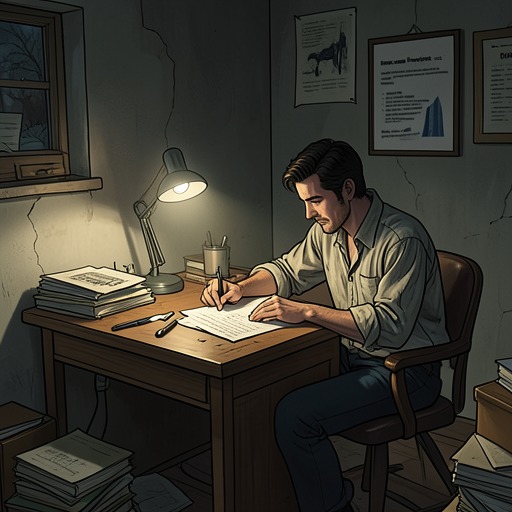
Strike’s Denmark Street office
The Cuckoo's CallingStrike’s Denmark Street office is both the headquarters of his investigation into Lula Landry’s death and a setting in which the pressures of his work become inseparable from the conditions of his life. Its desks, files, sofa, and makeshift sleeping arrangements frame a methodical inquiry: evidence gathered elsewhere is brought back, compared, and tested against details that witnesses have overlooked. The office is also where Robin’s professional support acquires a personal dimension, often through small acts of care rather than explicit conversation.
Working Base for the Investigation
Strike uses the office to conduct interviews, take notes, and process the material needed to revisit the police conclusion that Lula’s death was suicide. During his interview with Derrick Wilson, he writes in a notebook and judges Wilson’s answers unusually precise and well organized. That impression does not make him less thorough: Strike’s investigative habits and military training lead him to continue with the questioning rather than accept an easy account. The office is thus associated not with a single revelation but with a patient method of gathering and checking evidence.
The method becomes tangible when a bulky package arrives from Scotland Yard. Strike opens a thick gray folder containing witness statements, DNA findings from Lula’s flat, the Kentigern Gardens visitors’ book, information about her medication, the autopsy report, medical records, telephone records, and a summary of the examination of her laptop. A DVD labeled by Eric Wardle “CCTV 2 Runners” accompanies the papers. Because the DVD drive on Strike’s secondhand computer does not work, he puts the disc aside and begins reading the documents by the light of his desk lamp. The office’s limitations are practical, but they do not halt the work: he proceeds through the record systematically, looking for the truth behind Tansy Bestigui’s changing account.
From Documents to a Reconstructed Scene
The office’s function is to turn dispersed information into questions that can be tested on site. Strike’s reading of the case file draws his attention to Tansy’s insistence that Freddie Bestigui was asleep when Lula fell, and to the uncertain positions of both Bestiguis at that moment. Rather than treating the police account as settled, he considers what the layout of their flat and the timing of events might show. His notes and the evidence he studies in the office lead back to Kentigern Gardens, where he asks Wilson to demonstrate the order in which he searched Lula’s flat.
During that reconstruction, Wilson recalls that he slipped backwards on the stairs and sat down hard. He points out drops of water there. Strike repeats the detail, recognizing its importance, while the memory is still taking shape. The clue later fits the account Strike gives John Bristow: Bristow had carried white roses from Flat Two to Lula’s flat, leaving small drops of water behind, and Wilson slipped on them. The office is therefore connected to a larger investigative process: evidence is first organized and questioned there, then checked against the physical route through the building.
Work, Rest, and Exposure
The office also becomes Strike’s temporary home after the end of his relationship with Charlotte. At one point Robin leaves him there with his laptop beside him on the threadbare cushions. Once she has gone, Strike locks the glass door, smokes despite his usual weekday rule, removes his prosthesis, and examines the skin at the end of his amputated leg. The scar tissue is inflamed and warm. He remembers that creams and powders once kept at Charlotte’s home may now be among his unpacked possessions, but he cannot bring himself to search for them or put the prosthesis back on. The office makes visible the daily maintenance and discomfort that a purely professional account of the detective’s life would leave out.
Its cramped domestic improvisation affects the working relationship with Robin. After she wakes him with a cup of tea and tactfully avoids discussing the camp bed, Strike worries that their familiarity has crossed a boundary. He resolves to treat her with greater formality, but she returns to find him at her computer, typing rather than turning away from work for their customary conversation about the case. His abruptness leaves her wondering whether he is responding to something she has said to Lucy. The office thus records an unsettled negotiation: the intimacy of shared working space brings mutual concern, but Strike’s pride and unease make him try to restore distance.
Robin’s Note and the Office as Shelter
After a night of heavy drinking, Strike wakes fully clothed on his sleeping bag, uncertain of the time and whether Robin has left for good. A note pushed under the door tells him otherwise. Robin has read his list of points for further investigation and plans to follow up the first two, concerning J. P. Agyeman and the Malmaison Hotel in Oxford. She has also set an alarm outside his door so he can prepare for a five o’clock appointment at 1 Arlington Place with Ciara Porter and Bryony Radford. Water, paracetamol, and Alka-Seltzer have been left on the desk. Her reassurance that he has nothing to regret from the previous night lets him receive her help without having to face her immediately.
The note shows how the office functions at once as a workplace and refuge. Robin supports the investigation by identifying its next leads, while also making practical provision for Strike’s recovery; he, in turn, is spared an encounter for which he feels unready. Later, when Robin returns with food, he thanks her but remains at the computer and asks whether she can wait on the sofa while he works. The everyday furniture of the office—desk, sofa, camp bed—marks changing degrees of proximity without resolving the personal questions between them.
Narrative Significance
Strike’s Denmark Street office gathers the novel’s investigative strands into one constrained space. A police package becomes a working archive; a notebook captures an unusually clear witness account; an on-site recollection of water drops becomes a link in the reconstruction of John Bristow’s actions. The office’s modest equipment and makeshift living arrangements contrast with the elaborate, wealthy apartment building under investigation, but its importance comes from the discipline applied within it rather than from material comfort.
The space also complicates the distinction between detective and private person. Strike’s leg care, sleeping arrangements, hangover, and dependence on Robin’s quiet assistance intrude into the same rooms where he reads files and develops questions. The office does not resolve those difficulties, nor does it turn their working relationship into a settled personal bond. Instead, it holds the two processes together: evidence is examined there, and the relationship between the people examining it becomes more trusting, more exposed, and still uncertain.