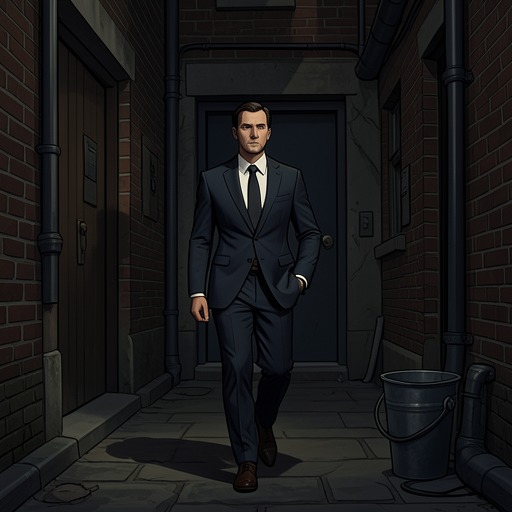
CCTV footage from the Kentigern Gardens crime scene
The Cuckoo's CallingCCTV footage from the Kentigern Gardens crime scene is a fragmentary record of movement around Lula Landry’s death, not a complete account of what happened inside the building. Initially treated as showing an unidentified man running away, the footage is later re-examined by Strike as evidence that the police had misread or overlooked; in his reconstruction, it helps connect a fleeing figure to the killer’s route and disguise.
What the Footage Shows
John Bristow tells Strike that the cameras recorded a man walking towards Kentigern Gardens about twenty minutes before Lula fell, followed by footage of the same man running away after her death. The police never identified or traced him. Bristow presents this alongside Tansy Bestigui’s claim that she heard an argument immediately before Lula fell, offering both as evidence against the official conclusion of suicide.
Strike later inspects the camera location on Alderbrook Road. The cameras are mounted above the busy street, which is lined with shops, bars, and cafés; nearby Bellamy Road leads towards the quieter residential part of Mayfair. He calculates that a person leaving Kentigern Gardens could pass the camera there twelve minutes after Lula’s fall. The location offers access to night buses and taxis, but the speed and direction of travel remain clues to be tested, not proof on their own.
Evidence and Reassessment
The footage reaches Strike as part of a broader police file. Its DVD, labelled “CCTV 2 Runners,” accompanies witness statements, medical and phone records, the autopsy report, and other case materials. Strike reads the documents methodically, comparing the recorded timings and accounts with the official conclusion of suicide and with inconsistencies in Tansy’s changing testimony. The video’s presence in the file does not mean its significance has been properly understood.
Public speculation also keeps the images in circulation. An online list of unanswered questions asks why two men with covered faces were seen running from the area and why they never came forward. Such questions register suspicion, but they are not equivalent to verified identification. The footage remains grainy, and the runners’ appearance alone cannot establish who they are or what they did.
Strike’s later assessment is that the most persuasive surviving physical clue is the black-and-white recording of two men running from the scene. By then, much of the physical evidence has been lost, disturbed, or covered by snow. He argues that police gave the footage only a cursory examination because they believed no one could have entered the building and that Lula had taken her own life; they dismissed the figures as loiterers. The recording’s importance thus lies partly in the gap between what it preserves and the interpretation imposed upon it.
Role in the Reconstruction
The footage gains force when set beside evidence from inside Kentigern Gardens. During a later walkthrough, Strike asks Derrick Wilson to repeat the order in which he searched Lula’s flat. Wilson recalls slipping on water on the stairs after hearing the Bestiguis arguing. In the final reconstruction, Strike links the drops to water left on the stems of roses carried out of Freddie Bestigui’s flat: John Bristow had taken the roses upstairs as a way to make Lula open her door. This small trace helps explain how the killer entered and how Wilson’s memory of the search fits the sequence of events.
The camera images also acquire a more specific connection to the people and objects in the case. Strike tells the police that one of the runners wore a Deeby Macc sweatshirt. Later, explaining his reconstruction to John Bristow, he says Bristow put on Deeby’s hoodie before leaving the flat. The clothing detail ties the indistinct figure on the recording to the killer’s movements, while the rose-water trace and the route past the camera support the larger account. The footage does not solve the case in isolation; its evidentiary value emerges through comparison with other observations and physical details.
Significance and Limits
The recording exposes the difference between possessing evidence and interpreting it well. It captures a route and two fleeing figures, but not the crime itself; its blurred images invite speculation and can be dismissed as readily as they can be overread. Strike treats it as a testable piece of a timeline, checking where the camera stands, how quickly someone could reach it, what the figure wore, and whether the route fits the events reconstructed elsewhere.
Its eventual significance is therefore both practical and thematic. The footage helps challenge the assumption that Lula’s death was necessarily suicide, while its initial neglect shows how a settled conclusion can make inconvenient evidence appear trivial. Only when joined to testimony, timing, clothing, and the overlooked drops of water does the recording become part of a coherent case against John Bristow.