Celebrity culture and media intrusion
The Cuckoo's CallingCelebrity culture and media intrusion are forces that convert Lula Landry from a person into a public image, then make that image profitable even after her death. The novel shows fame as both commercial currency and exposure: photographs, headlines, gossip, and the monitoring of private communications draw attention to Lula while making her personal life harder to protect. The resulting spectacle distorts public understanding of the death and helps explain why privacy, trust, and evidence become central to the investigation.
Fame as a Marketable Image
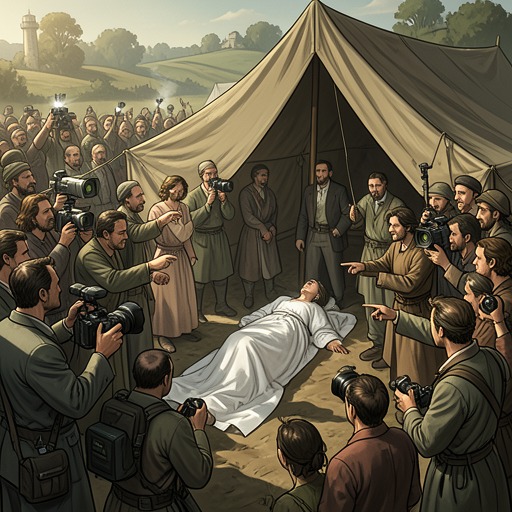
The first public account of Lula’s death quickly pushes politics, war, and disaster aside. Its handful of known details—the public quarrel with her famous boyfriend, her journey home alone, reports of an argument, and the fatal fall—spread to millions, accompanied by repeated images of her face and body. Coverage does not merely report a death: it makes Lula’s appearance part of the event’s commercial appeal. Those who had been with her are hounded, and the witness who claims to have overheard another argument becomes briefly famous herself. When her account is discredited, the public story changes again, with interest organized around the famous boyfriend as a continuing spectacle.
The novel makes that transformation explicit through a newspaper essay Robin reads. Its writer questions the idea that Lula’s success represented a meaningful change in the fashion industry, and contrasts the attention lavished on her with the relative anonymity of other young women who die in unnatural circumstances. The essay argues that the public does not necessarily mourn Lula as a person; it mourns the image that appeared in celebrity magazines and sold clothes, handbags, and an idea of celebrity. Its criticism also identifies the appetite for a packaged persona: the entertaining, supposedly shallow girl defined by drugs, fashionable clothes, and an unstable romance. The essay’s account of the funeral sharpens the disparity between the public image and the people close to her: celebrity coverage is lavish, while Lula’s family receives little photographic attention.
A week after the inquest returns a verdict of suicide, an advertising photograph brings the commercial afterlife of Lula’s image into view. The picture, made for Guy Somé’s products, places Lula and Ciara Porter in an alleyway with accessories and theatrical wings; Lula’s image dominates the composition. The choice to use the photograph draws criticism because it can be read as profiting from a recent death. A fan account, by contrast, claims that Lula would have wanted it used and presents it as a tribute. The disagreement exposes how little control the dead woman has over the meaning assigned to her likeness: the same image can be treated as exploitation, memorial, or enduring brand.
Public Narratives and Private Evidence
The coverage of the case produces familiarity without reliable knowledge. Cormoran Strike remembers the images of Lula’s body being carried to an ambulance amid camera flashes, and recognizes how exposure has made people across Britain feel informed and opinionated about the case. That saturation is not neutral background. It can make a reader feel qualified to judge the evidence before hearing it, while encouraging the repetition of an interpretation that may be incomplete.
The official investigation has its own narrowing effect. John Bristow tells Strike that the detective in charge believed from the outset that Lula had died by suicide because she was taking lithium, and that details were overlooked. Bristow arrives with a crumpled envelope containing his timings and theory; the signs of strain in his hand and posture initially resemble the presentation of an obsessive amateur, even as he is able to pay for the investigation. The episode links public and institutional judgment: prior assumptions can make a theory appear settled, while a person’s manner and status affect how seriously others receive what they say.
Online discussion both challenges and reproduces those judgments. Blogs collect questions about who might have called off the paparazzi, why two men with covered faces were seen running from the building, and why Lula wore different clothes when she fell from the balcony than when she returned home. These lists do not establish the answers, and their speculative tone is part of the point: the internet keeps unresolved details visible, but turns uncertainty into a stream of theories. Strike encounters the online material while following leads that have fed Bristow’s belief in murder. Public attention can therefore preserve neglected questions without itself supplying dependable proof.
Surveillance, Trust, and Exposure
Fame reaches beyond photographs into Lula’s communications. Ciara Porter says that after Lula’s birth mother began selling stories, Lula became more suspicious about confidences reaching the press. She asked whether Ciara had told anyone that she and Evan Duffield were back together. Ciara thought the reunion could not remain secret, but also recognized that Lula disliked this aspect of celebrity. Her recollection shows that the desire to be talked about and the wish to keep particular parts of life private can coexist; fame does not make every disclosure welcome.
Evan Duffield describes the phone tapping as a source of paranoia. Lula tried to work out what she had said on calls and who might have passed information to newspapers; she sometimes suspected even him of selling stories. He presents that suspicion as a consequence of publicity that Lula was unable to accept as part of fame. His account is a participant’s explanation, not independent proof of the extent or source of surveillance, but it establishes how the perceived monitoring affected trust between them. The pressure is intimate as well as public: once private conversations seem liable to become news, ordinary confidences become matters of suspicion.
The novel contrasts media tracking with police evidence-gathering without making surveillance all-seeing. On Alderbrook Road, cameras mounted above the street point in opposite directions, and Strike identifies the location as the place where a runner connected with the case was caught on film. The recording helps establish a route and a time, but the larger case still contains gaps that invite speculation. Cameras can preserve movements while failing to explain them; their presence does not resolve what happened inside Lula’s private life or why.
Spectacle, Violence, and the Investigator
The pursuit of celebrity continues physically in the novel’s present. As Strike travels with Duffield and Ciara, photographers run alongside their car, firing flashes; motorbikes follow them, and another group of photographers gathers when they arrive at a building. Strike imagines striking the photographers, but instead gets the group inside and shuts the door against them. The scene gives paparazzi culture a direct consequence: an investigation involving a famous suspect becomes difficult to conduct without being surrounded by cameras, while the investigator’s own movements are pulled into the spectacle.
That pursuit also triggers Strike’s memory of Afghanistan. The flashes and the sound of the chase bring back a roadside incident in which he had shouted for the vehicle to brake and grabbed Anstis before an explosion. The episode connects his present exposure to a different kind of danger without equating the two: the photographers are not combatants, but their flashing cameras become an involuntary cue that takes Strike back to an experience of violence. Later, he recalls the images of Lula’s body being loaded into an ambulance, with photographers raising cameras toward the darkened windows. The media’s gaze reaches both the dead woman and the living investigator, though in profoundly different ways.
The novel further complicates public suspicion by showing how fame can turn a person’s vulnerabilities into a ready-made story. Online footage of Duffield, apparently intoxicated, circulates alongside his remarks about death, while public discussion casts him as both idol and suspect. The press had also speculated about his proximity to Lula after Deeby Macc moved into the apartment below hers; Macc’s public declarations of interest in her and the imagined possibilities of their closeness generated stories before any such relationship was established. These episodes show how celebrity reporting fills the gaps between known facts with anticipation, rumor, and performance.
Narrative Significance
Celebrity culture in the novel is not simply a backdrop to Lula’s death. It shapes what becomes visible, how testimony is received, and which interpretations acquire authority. The public’s access to images and fragments of information creates the feeling of knowing the case, while the investigation depends on distinctions between a circulating story and verifiable evidence. A witness can gain fame through a claim and lose credibility when it is disproved; a celebrity suspect can be made into a character in a public drama before the facts are settled.
The account of Lula’s image also resonates with Strike’s private memory of his mother, Leda. He remembers the famous photograph that labels her a “supergroupie,” reducing her to a public identity, and contrasts that label with his own complicated memories and unanswered questions about her death. The connection does not make the two deaths equivalent; it shows Strike recognizing how a social image can shape what others believe about a woman, including whether her death seems inevitable. In both cases, a life can be flattened into a story that appears to explain its ending.
By setting the commercial circulation of photographs beside the fragility of private trust and the uncertainty of evidence, the novel presents fame as a condition that both exposes and obscures. Lula is made intensely visible, yet that visibility does not guarantee that the public sees her clearly. The spectacle supplies images, headlines, and theories; the work of understanding her death requires resisting the assumption that visibility is knowledge.