Cormoran Strike and John Bristow’s relationship from client and detective to adversaries
The Cuckoo's CallingCormoran Strike and John Bristow’s relationship moves from client and investigator to adversaries when Strike concludes that John murdered his sister, Lula Landry, and then hired him to reopen the case. John’s insistence on controlling access to his mother, his effort to terminate the investigation after Strike finds Lula’s will, and the evidence Strike assembles about the crime turn a professional arrangement into a confrontation that ends with John attacking Strike and Robin Ellacott calling for help.
The client relationship and its limits
John Bristow enters Strike’s office agitated after learning that Strike has spoken to his mother without him present. He reproaches Strike for disregarding his explicit instruction and says that his mother has been left crying. The scene exposes a boundary John expects Strike to observe: the detective may investigate Lula’s death, but John believes he should retain control over contact with the surviving family member whose inheritance is central to the case.
John’s anger becomes an attempt to end the arrangement. He says he has had enough, terminates the investigation, and tells Strike to keep the money already paid. He frames the decision as concern for his mother. Strike counters by asking whether he wants to know what was found in her wardrobe, showing that the conflict is no longer merely about the conduct of an investigator. John’s effort to stop the inquiry comes just as it has produced evidence he cannot safely ignore.
The will changes the investigation
Strike tells John that a detachable lining in a white bag concealed a handwritten will by Lula, written on her mother’s blue notepaper and witnessed by Rochelle Onifade. Strike has already given the document to the police. John’s immediate question is what the will says; its discovery shifts the balance between the two men, because a private document hidden in his mother’s belongings is now part of the official investigation rather than something he can manage through his instructions to Strike.
The will also clarifies the financial stakes Strike sets out in their confrontation. He argues that John stands to receive ten million pounds once their mother dies, while the value of his Albris shares is poor. Strike presents this prospective inheritance as a reason John benefited from Lula’s death, and says that John had tried to frame Jonah Agyeman so that the inheritance would reach him whether or not the will emerged. These are Strike’s accusations during the confrontation; his claim of proof rests on the evidence he says he has found, not on John’s agreement.
From inquiry to accusation
The change from professional suspicion to direct accusation is unmistakable when Strike tells John that he believes John killed Lula and then hired him to reinvestigate her death. Strike says the person who benefits most is John. John denies the charge and insists that Strike has no proof, but Strike points to the CCTV footage and the other man recorded on it. The footage therefore has a double role in their relationship: it is part of the case against John and the answer to his attempt to dismiss Strike’s allegations as fantasy.
The confrontation draws together details that had first appeared as uncertainties in the inquiry. Strike had questioned where Freddie and Tansy Bestigui were when Lula fell, noting Tansy’s insistence that Freddie was asleep and the inconsistencies in her account. He had also reread Derrick Wilson’s account of entering Lula’s flat with a master key, and later asked Wilson to demonstrate the order in which he searched the rooms. On the stairs, Wilson recalled slipping backwards on water drops—an incident he had forgotten. In Strike’s reconstruction, John carried white roses from the Bestiguis’ flat after drying their stems, but left drops behind; Wilson slipped on them. The small trace connects John’s route through the building to the security officer’s account and helps replace disputed testimony with a physical sequence.
The relationship ends in violence
Strike’s reconstruction places John at Lula’s flat after the street outside had cleared. John, Strike alleges, carried the roses upstairs so that Lula would see them through the peephole and open the door, expecting her long-lost brother. In this account, the familiar bond John invokes in hiring Strike becomes the means by which he gained access to his sister. The relationship’s central irony is that Strike was initially engaged to establish whether Lula’s death had been a crime; he ultimately tells John that John used that investigation to conceal his own guilt and implicate Jonah.
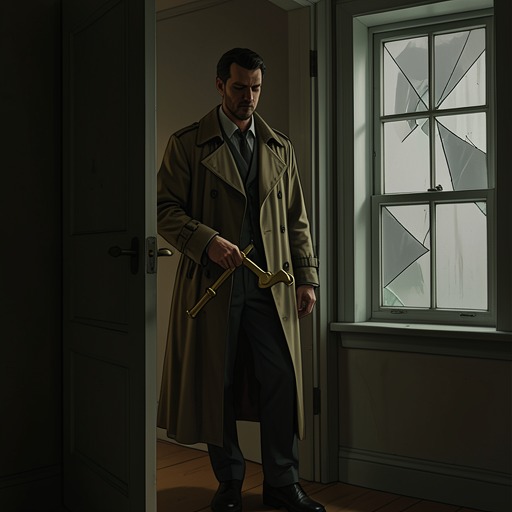
John’s response turns accusation into physical danger. In the dark office he lunges at Strike with a knife. Strike fights him off, using his prosthetic leg to stop the attack; John becomes motionless, and Strike, bleeding and beside the overturned desk, tells Robin that he thought he had asked her to go home. Robin is already on the telephone. The episode closes their relationship not with agreement or a confession, but with the detective’s evidence-backed accusation, John’s attempted violence, and the arrival of help summoned by Strike’s colleague.