Criminal Procedure and Investigation Act
The Cuckoo's CallingThe Criminal Procedure and Investigation Act is the procedural framework governing how evidence is gathered, recorded, and disclosed in the investigation of Lula Landry’s death. In the novel, it gives Cormoran Strike’s private inquiry a crucial discipline: even when he believes his client’s account may be deluded, he keeps accurate notes and tests each claim against its source, setting, and physical consequences.
Role in the Investigation
After John Bristow hires him, Strike is free to collect and collate evidence as he chooses, but he continues to conform to the Criminal Procedure and Investigation Act. He does so even while suspecting that he is pursuing a figment of Bristow’s disturbed imagination. The procedure is therefore not presented as a technique reserved for a theory Strike already accepts; it is the standard that keeps his investigation thorough when his own confidence is low.
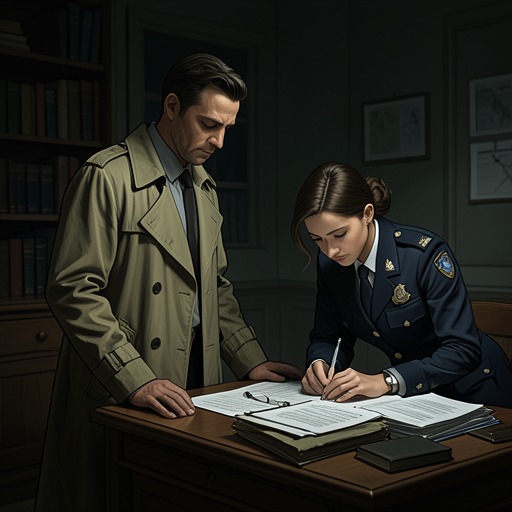
That commitment is visible in his written record. Strike writes up the interviews with Bristow, Derrick Wilson, and Kieran Kolovas-Jones, preserving what each man said rather than allowing his provisional disbelief to shape or erase the account. The resulting notes let him return to details and compare versions as his understanding changes.
Recording and Testing Testimony
The case repeatedly turns on the difference between a witness’s assertion and what the circumstances could support. Tansy Bestigui says she heard an argument shortly before Lula fell and saw the fall, but Eric Wardle explains why the police rejected her account: the apartments’ triple-glazed windows appeared to block sound. Officers tested the claim by having a man shout from Lula’s balcony while sober people in the Bestiguis’ flat listened; they could not hear him. Bestigui then altered her explanation, saying she had opened the windows.
When Strike later interviews Bestigui, her account changes again. She says she went to the bathroom for water, heard Lula say she had already done something, heard a man call her a lying bitch, and saw him throw Lula over the balcony. Strike notices that the story differs from what she told police. Rather than treating the more dramatic version as proof, he attends to its changing wording and to the conditions in which it was supposedly heard.
The police file gives Strike material with which to make those comparisons: witness statements, DNA findings from Lula’s flat, the visitors’ book from 18 Kentigern Gardens, medication and medical records, phone records, an autopsy report, findings on Lula’s laptop, and a DVD marked “CCTV 2 Runners.” Read together, these materials had supported the official conclusion of suicide. Strike’s review does not make that conclusion disappear; it lets him test particular details—including Bestigui’s shifting account and the circumstances around her husband—against the record.
Reconstructing the Scene
Strike’s method also depends on physical sequence. At the flat, he asks Wilson to retrace the order in which he searched the rooms. On the stairs, Wilson suddenly remembers slipping backwards on water droplets. The small, previously forgotten detail becomes significant when Strike later reconstructs how John Bristow carried white roses upstairs after drying their stems imperfectly: drops left by the flowers explain Wilson’s slip and help connect the route through the building to the crime.
The reconstruction is not simply an imaginative alternative to the police account. Strike asks who was where, what could be seen or heard, and how a person could have moved through the building. He also questions Bestigui’s insistence that her husband was asleep when Lula fell, noting that the exact positions of both Bestiguis had not been established. A witness’s certainty cannot substitute for a verified account of opportunity and location.
Significance and Limits
The Act’s significance lies in the contrast between leads and proof. Bristow points Strike toward Bestigui’s testimony and CCTV of a man approaching Kentigern Gardens and running away after Lula’s death. Those details warrant inquiry, but the existence of a lead does not by itself establish who the man was or what happened. Similarly, the overheard telephone call that Strike traces to Lula’s meeting with Rochelle Onifade supplies context for the final night, while its source—a shop assistant listening from a neighboring changing cubicle—must remain distinct from what the caller herself said.
By continuing to record, compare, and verify, Strike turns scattered recollections and overlooked physical traces into a reasoned account that can be presented to the police. The novel thus associates procedural rigor with intellectual restraint: testimony may be mistaken or strategically altered, a clue may point in more than one direction, and a compelling reconstruction must still be built from particulars that can be checked.