Derrick Wilson
The Cuckoo's CallingDerrick Wilson is the security guard at the Kentigern Gardens apartment building and an important witness in Cormoran Strike’s reinvestigation of Lula Landry’s death. His account establishes what happened after he left his post because of illness, while his careful recollection of the building and his later walkthrough help Strike test the competing accounts of the fatal night. A seemingly incidental detail—Wilson slipping on the stairs—eventually becomes part of the physical chain connecting John Bristow to the crime.
Identity and Introduction
Strike meets Wilson at the Phoenix Café on Coldharbour Lane, where the guard is sitting alone with a newspaper. Wilson has a deep, measured voice and a faint Caribbean lilt beneath his London accent. Strike considers him a reassuring presence in a security uniform, an impression matched by the calm, orderly way he answers questions.
Wilson already knows that John Bristow has hired Strike to examine the evidence after being dissatisfied with the inquest into his sister’s death. Strike asks whether Bristow has paid Wilson to speak with him; the exchange establishes that the guard is being interviewed as a potential source of information, not merely introduced as part of the building’s staff.
The Night Lula Died
Wilson explains that he had gone into the back room because he urgently needed the bathroom after catching the illness that had kept a colleague off work. He estimates that he was away for about fifteen minutes. While still in the bathroom, he heard a distant bang, which he later understood to have been Lula falling, followed by increasingly loud cries from the stairs.
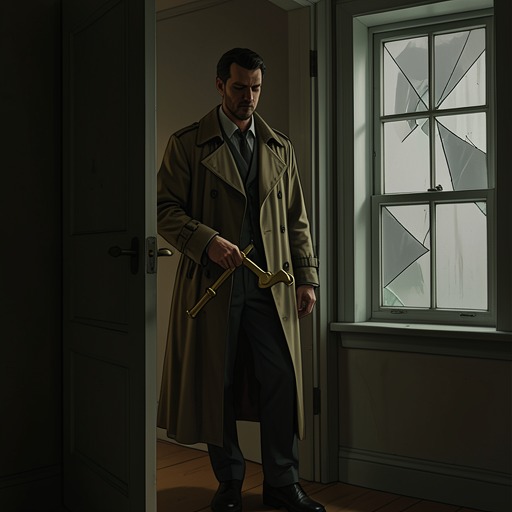
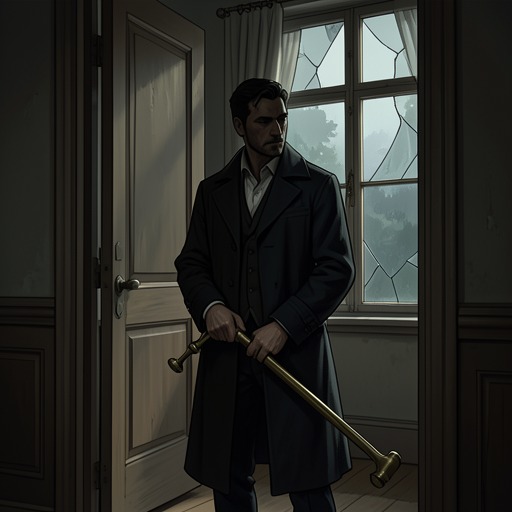
When Wilson emerged, Tansy Bestigui was in the lobby, distressed and saying that Lula was dead and that a man in her flat had pushed her from the balcony. Wilson told the Bestiguis to call the police and to watch the lift in case the man tried to leave that way. He then took the master key from the back room and went upstairs to Lula’s flat. He recalled finding no one in the stairwell before unlocking the door. His account thus distinguishes what he directly did and heard from what he learned from Tansy.
Wilson’s brief absence becomes a point of interest to both Strike and the police. Eric Wardle confirms that the police considered the interval, but says they quickly discounted Wilson as responsible: he had not touched anything and had conducted a proper search after Lula’s death was reported. Wardle also notes that the pool door had been unlocked, while questioning how a killer could have passed between the pool area and the building without going by the security desk. The details frame the problem as one of access and timing, rather than establishing that Wilson’s absence gave a murderer an easy route.
Evidence and the Building
Strike regards Wilson’s testimony as unusually high quality: concise, precise, and well organized. He notes that Wilson answers questions directly, requiring little follow-up, and therefore finds him especially useful in a case where other people’s memories and accounts need painstaking examination. Strike nevertheless insists on a thorough interview, proceeding through the day before Lula’s death rather than stopping at the most dramatic events.
Wilson’s knowledge of Kentigern Gardens also supports Strike’s physical inspection of the building. He shows Strike and Robin the small staff room, where the master keys are kept, and the security desk with four monitors: views of the front entrance, underground car park, back garden, and stationary lift. The desk also has controls for communal alarms and for the doors to the pool and car park, as well as two telephones, one connecting to an outside line and another serving the three flats. Wilson identifies the solid wooden door leading toward the gym, pool, and car park, and confirms that the pool door was not locked on the night Lula died. There are no cameras in the pool itself.
During a reconstruction of his search, Wilson leads Strike and Robin through the route he took that night. As he reaches the stairs, he remembers an overlooked detail: he had slipped backwards and sat down hard there, on drops of water. The recollection is a change in the evidentiary picture. Wilson had not previously identified the water as significant; now the location of his fall gives Strike a specific trace to investigate against the movements and accounts of others.
Cooperation, Pressure, and Significance
Wilson is not simply an information source who remains readily available throughout the inquiry. When Strike reaches him late on a Sunday evening, Wilson says that he cannot meet that week because Freddie Bestigui is frequently around and Wilson needs to think about keeping his job. Strike hears a buzzer in the background. The exchange reveals that Wilson’s cooperation is constrained by his employment and by the presence of a resident connected to the case, even though the evidence does not establish that Bestigui has directly threatened him.
Wilson nonetheless helps Strike make contact with Rochelle Onifade. When she appears at the building, Wilson reads her name from what he can see, checks its spelling when Strike asks, and spells it out so that Strike can record it. This small practical act expands the inquiry beyond the building’s staff and residents, connecting Wilson’s role as a source of access and information to Strike’s wider investigation.
The later explanation of the water drops gives Wilson’s remembered slip its full significance. Strike argues that John Bristow removed white roses from a vase in the Bestiguis’ flat, wiped them, and carried them upstairs to Lula’s flat as a way of presenting himself as the expected visitor. Some water remained on the roses and fell onto the stairs; Wilson slipped on those drops later. The detail turns Wilson’s ordinary account of an accident into independent support for the reconstructed route of the flowers. Wilson does not identify the killer, and his absence is not presented as proof of guilt. His value to the investigation lies instead in the precision of his testimony, his familiarity with the building, and a mundane remembered mishap that helps Strike connect the scene’s physical traces to John Bristow’s actions.